
Robinhood Chain is an Ethereum layer-2 blockchain developed by Robinhood, officially launched on mainnet on July 1, 2026. Built on Arbitrum technology, Robinhood Chain focuses on tokenized stocks and real-world assets (RWA), enabling 24/7 trading and direct integration with DeFi. With more than 20 million existing users, Robinhood Chain aims to bridge the gap between traditional financial markets and the on-chain ecosystem. Let’s take a closer look at this blockchain in the article below.
What Is Robinhood Chain?
Robinhood Chain is an Ethereum layer-2 blockchain built on Arbitrum technology and operated by Robinhood, the well-known US fintech company that provides investment and trading services for stocks, ETF funds, crypto and more. It is an EVM-compatible network, allowing anyone to interact with it, deploy smart contracts and build applications on the platform.
What is Robinhood Chain?
The core goal of Robinhood Chain is to bring traditional financial assets, especially stocks, onto the blockchain in tokenized form through Stock Tokens. Robinhood Chain’s biggest advantage lies in its massive existing user base and a DeFi ecosystem that has been active since day one, something most new blockchains need months or even years to build.
Key Highlights of Robinhood Chain
A Direct Bridge Between TradFi and DeFi
Robinhood Chain uses Robinhood’s base of more than 20 million users as a natural distribution channel, turning one of America’s most popular stock-trading platforms into a gateway to the DeFi world. Users can access Stock Tokens through Robinhood Wallet in more than 120 countries, trading tokenized stocks 24/7 without being limited by traditional market opening hours.
Tokenized Stocks
Stock Tokens are the core product of Robinhood Chain, allowing DeFi users to gain exposure to blue-chip stocks such as NVDA, GOOG, AAPL and others. These are tokenized debt securities issued by Robinhood Assets Limited and do not grant legal ownership of the underlying real shares.
Stock Tokens can be used as collateral for derivatives trading, deposited into lending pools to generate yield, or traded on DEXs. In addition, Robinhood has launched Robinhood Earn, a decentralized lending product with an estimated yield of around 7% APY on the USDG stablecoin, supported by the Morpho protocol.
Regulatory Compliance and Institutional Standards
Robinhood Chain is designed with institutional-grade standards and integrates Chainlink as its official oracle, providing data feeds, cross-chain messaging through CCIP and proof-of-reserve for assets issued by Robinhood. The network also works with infrastructure partners such as BitGo and Alchemy for institutional-grade backend support.
Rising With the Memecoin Frenzy
Although Robinhood Chain’s long-term goal is focused on RWA and tokenized stocks, memecoins were what caused the network to explode during its first week. In just seven days, total assets on the chain reached $341.87 million, TVL hit $204.92 million and more than 5 million transactions were processed. Many memecoins on the network surged sharply after Vlad Tenev, CEO of Robinhood, said that Robinhood Chain could also be a great chain for memecoins.
Robinhood Chain Ecosystem
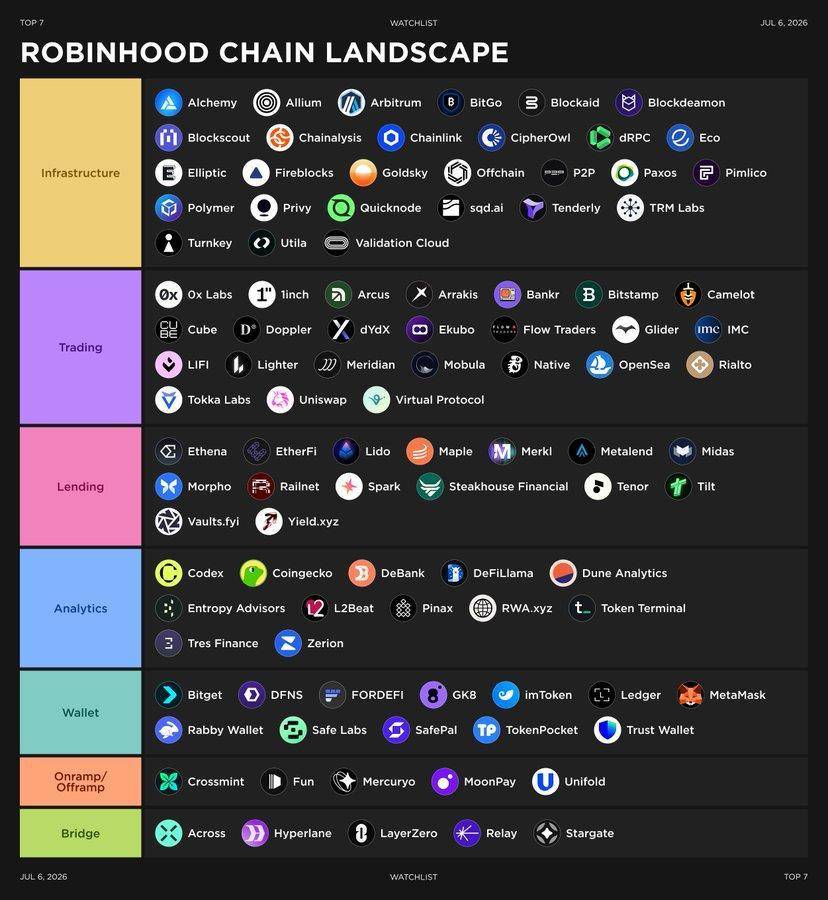
From the first day of mainnet launch, Robinhood Chain already had a fully functioning DeFi ecosystem, which is rare for new blockchain launches. Confirmed integrated protocols include:
- Uniswap: Serves as the main AMM, providing public liquidity for Stock Tokens and other assets on Robinhood Chain.
- Chainlink: Provides oracle data feeds, CCIP for cross-chain messaging and proof-of-reserve for assets issued by Robinhood.
- Lighter: A perpetual futures trading platform that has committed $11 million worth of LIT tokens to the Robinhood Chain community ecosystem.
- 1inch: A trading aggregator that helps users find optimal swap routes.
- Arcus: A perpetual swap DEX built by former dYdX team members, expanding 24/7 markets for tokenized stocks.
- Pleiades: A proprietary AMM serving professional trading and prop trading.
- Curve Finance: Integrated on July 3, 2026, expanding stablecoin liquidity options.
- Rialto: An on-chain spot exchange with a PropAMM architecture, built directly on Robinhood Chain.
In addition to DeFi protocols, Robinhood Chain is directly integrated with Robinhood Wallet, allowing users to send, receive and swap crypto, as well as interact with dApps without manual configuration. Other EVM wallets such as MetaMask can also connect by manually adding the network information.
Development Team
Robinhood Chain is developed by the Robinhood team under the leadership of Vlad Tenev, Co-Founder and CEO of Robinhood.

Specific information about Robinhood Chain’s technical team, including lead engineers and core developers, has not yet been widely disclosed. Coin68 will provide further updates when official information is released by the project.
Development Roadmap
Robinhood Chain went through a testnet phase starting in February 2026, recording millions of transactions before officially launching its mainnet on July 1, 2026. Below are the milestones already achieved and the project’s upcoming direction:
- February 2026: Public testnet launched and opened for developer testing.
- July 1, 2026: Mainnet officially went live with Stock Tokens, a full DeFi ecosystem and Robinhood Earn in the United States.
- After mainnet: Continued expansion of the Stock Token list, integration of additional DeFi partners and broader geographic availability.
In the long term, Robinhood Chain’s ambition is to become the infrastructure for an “everything exchange,” where all types of financial assets — from stocks, crypto and ETFs to commodities and foreign exchange — can be traded 24/7 on the same on-chain liquidity layer. FORECK.INFO notes that Robinhood Chain’s long-term roadmap largely depends on regulatory clarity in key markets, especially the United States.
Conclusion:
Robinhood Chain could become an important bridge between traditional finance and DeFi if tokenized stocks, RWA products and on-chain liquidity continue to grow. However, its long-term success will depend on regulatory clarity, user adoption and whether the network can move beyond the early memecoin-driven activity toward sustainable financial infrastructure.