

THEA is a predictive behavioral AI network built to analyze and forecast how people and markets behave in high-risk environments. Instead of building AI infrastructure from scratch on a blockchain foundation, the project uses an off-chain AI system that already processes hundreds of millions of queries per month for thousands of enterprise clients, then expands onto blockchain to create a decentralized payment and coordination layer. Let’s take a closer look at this project in the article below.
What Is THEA?
THEA is a predictive behavioral AI network designed for risk markets, where every decision carries immediate economic consequences. The project builds machine learning models trained on more than 35 billion real human decisions, allowing enterprise clients to make real-time predictions about user behavior, market movements and counterparty risk.

Unlike general-purpose AI platforms, THEA focuses specifically on behavioral analysis in high-pressure environments, where synthetic data cannot replace real behavioral patterns. THEA’s system has been operating in real-world conditions for more than 10 years, serving over 3,000 enterprise clients across 30 jurisdictions and processing more than 400 million AI inference queries per month.
Key Highlights of THEA
Large-Scale Real Behavioral Data
THEA’s AI models are trained on a dataset of more than 35 billion real human decisions made in situations involving actual risk, rather than simulated data. This is a key competitive advantage because behavioral patterns under real financial pressure cannot be accurately recreated in a laboratory environment. As a result, THEA can provide highly accurate predictions for use cases such as risk scoring, liquidity management and customer retention.
Combining Off-Chain and On-Chain Architecture
THEA uses a hybrid architecture: heavy AI computation tasks are processed outside the blockchain off-chain, while request coordination and payments are sent to Solana in the form of zero-knowledge (ZK) proofs. This approach allows the system to scale horizontally with performance comparable to cloud infrastructure, while still preserving blockchain integrity and transparency for the payment layer.
Real-World Applications
THEA is not a concept-stage project. The system currently operates more than 10,000 autonomous agents, monitors 500,000 log events per second and processes 0.5 petabytes of data per week. Some of THEA’s enterprise clients have recorded improvements of up to 30% in customer retention after integrating the project’s technology.
THEA’s Main Products and Features
Predictive Behavioral Intelligence
This is THEA’s core product, providing real-time behavioral prediction models for businesses. The system analyzes how users, markets and counterparties react under pressure, then generates predictions that support decision-making in areas such as risk scoring, fraud detection, liquidity management and customer-experience optimization. Enterprises can integrate directly through an API to receive real-time prediction results.
Autonomous Agent Fleet
THEA operates more than 10,000 autonomous agents deployed on Kubernetes infrastructure, using a distributed consensus mechanism to coordinate tasks. Each agent is designed to execute analytical and predictive tasks independently, with automatic failover, exactly-once task execution and restart capability in case of errors. The system can record more than 100,000 execution sessions per second and supports deterministic replay for debugging and auditing.
THEA Network
THEA Network is the decentralized payment layer for AI services that the project is building. The network is designed as a programmable payment system, allowing AI models, humans and AI agents to pay for and coordinate services with one another without relying on a centralized intermediary. THEA Network uses an off-chain compute network combined with the Solana blockchain, enabling parallel processing of independent requests and horizontal scalability.
Development Team
THEA’s team brings together senior researchers and engineers with decades of experience in AI, mathematics, gaming and blockchain technology. The project is led by Valentin Batura as CEO.

Detailed information about THEA’s other co-founders and executives has not yet been officially disclosed by the project. Coin68 will provide further updates when new information is released by the project.
Investors and Partners
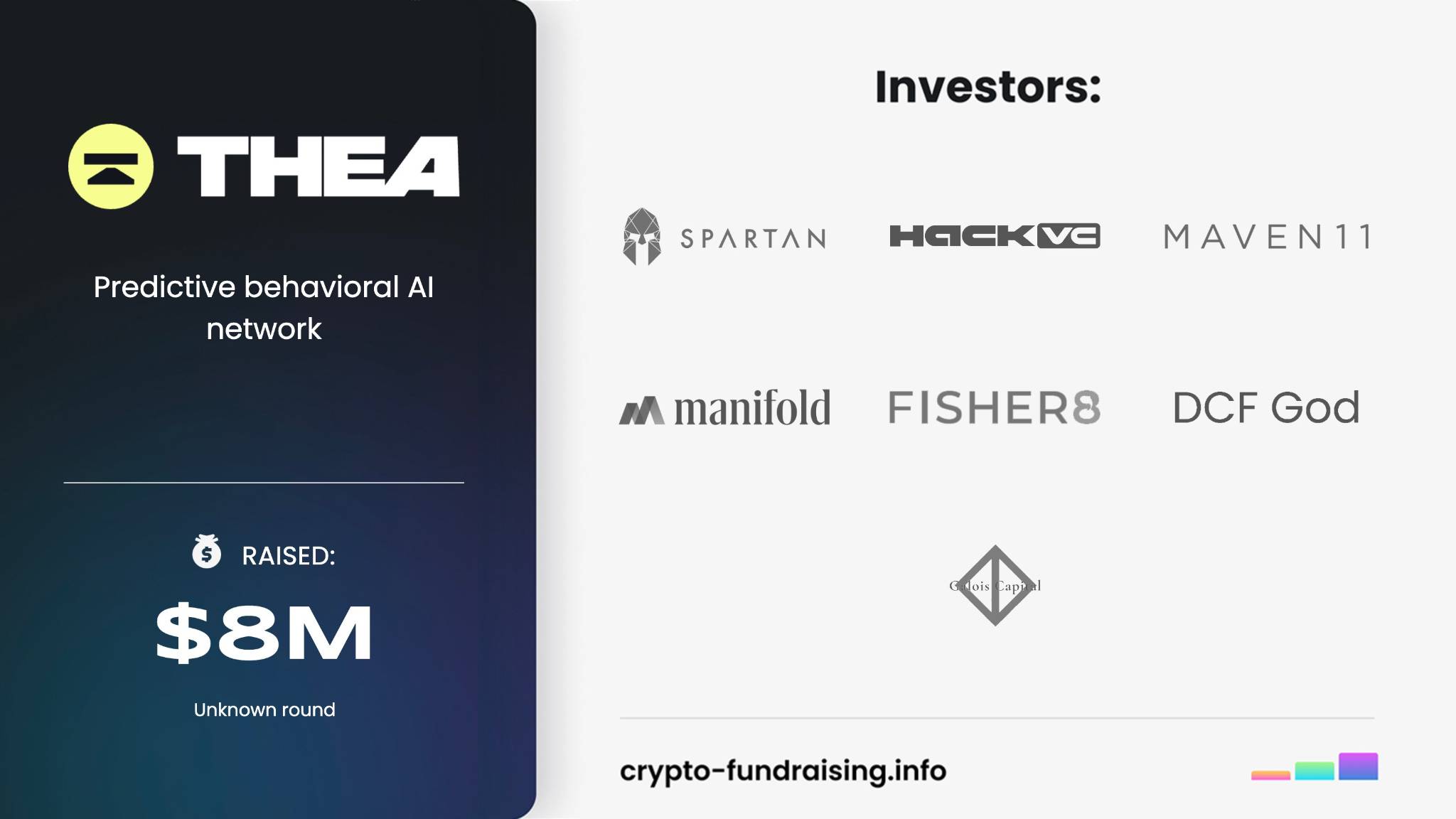
THEA raised $8 million to develop its behavioral AI infrastructure and build THEA Network. The funding round included participation from investment firms Maven11 Capital, Spartan Group, Manifold Trading, Hack VC and Fisher8 Capital.
Development Roadmap
THEA is currently in the phase of expanding its AI infrastructure and developing THEA Network. With the recently raised $8 million investment, the project is focusing on the following main goals:
- Expanding existing AI infrastructure: Enhancing the processing capacity of its autonomous agent system and behavioral prediction models to serve more enterprise clients worldwide.
- Building THEA Network: Developing a decentralized payment layer on Solana, integrating ZK proofs and AI inference request-routing mechanisms.
- Tokenizing access: Researching and designing a utility token model to expand access to AI services under a pay-per-use model.
Specific timelines for these goals have not yet been announced by the project.
Conclusion:
THEA stands out by combining real-world enterprise AI usage with blockchain-based payments and coordination. If the project successfully scales THEA Network on Solana, it could become an important bridge between AI inference, autonomous agents, risk analytics and decentralized payment infrastructure.