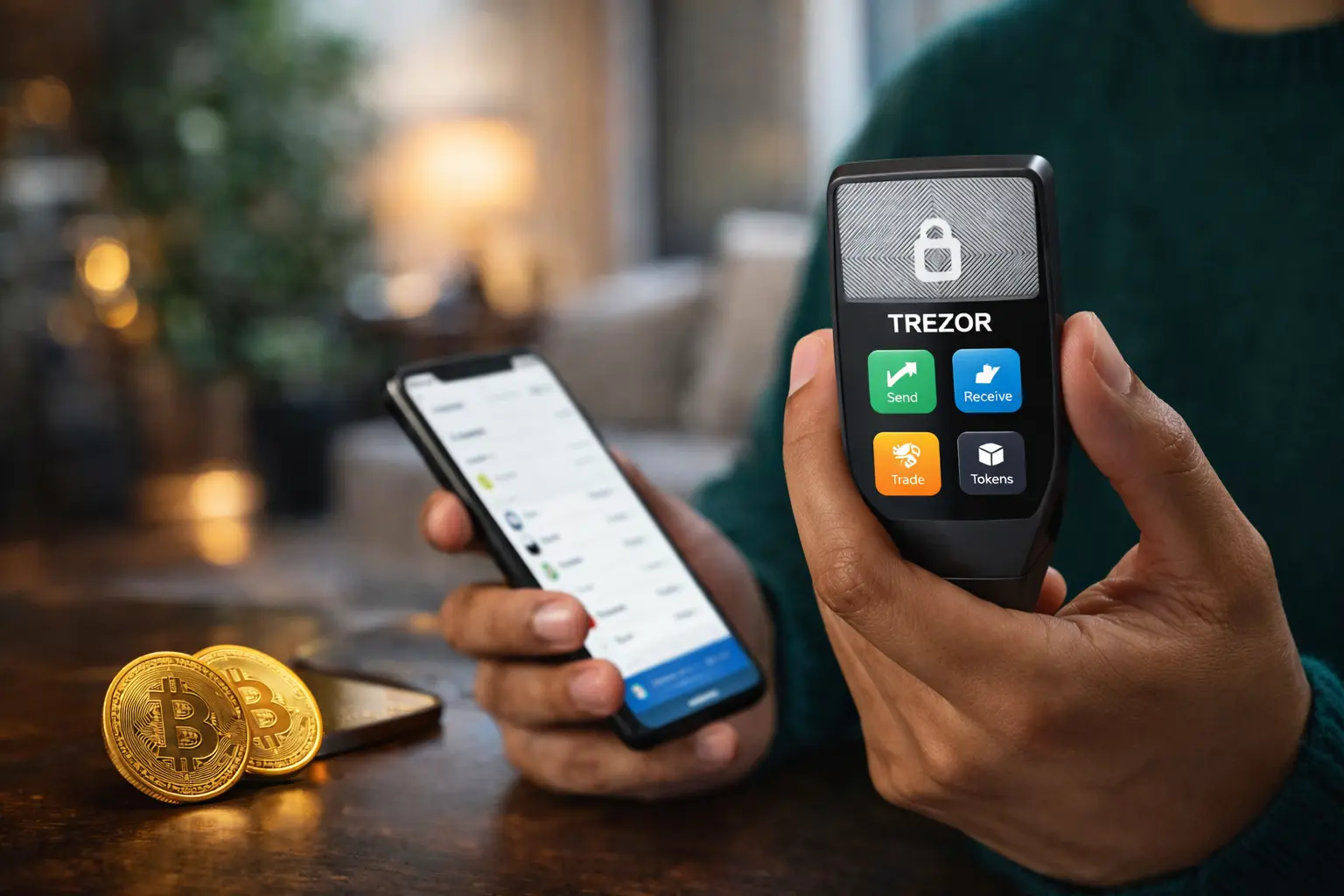

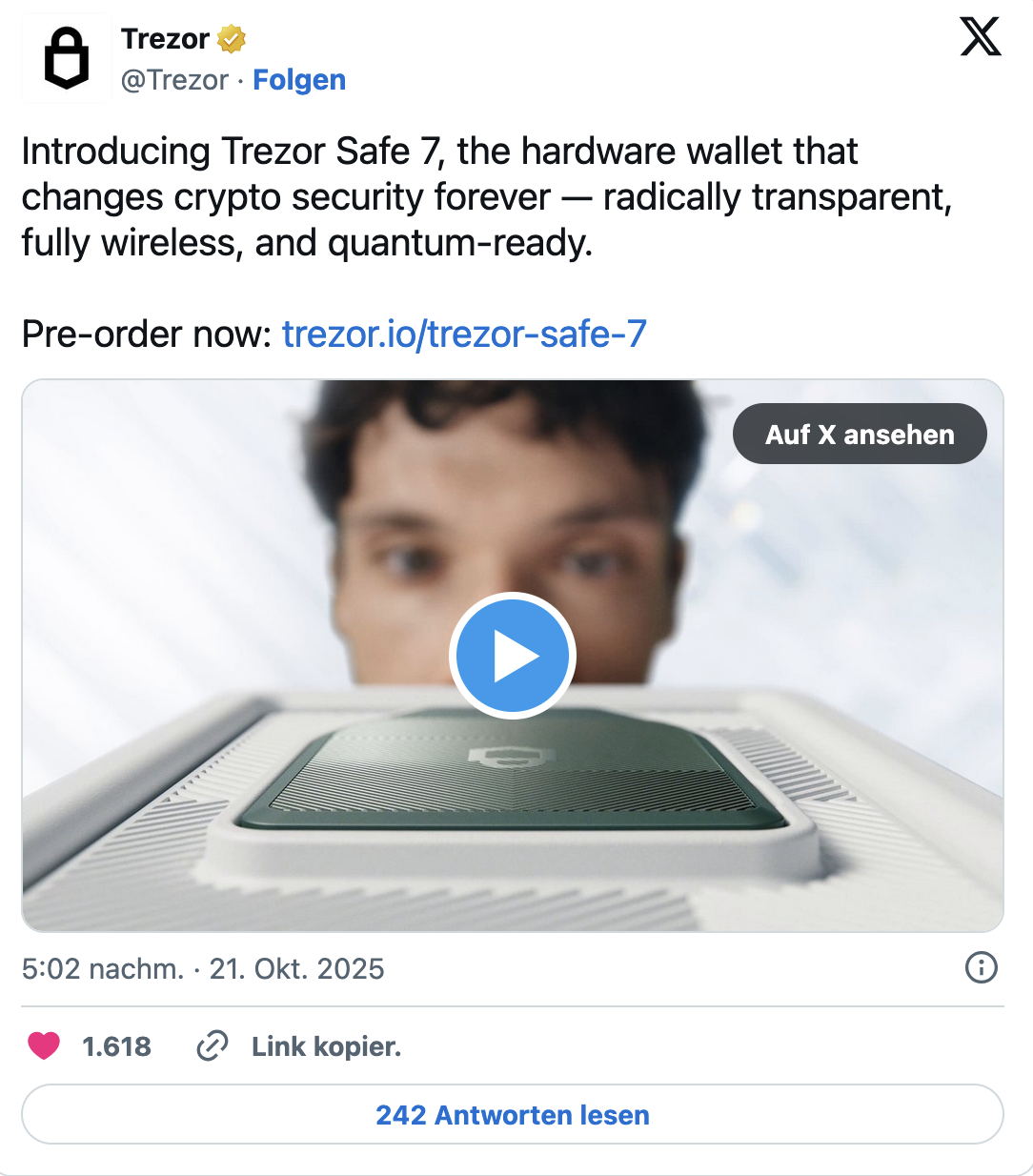
Trezor says its new device could “forever change the approach to cryptocurrency security.” It is an ambitious claim, but that is exactly how Trezor Safe 7, the company’s new flagship hardware wallet, entered the market. We tested the device to determine whether Safe 7 truly sets a new standard for hardware wallets or represents an evolution of already familiar solutions.
Hardware wallets are still considered the gold standard for self-custody of crypto assets, and Trezor has traditionally held a special position in this segment thanks to its open-source approach and emphasis on transparency. With Safe 7, the manufacturer aims to combine several priorities: everyday usability, mobility, modern design and a multi-layered security architecture built for long-term use.
Design and Build Quality
At first glance, the Trezor Safe 7 feels like a more premium device than the company’s previous models. It features a machine-anodized aluminum unibody, a reinforced glass backplate and a display protected by Gorilla Glass 3.
The device has an IP54 rating, meaning it is resistant to dust and water splashes. It is not designed to withstand immersion in water.
With dimensions of 75.4 × 44.5 × 8.3 mm and a weight of around 45 grams, Safe 7 remains compact, yet it looks and feels more like a modern consumer device than a niche “crypto gadget.” Trezor is clearly moving beyond a product designed mainly for technical enthusiasts and toward a broader mainstream audience.
The touchscreen is around 62% larger than the display on Trezor Safe 5. The box includes the hardware wallet, a USB-C to USB-C cable, two 20-word wallet backup cards, a start-up guide, a product safety guide and Trezor stickers.
Display and User Experience
One of the key upgrades is the 2.5-inch color touchscreen with a resolution of 520 × 380 pixels, brightness of up to 700 nits and precise haptic feedback. This significantly improves everyday interaction with the device.
Verifying long addresses, confirming transactions, entering a PIN and navigating menus are noticeably easier. Unlike wallets with small displays and physical buttons, Safe 7 rarely requires users to scroll repeatedly or interpret shortened information. For anyone who regularly signs transactions, the larger display can reduce the risk of mistakes when checking addresses, amounts and blockchain networks.
Setup, Backup and PIN Protection
Safe 7 is initialized through Trezor Suite, which is available for desktop and mobile devices. During testing, the application proved to be one of the more intuitive platforms in the hardware-wallet market, making the device suitable for both experienced users and beginners.
Trezor offers several wallet backup options:
-
12-, 20- and 24-word wallet backups are supported;
-
an advanced Multi-share Backup option is available.
When creating a new wallet, Safe 7 uses a 20-word SLIP39 Single-share Backup by default. The words must be written down and stored offline. Users can also restore compatible 12- or 24-word BIP39 backups created on another wallet.
After creating the backup, the user sets a PIN of up to 50 digits. Following 10 consecutive incorrect PIN attempts, the device automatically resets and erases the wallet data stored on it. Access can then be restored only with a valid wallet backup.
The Backup Check feature is also worth highlighting. It allows users to verify that their wallet backup was recorded correctly by entering the words directly on the device. Once the wallet has been set up, this verification can be performed without keeping Safe 7 connected to Trezor Suite.
Bluetooth and Wireless Charging
Safe 7 takes a major step toward mobile use. Bluetooth is not simply an optional extra but a central part of the device’s design.
-
Android: Bluetooth or USB-C;
-
iPhone and iPad: wireless connection through Bluetooth.
Bluetooth is also supported on macOS, Windows and Linux. Users who prefer a wired connection can disable Bluetooth completely and operate the device through USB-C.
Both Bluetooth and USB-C communication are protected by the open-source Trezor Host Protocol, which encrypts and authenticates communication between the hardware wallet and Trezor Suite.
Connections are established quickly and remained stable during testing. Transactions can be initiated on a smartphone and then reviewed and confirmed directly on the hardware wallet’s screen.
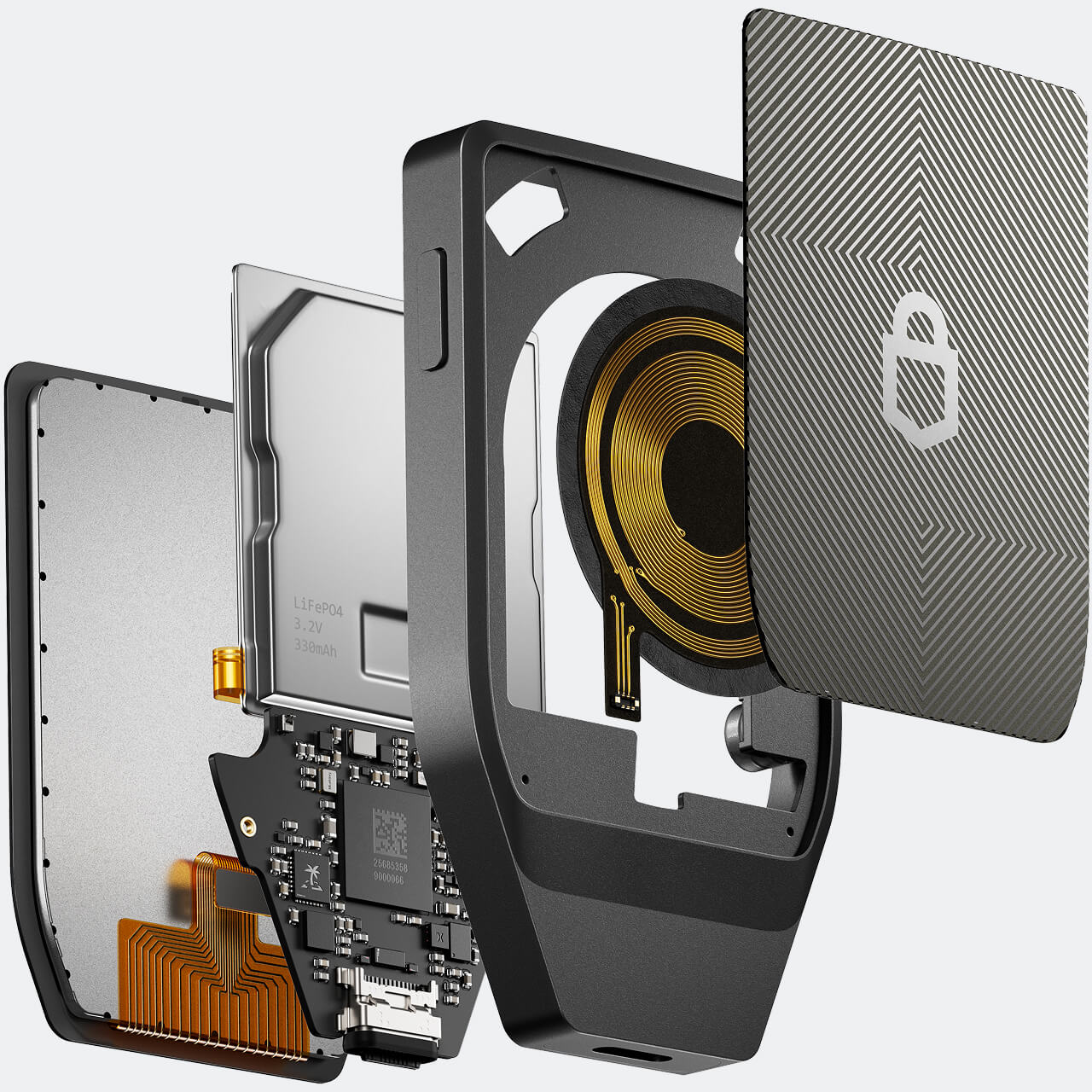
The device also supports Qi2-compatible wireless charging. Safe 7 uses a LiFePO₄ battery selected for its thermal stability, long service life and resistance to degradation.
According to Trezor, a full charge lasts about one day of normal use, while standby time is considerably longer. The battery is designed to withstand more than 1,000 charging cycles and offers up to four times as many cycles as conventional lithium batteries. Even if the battery eventually fails, the wallet can continue to operate when connected through USB-C.
Security Architecture: A Layered Approach
Instead of relying on a single “universal” Secure Element, Trezor Safe 7 uses three independent hardware layers:
-
TROPIC01 — a transparent and independently auditable Secure Element developed by Tropic Square;
-
OPTIGA Trust M — an additional NDA-free Secure Element from Infineon with EAL6+ certification;
-
STM32U5 — a hardened security microcontroller that coordinates communication between the two Secure Elements.
Security functions are distributed across the three components, and no single chip stores or controls all of the secrets required to access the wallet. Compromising one component should therefore not be enough to gain full control of the device.
Both Secure Elements include protection against physical tampering, including abnormal voltage, temperature manipulation and laser attacks. If suspicious activity is detected, the chips can block operations or erase protected secrets.
Trezor also describes Safe 7 as quantum-ready. Post-quantum cryptography is already used to protect the boot process, device authentication and firmware verification.
However, this does not make Bitcoin, Ethereum or other supported assets fully resistant to quantum attacks. Complete protection will require the underlying blockchain networks to adopt post-quantum cryptographic standards as well.
Compatibility and Additional Features
Through Trezor Suite, users gain access to:
-
Coin Control for selecting individual UTXOs;
-
Tor integration for improved network privacy;
-
WalletConnect support for compatible dApps and third-party wallets;
-
FIDO2 / WebAuthn, allowing Safe 7 to function as a hardware security key.
Trezor Safe 7 supports Windows, macOS, Linux, Android and iOS. Through Trezor Suite and compatible third-party applications, users can store and transfer assets, connect to decentralized applications, and buy, sell, swap or stake supported cryptocurrencies.
Final Verdict: Who Is Trezor Safe 7 For?
Trezor Safe 7 is aimed not only at long-term holders but also at users who:
-
regularly sign transactions;
-
interact with dApps;
-
manage assets from a smartphone;
-
value convenience and want to reduce the risk of transaction errors.
The large touchscreen and Bluetooth connectivity significantly improve the user experience, while the two Secure Elements and separate security microcontroller give Safe 7 one of the most sophisticated hardware architectures in Trezor’s consumer wallet range.
Priced at $249 or €249 at launch, Safe 7 sits firmly in the premium segment. It is available in Charcoal Black, Obsidian Green and an orange Bitcoin-only Edition. Users who do not need Bluetooth, a built-in battery or wireless charging may prefer the more affordable Trezor Safe 5.
Sources
- Trezor — Trezor Safe 7 Specifications and Features
- Trezor — Trezor Safe 7 Frequently Asked Questions