
DeFi is shifting from individual protocols toward AI Agent-driven automation. Against this backdrop, Astarter has repositioned itself as a Web4 AI Agent DePIN Network, combining AI Agents, hardware nodes, a DEX and on-chain data within a single infrastructure.
So, what makes Astarter different? Let’s take a closer look at this DeFAI infrastructure project that combines AI Agents, DePIN and DEX technology.
What Is Astarter?
Astarter is a DeFAI infrastructure platform that combines AI Agents, DePIN nodes and on-chain financial applications. The project aims to create an environment in which AI Agents can automatically trade, process data and interact with smart contracts.
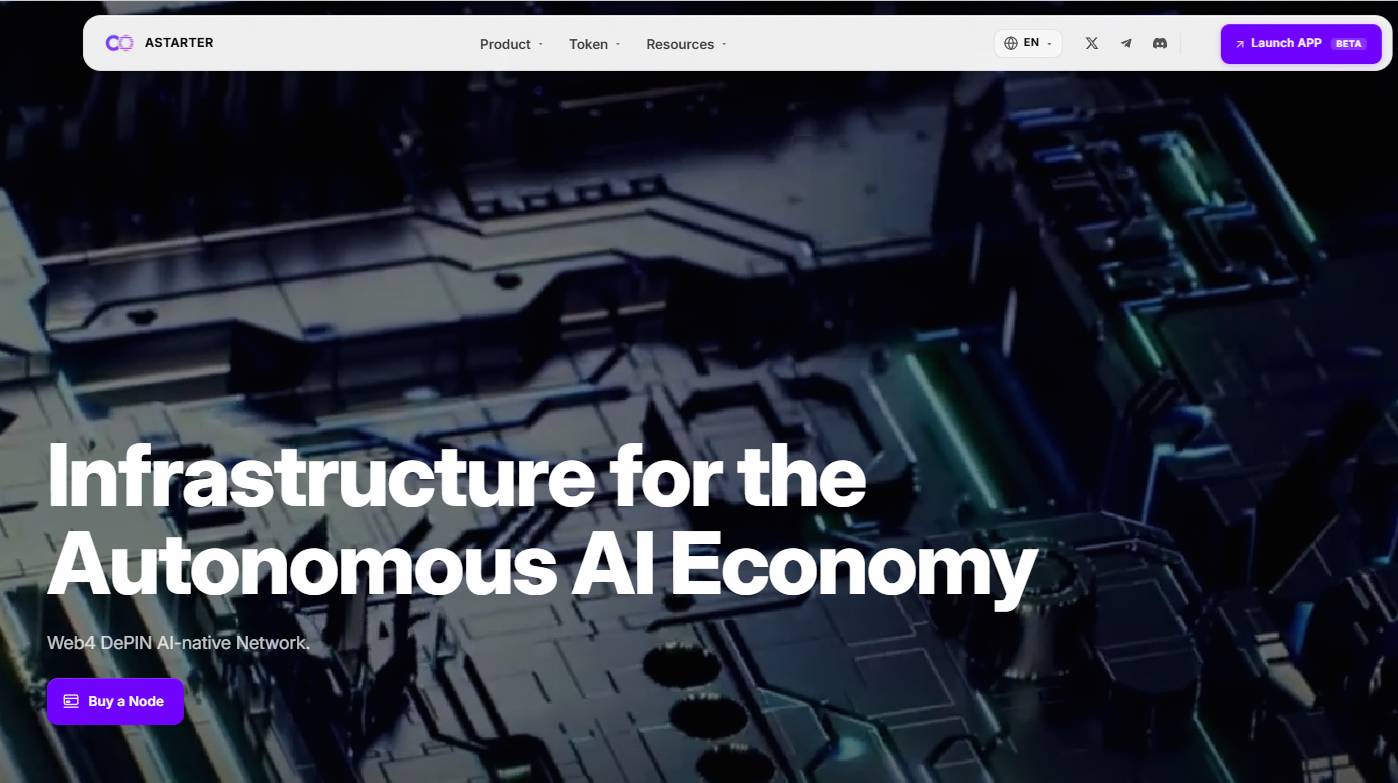
Before expanding into the AI Agent economy, Astarter operated as a smart-contract ecosystem on Cardano, focusing on four main product groups: a Launchpad, DEX, Money Market and Tech Services. At its current stage, the project has repositioned itself around a DeFAI model that connects AI Agents, ABox nodes, an AI DEX, prediction markets and a data market within one ecosystem.
What Makes Astarter Different?
Astarter’s main focus is its transition from traditional DeFi to infrastructure designed for AI Agents. In conventional DeFi, users must make their own decisions, manage liquidity and interact manually with each protocol. This creates barriers as on-chain strategies become increasingly complex and require continuous data processing.
Astarter aims to build a model in which AI Agents can directly participate in activities such as trading, market making, arbitrage, prediction and data processing. Instead of simply offering an interface for users, the project is developing an infrastructure layer through which agents can execute economic tasks on the blockchain.
Astarter’s mechanism is divided into several layers: ABox nodes provide computing and execution capabilities, AI Agents handle logic, applications such as AI DEX and prediction markets create demand, while the blockchain serves as the settlement layer. This approach separates the roles of users, node operators, AI Agents and protocols.
How Astarter Works
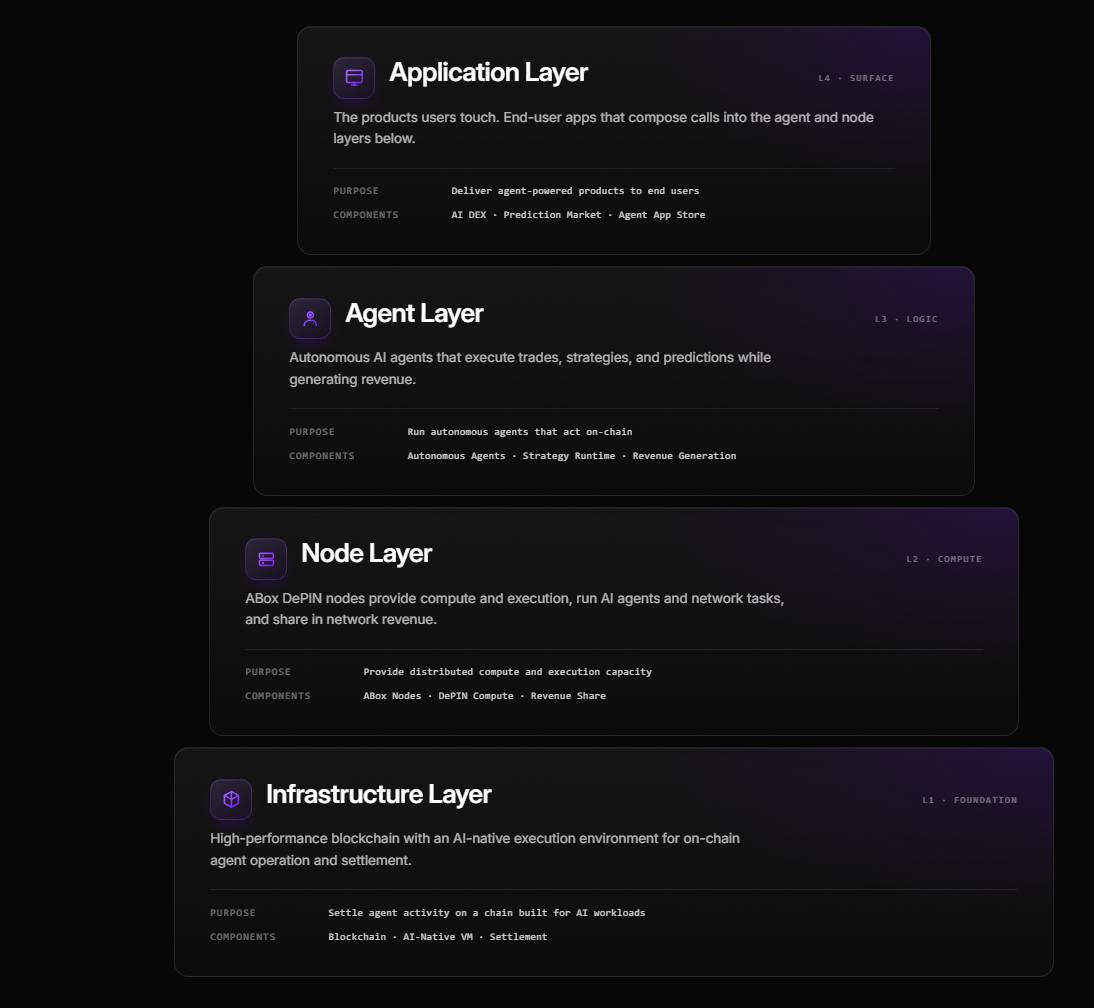
Astarter is built around four main architectural layers:
- Application Layer: The application layer where users interact with AI DEX, Prediction Market and the Agent App Store.
- Agent Layer: The layer responsible for AI Agent operations, allowing agents to process data, run strategies and interact with smart contracts.
- Node Layer: The ABox DePIN node layer, providing computing power and execution capabilities for the network.
- Infrastructure Layer: The blockchain and settlement layer, where transactions, on-chain interactions and agent execution results are recorded.
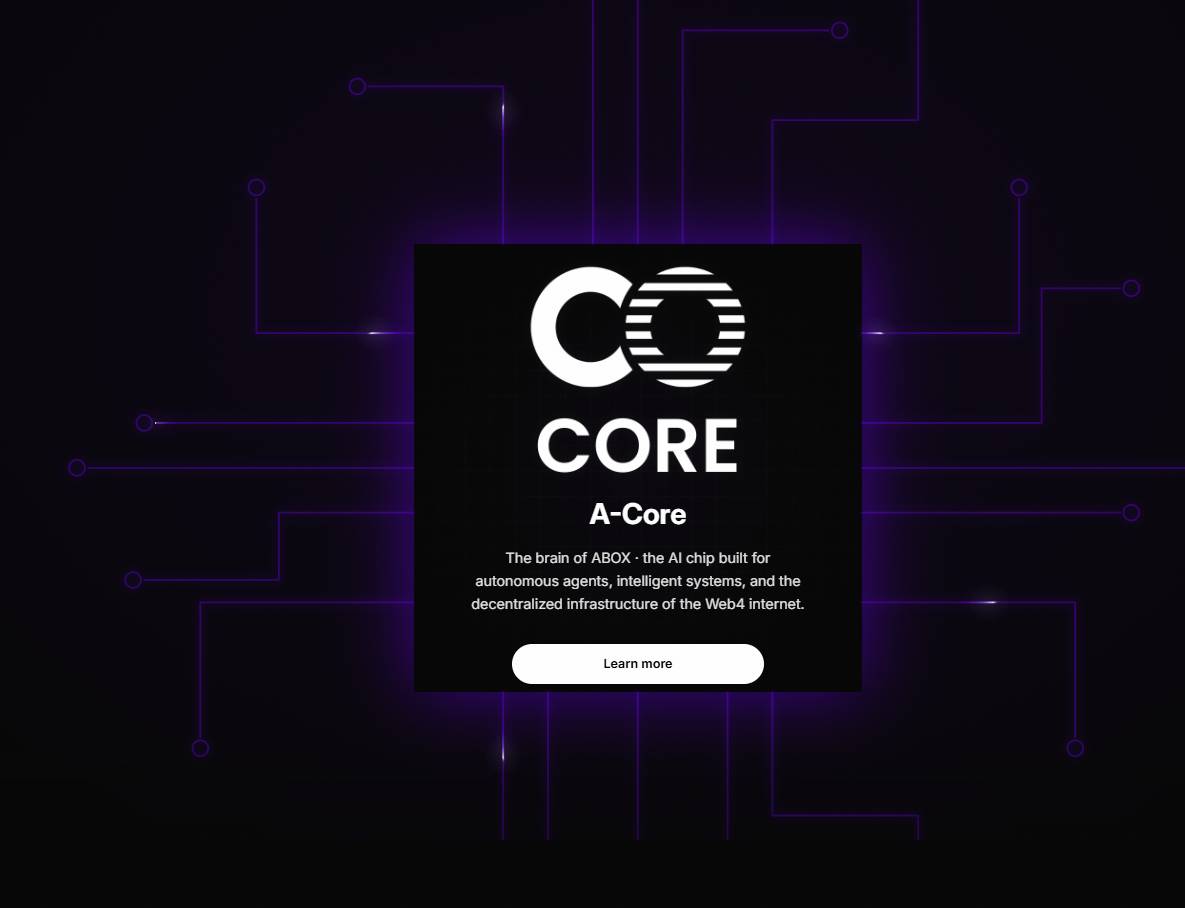
Within this model, ABox is a plug-and-play hardware node that supports open protocols, on-chain execution, multi-agent runtime and smart-contract calls. Inside ABox, A-Core acts as a chip and economic-execution layer connected to AST allocation, revenue sharing and whitelist access for ABox presales across different tiers.
For example, when an AI Agent runs a trading strategy on the AI DEX, the agent processes data and determines the appropriate action. The ABox node provides execution capacity, while the final transaction is recorded on-chain through the settlement layer.
Key Features of Astarter
- AI DEX: Astarter DEX V2.1 Beta is an AMM that integrates AI-optimised routing, liquidity pools, one-click token issuance, order management and plans to develop into a cross-chain DEX aggregator.
- ABox Nodes: ABox is a physical DePIN node designed to run AI Agents and participate in the network. According to the project, node operators may receive revenue from execution fees, compute rewards, marketplace income, AI DEX fees and prediction-market fees.
- A-Core: A-Core consists of three tiers: Lite, Pro and Max. The project website lists prices of $500, $1,000 and $3,000 respectively, together with AST token allocations, revenue-sharing opportunities and whitelist access for ABox presales.
- Prediction Market: A platform where AI Agents can analyse on-chain and off-chain data to participate in market or event predictions.
- Agent Marketplace: Users can buy, deploy or rent AI Agents for use in on-chain economic activities.
- Data Market: AI Agents can generate, process and trade data, supporting the development of a decentralised data network for AI applications.
- Launchpad / IDO: Under its previous model, Astarter operated a Launchpad to help startups raise capital and launch tokens, including whitelist, IDO and ISPO mechanisms.
Astarter Token and Tokenomics
AST Token Overview
|
Parameter |
Details |
|---|---|
|
Token Name |
Astarter |
|
Ticker |
AST |
|
Blockchain |
BNB Chain |
|
Contract |
To be updated |
|
Total Supply |
1,000,000,000 AST |
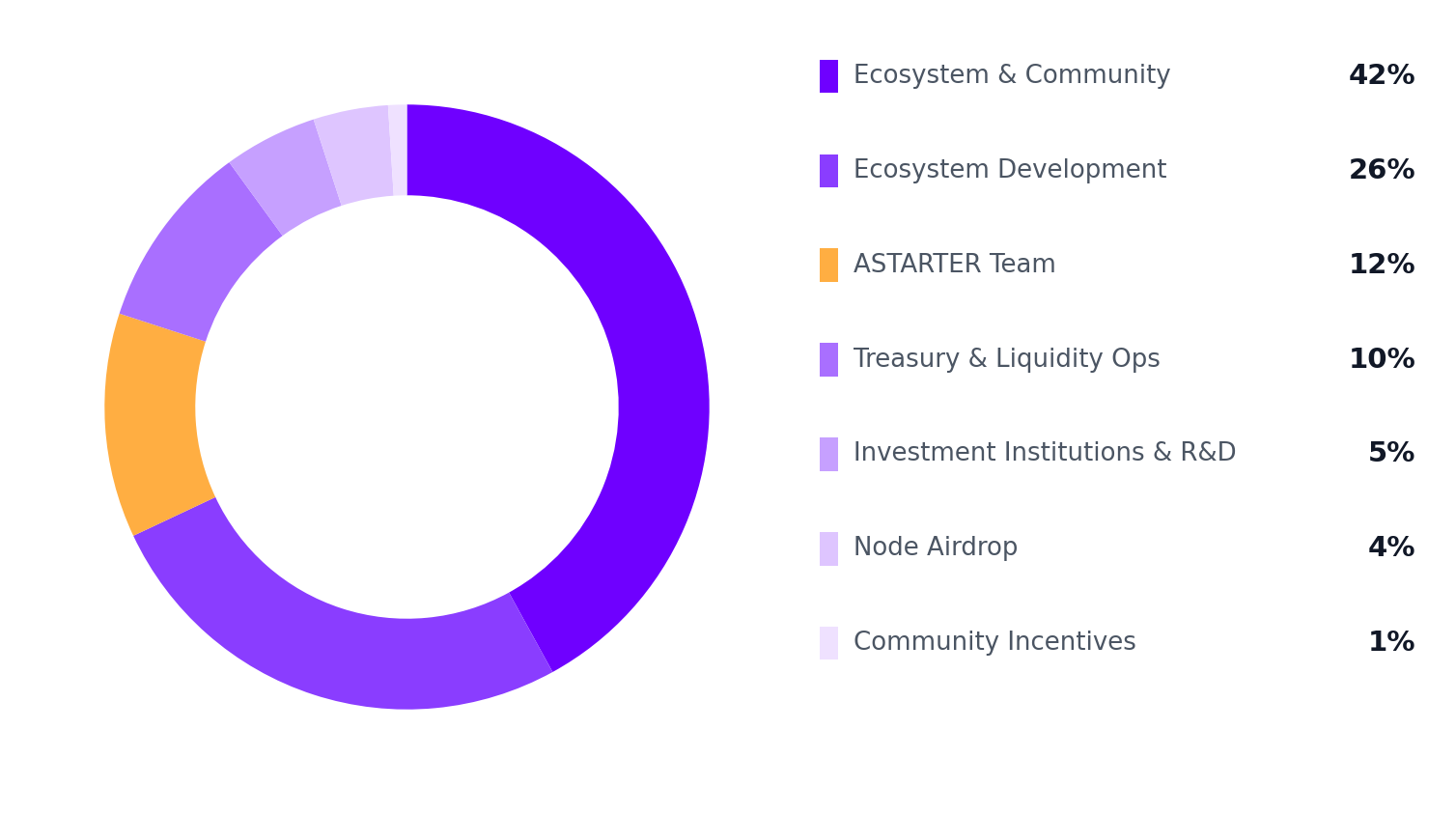
AST Token Allocation
- Ecosystem and community: 42%
- Ecosystem development: 26%
- Team: 12%
- Market capitalisation management: 10%
- Institutional investors: 5%
- Node airdrop: 4%
- Community incentives: 1%
AST Token Utility
- Participation in the Astarter ecosystem: AST is the main token of the Astarter ecosystem and is connected to products such as ABox, A-Core, AI DEX and user-incentive mechanisms.
- Node rewards: AST is used as part of the reward system for node operators who provide computing and execution capacity to the network.
- Revenue sharing: Certain A-Core tiers are linked to a revenue-sharing model, allowing participants to receive a portion of revenue according to the project’s design.
- Staking: Astarter mentions staking as part of its token-distribution and incentive mechanism.
- Community rewards: A portion of AST is allocated to Community Incentives to support user and community-engagement activities.
Astarter Roadmap
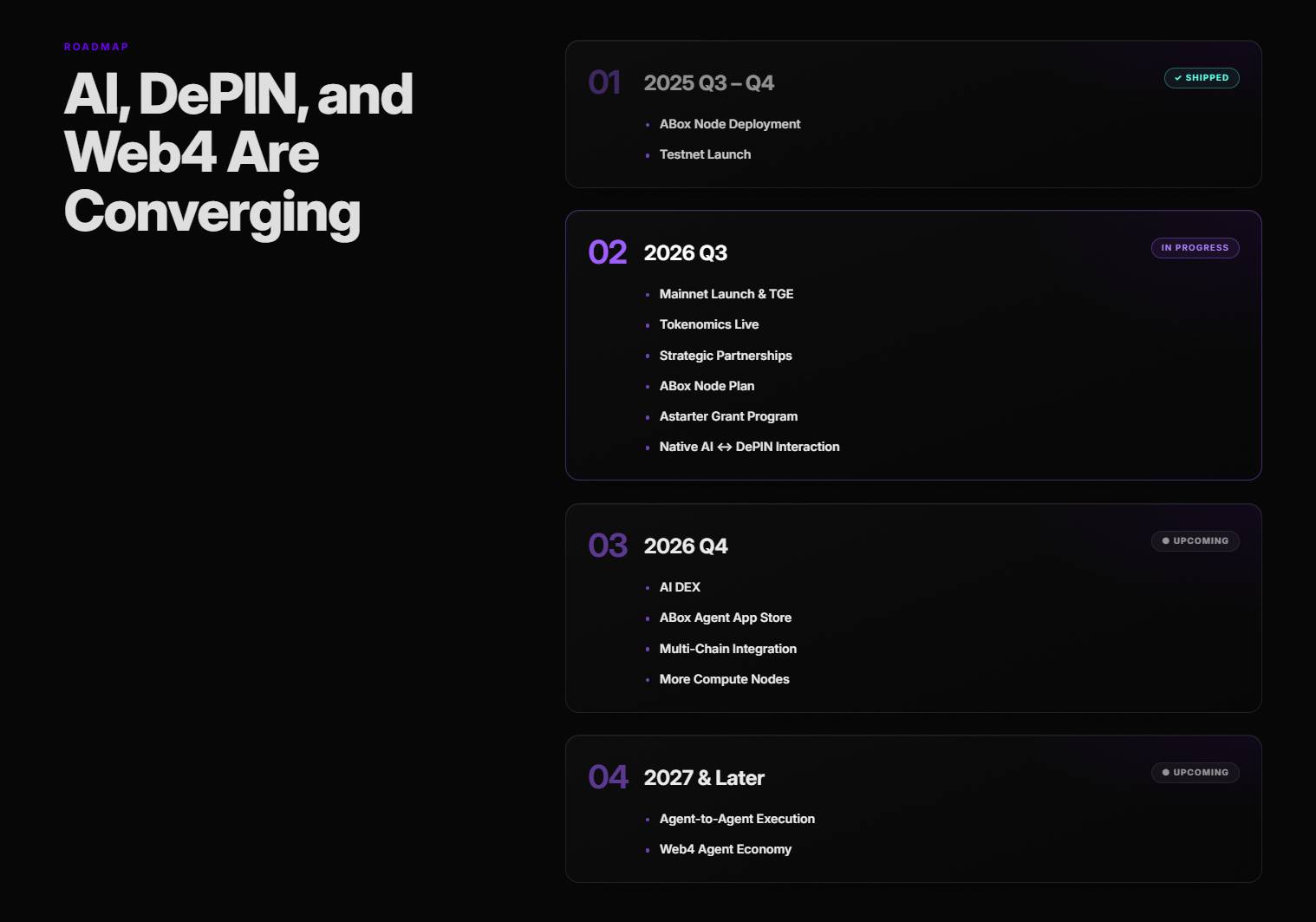
- Q3–Q4 2025: Astarter focused on deploying ABox Nodes and launching its testnet.
- Q3 2026: The project plans to launch its mainnet and TGE, publish tokenomics, expand strategic partnerships, roll out the ABox Node Plan and Astarter Grant Program, and develop Native AI ↔ DePIN interoperability.
- Q4 2026: Astarter aims to develop the AI DEX, ABox Agent App Store, multi-chain integration and expand the network with additional computing nodes.
- From 2027 onward: The project targets Agent-to-Agent Execution and a Web4 Agent Economy, a model in which AI Agents can interact with one another and execute economic tasks within an on-chain ecosystem.
Astarter Team
As of now, Astarter has not publicly disclosed full details of its core team on its official website. More information may become available as the project develops.
Astarter Investors
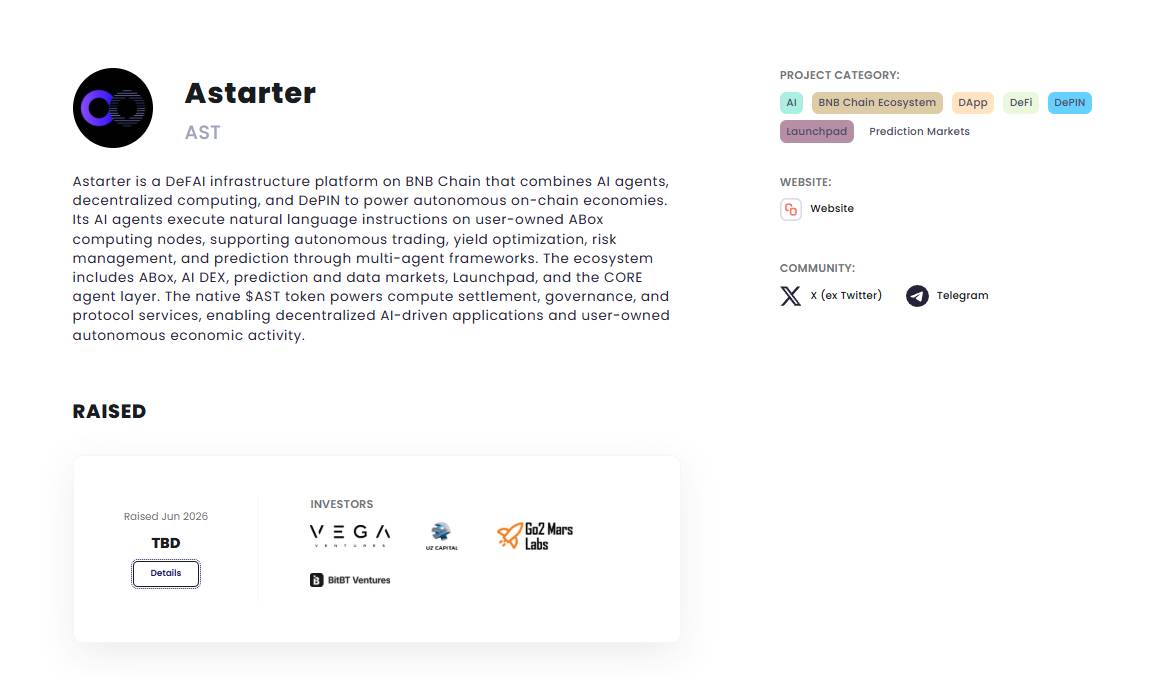
Astarter recorded a funding round in June 2026. However, the project has not yet publicly disclosed the amount raised.
Reported investors include Vega Ventures, UZ Capital, Go2Mars Labs, BitBT Ventures and another investor whose name is not fully displayed in the public data.
Conclusion
Astarter’s concept is ambitious because it combines several fast-growing narratives: AI Agents, DePIN, DeFi automation and on-chain data markets. Its long-term potential will depend on whether ABox nodes, AI Agent tools and real user demand develop faster than competing DeFAI ecosystems.