
Fiat payments can take several days to complete settlement even after a transaction has been confirmed. Stablecoins can accelerate the transfer of value, but they do not independently solve issues involving local payment methods, foreign exchange, reconciliation and regulatory compliance.
Credible is designed as a PayFi layer connecting on-chain stablecoin liquidity with off-chain fiat payment networks, allowing businesses to receive funds before the underlying traditional payment rails complete settlement. What distinguishes Credible from other payment infrastructure providers? This article examines the project’s PayFi infrastructure and the way it connects stablecoins with fiat payment systems.
What Is Credible?
Credible is a payment orchestration infrastructure designed for neobanks, fintech companies, Web3 businesses and other platforms that need to collect and distribute funds across borders.
Through its Pay-in and Pay-out APIs, global collection accounts, ledger and treasury management tools, Credible connects banks, payment service providers, foreign exchange partners, local payment methods and stablecoins within a single workflow.
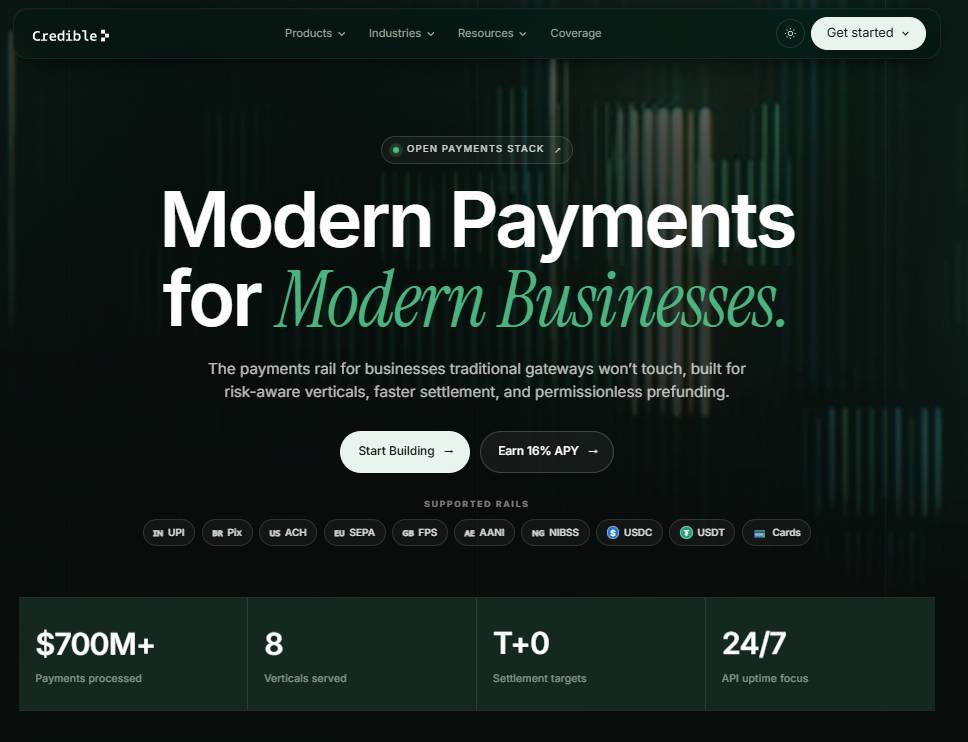
According to the project’s current website, Credible supports more than 42 markets, 37 currencies and 86 payment methods. These include cards, UPI, Pix, ACH, SEPA, mobile wallets, USDC and USDT.
Credible Homepage
Credible Finance is operated by Kiwimoney Inc., a Delaware company that provides payment technology and orchestration services.
Credible lists Kiwimoney Inc. as a Money Services Business registered with the US Financial Crimes Enforcement Network under registration number 31000324258161. An MSB registration does not constitute a banking licence, a state money-transmitter licence or an endorsement by FinCEN. Credible is not a bank, broker-dealer, insurance company, investment adviser or licensed custodian. Fiat balances are held by regulated partner banks or licensed payment processors, while Credible primarily provides the technology and orchestration layer.
What Makes Credible Different?
Credible separates the time at which a merchant or beneficiary receives funds from the time at which the underlying fiat payment completes settlement. After a transaction has been approved and has passed the required risk and compliance controls, Credible’s liquidity layer may advance USDC, USDT or supported fiat currencies to the recipient. The underlying card network, bank or local payment rail then completes settlement in the background.
Credible generally describes the traditional settlement cycle behind this system as T+3. The exact period may vary depending on the payment method, banking partner, market and compliance requirements. According to Credible’s documentation, its short-term payment financing is normally linked to a specific pay-in or pay-out receivable and may remain outstanding for between one and seven days.
The project therefore presents the model as short-term receivables financing rather than revolving credit or long-term working capital.
Credible calls the accelerated mechanism T+0 settlement. However, its legal policies state that T+0 and “instant settlement” are target service levels rather than contractual guarantees. Actual settlement times may be affected by liquidity, blockchain congestion, banking cut-off times, third-party processors and compliance reviews.
Main Components of Credible
-
PayFi credit layer: Provides short-term liquidity backed by receivables associated with approved pay-in or pay-out transactions.
-
Payment orchestration layer: Selects processing routes based on approval rates, cost, foreign exchange conditions, availability, risk and compliance requirements.
-
Fiat settlement layer: Handles clearing, transfers and fiat settlement through banks, payment processors and locally authorised partners.
How Credible Works
Pay-in Process
-
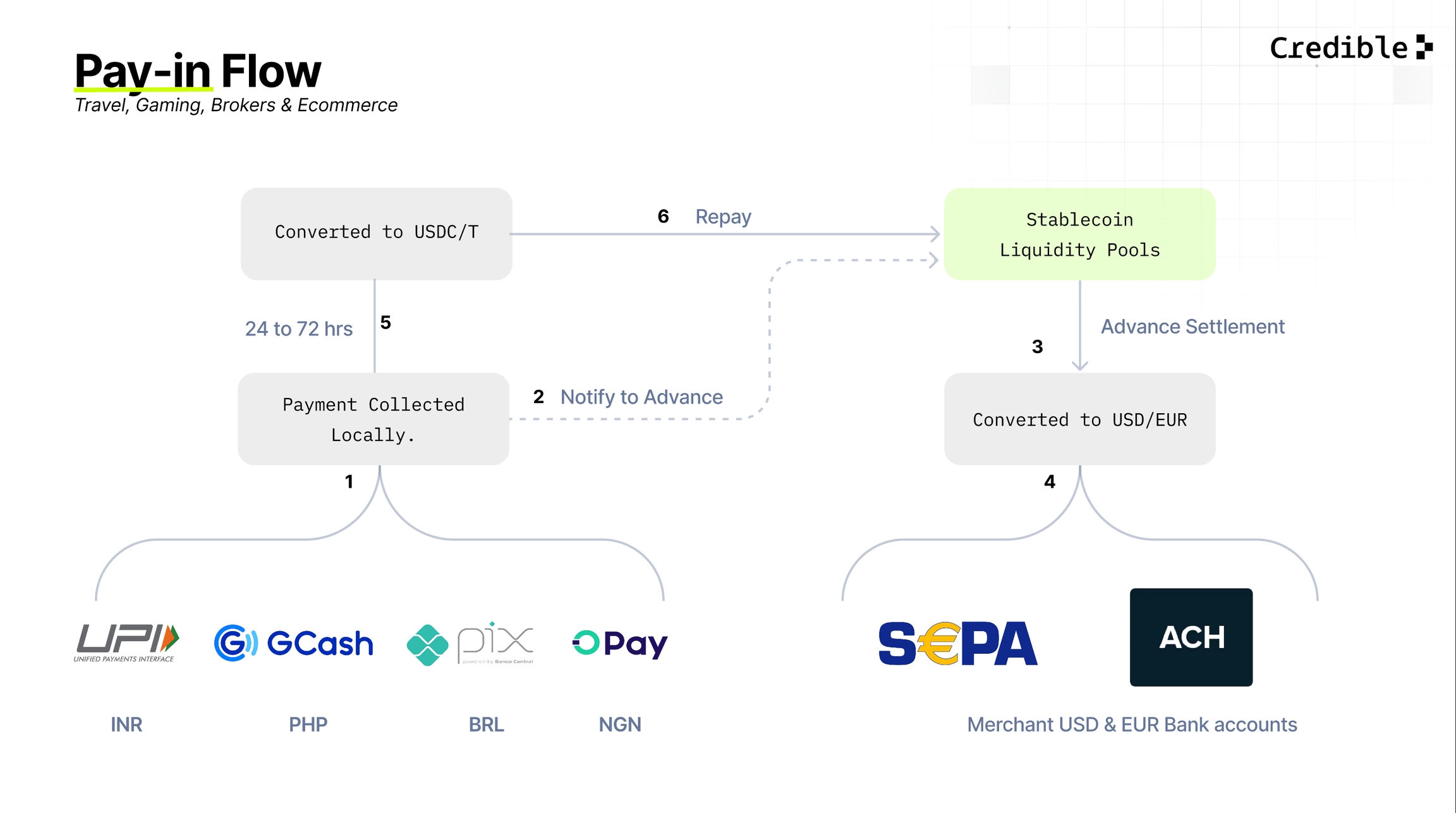
A customer pays through a card, bank transfer, digital wallet or local payment method such as UPI or Pix.
-
Credible routes the transaction through an appropriate payment service provider or acquiring partner and verifies its status.
-
Once the transaction has passed the necessary risk and compliance checks, the liquidity layer may advance funds so that the business receives USD, EUR, GBP, USDC or USDT before the underlying payment rail settles.
-
When the fiat transaction completes settlement, the advance is repaid and the corresponding information is recorded in Credible’s ledger and reconciliation system.
Pay-out Process
-
A business submits a pay-out request through the Credible API, together with the recipient’s information and any required compliance data.
-
Credible reviews the transaction and selects an appropriate bank, card network, digital wallet, local payment rail or blockchain network.
-
A pre-funded liquidity pool may provide the necessary funds so that the beneficiary receives payment before the complete back-end settlement process has finished.
-
Transaction statuses are updated through webhooks, ledger records and reconciliation data. Foreign exchange, refunds, reversals and failed payments may involve third-party payment and banking partners.
On-chain and Off-chain Components
At the on-chain layer, Credible says it uses non-custodial vault contracts on Solana and Polygon to manage stablecoin liquidity, finance settlement advances and distribute returns to liquidity providers. The project states that the vault contracts are open-source and audited. However, the identity of the auditor and the corresponding audit report should be checked separately before presenting this statement as independently verified.
At the off-chain layer, Credible connects banks, payment processors, acquiring partners, fiat-to-stablecoin conversion providers and KYC/KYB systems.
Fiat funds are held by regulated partners, while services requiring local licences are performed through authorised entities in the relevant jurisdictions. The exact provider and legal structure may differ depending on the product and market.
Credible Features
-
Payment collection: Allows businesses to accept cards, bank transfers, digital wallets, real-time payment systems and stablecoins through one integration.
-
Pay-outs: Supports transfers to bank accounts, cards, mobile wallets and blockchain addresses in supported markets.
-
Global collection accounts: Provides named business collection accounts in USD, EUR and GBP. Through financial partners, these accounts connect to rails including ACH, Fedwire, SEPA, SEPA Instant, Faster Payments and BACS.
-
Liquidity pools: Allow eligible liquidity providers to supply USDC or USDT through vaults on Solana and Polygon. The funds are used to finance short-term payment receivables. Any displayed yield is variable, indicative and not guaranteed.
-
API and ledger: Provide payment data, webhooks, reconciliation tools and balance management. Businesses must complete the required KYB process before obtaining production access.
-
Treasury management: Combines account, transaction and liquidity-pool information to support foreign exchange, asset and multi-currency cash-flow management.
-
Creddy: A planned consumer-facing product for peer-to-peer transfers and merchant payments. Credible currently presents it as coming soon or being rolled out gradually.
-
Compliance infrastructure: Includes KYC/KYB, sanctions screening, transaction monitoring and anti-money laundering controls. Regulated services are delivered either by Kiwimoney within its applicable registration scope or by licensed partners.
Key Risks
-
Settlement risk: Transactions pass through several banks, processors and other intermediaries, meaning that a payment may be delayed, rejected or reversed.
-
Liquidity risk: A rapid increase in demand or high pool utilisation could reduce the amount of capital available for accelerated settlement or delay withdrawals from a liquidity pool.
-
Foreign exchange risk: Exchange-rate movements during settlement may change the value of a receivable or increase the cost of completing a transaction.
-
Stablecoin risk: USDC, USDT or another supported stablecoin could temporarily or permanently lose its peg or face issuer, redemption or regulatory problems.
-
Blockchain and smart-contract risk: Network congestion, validator outages, chain reorganisations, coding errors or security vulnerabilities could disrupt settlement or cause losses.
-
Regulatory risk: Payment, stablecoin and digital asset regulations vary between jurisdictions and may change over time.
-
Counterparty risk: A bank, custodian, payment processor, liquidity provider or on/off-ramp partner could experience an operational or financial failure.
-
Operational risk: API failures, incorrect reconciliation data, cybersecurity incidents or outages affecting partner systems could interrupt payment processing.
Information About the CRED Token
Basic CRED Token Information
| Parameter | Details |
|---|---|
| Token name | Credible |
| Ticker | CRED |
| Blockchain | Solana |
| Contract address | CREDBHvVqREBCAxMihzr8D1nepHMr2gmQoZWpmgGmeta |
| Initial allocation | 22,663,387 CRED |
| Maximum supply | Not fixed, as additional tokens may be minted following future governance proposals |
The contract address and initial allocation figures are listed on Credible’s official MetaDAO fundraising page. Users should independently verify the contract address through an official source before interacting with any token.
Initial CRED Allocation
-
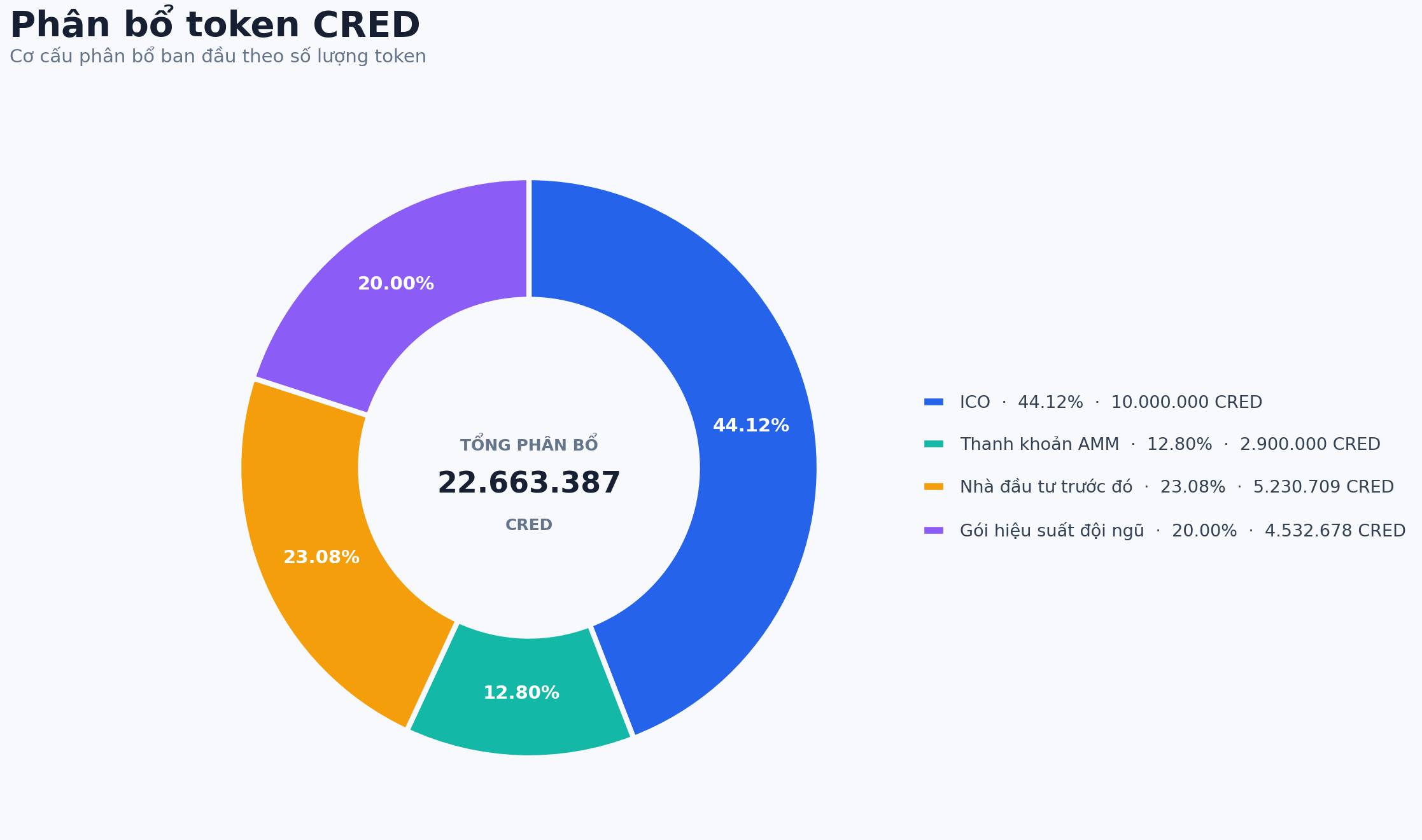
Public token sale: 44.12% — 10,000,000 CRED
-
AMM liquidity: 12.80% — 2,900,000 CRED
-
Previous investors: 23.08% — 5,230,709 CRED
-
Initial team performance package: 20% — 4,532,678 CRED
MetaDAO states that the tokens allocated to previous investors are subject to a three-year linear vesting period with a one-year cliff.
The initial team performance package uses price-based unlocks, with an initial minimum period of 18 months and further tranches linked to multiples of the token-sale price.
CRED Token Functions
-
Governance: CRED is intended to participate in Credible’s MetaDAO-based decision-market governance structure.
-
Intellectual property oversight: MetaDAO states that Credible’s intellectual property is held through a segregated portfolio of Futarchy Governance SPC, with CRED acting as an oversight instrument.
-
Proposal coordination: Decisions involving substantial budgets, token issuance or changes to the organisation may be submitted through governance and decision markets.
-
Network-value distribution: The Credible Foundation describes CRED as an on-chain ownership layer intended to route protocol revenue back to the network. However, the detailed formula, eligibility conditions, legal treatment and distribution timetable have not been fully disclosed.
MetaDAO and Credible describe CRED as an “ownership coin” rather than equity. This terminology represents the project’s chosen structure and should not be interpreted as an independent legal or regulatory determination regarding the token.
Credible Development Roadmap
The following milestones and targets come from Credible’s public roadmap. Future dates and volumes are project objectives rather than guaranteed outcomes.
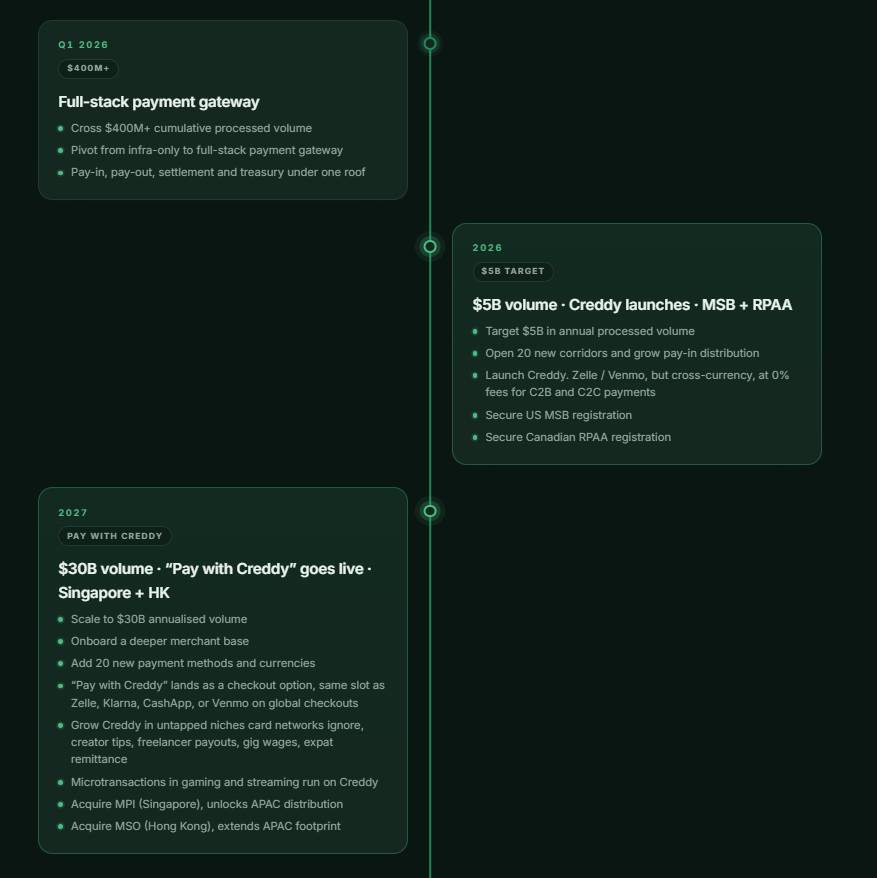
-
Q1 2026: Credible reported that cumulative processed volume had exceeded $400 million. The company also said it had moved from an infrastructure-focused model to a broader payment gateway combining pay-in, pay-out, settlement and treasury services.
-
2026: Credible is targeting $5 billion in annual processed volume, 20 new payment corridors and the launch of Creddy. Kiwimoney Inc. now lists a US FinCEN MSB registration. The project also plans to obtain registration under Canada’s Retail Payment Activities Act, but completion has not been confirmed.
-
2027: Credible plans to introduce “Pay with Creddy,” add 20 payment methods and currencies, and pursue a Major Payment Institution licence in Singapore and a Money Service Operator licence in Hong Kong.
-
2028: The project aims to expand both the Credible payment gateway and Creddy, with a target of $200 billion in annual processed volume.
-
2029: Credible plans to pursue broader US payments licensing and continue expanding its merchant network.
-
2030: The project intends to pursue payment licences in the European Union and the United Kingdom.
Credible Development Team
-
Shrikant “Shri” Bhalerao — Co-founder and CEO: According to Credible’s MetaDAO materials, Bhalerao has more than 14 years of experience in payments and has worked at Gemalto, CellPoint Digital, Anatwine, Oracle and Nexo.
-
Akshay Soam — Co-founder and CTO: The project says Soam has more than 10 years of experience across fintech, gaming and payments, including work at YooZoo Games and HSBC.
Credible Investors and Fundraising
Credible’s public roadmap states that Outlier Ventures made the project’s first institutional investment in the second quarter of 2024. Cauris Finance later became an early liquidity provider. The project also reports receiving support or grants from Circle and the Stellar Community Fund.
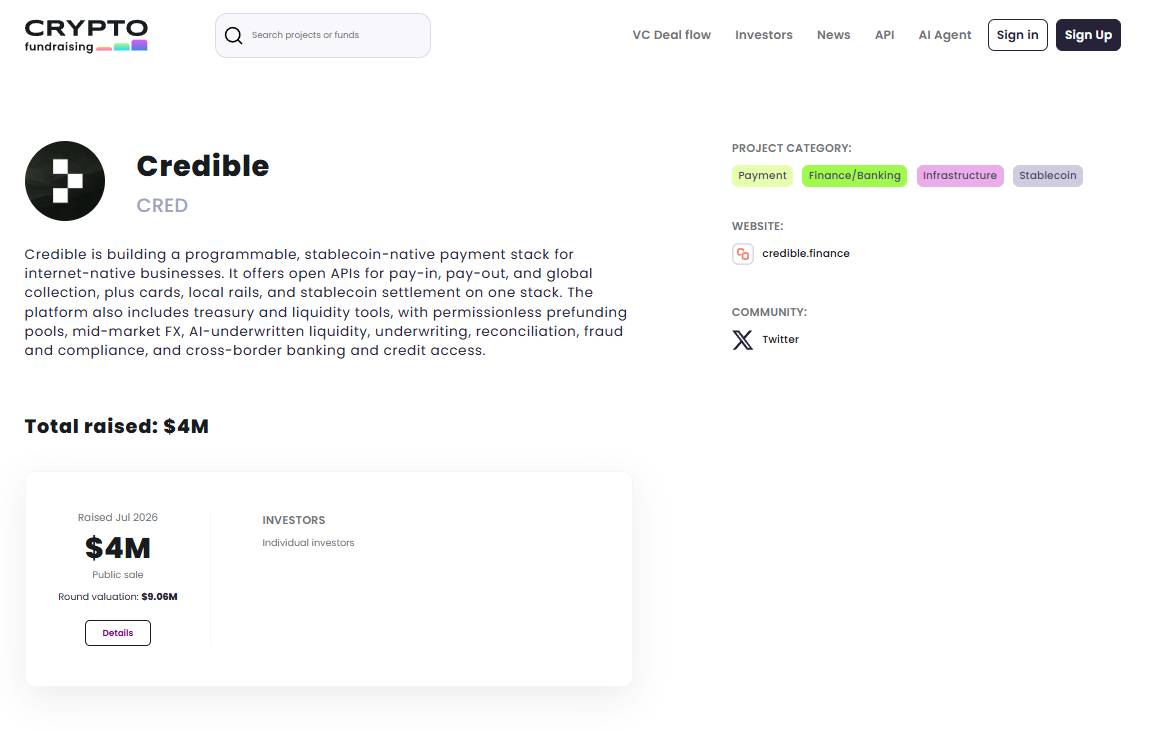
In July 2026, Credible completed a CRED token raise through MetaDAO. According to MetaDAO’s official project page, 790 contributors committed approximately $32.775 million. However, the amount actually raised was capped at $4 million. The remaining commitments were not equivalent to capital retained by Credible because token allocations were limited and MetaDAO applied its allocation rules. The available official fundraising page does not clearly confirm the participation of Trident Digital, Theia, Anagram or Lattice in the completed $4 million raise. Those names should therefore not be presented as confirmed investors without an additional primary source.
Conclusion
Credible is developing payment infrastructure that combines traditional fiat rails with stablecoin liquidity to accelerate settlement for approved transactions. Its model is based on advancing short-term liquidity against payment receivables rather than waiting for card networks, banks and local payment systems to complete their normal settlement cycles. However, many of the platform’s operational metrics, processed-volume figures, AI capabilities, contract-audit claims and future targets are supplied by the project itself. Credible also depends on stablecoins, smart contracts, external liquidity, banking partners and regulatory coverage across multiple jurisdictions.
The project’s FinCEN MSB registration should not be confused with a banking licence, full US money-transmitter licensing or regulatory approval of CRED. Readers should distinguish between services that are currently operational, targets published in Credible’s roadmap and claims that have not yet been independently verified.
Sources
- Credible — Legal Policies and Compliance Information
- MetaDAO — Credible Token Fundraise and CRED Allocation