
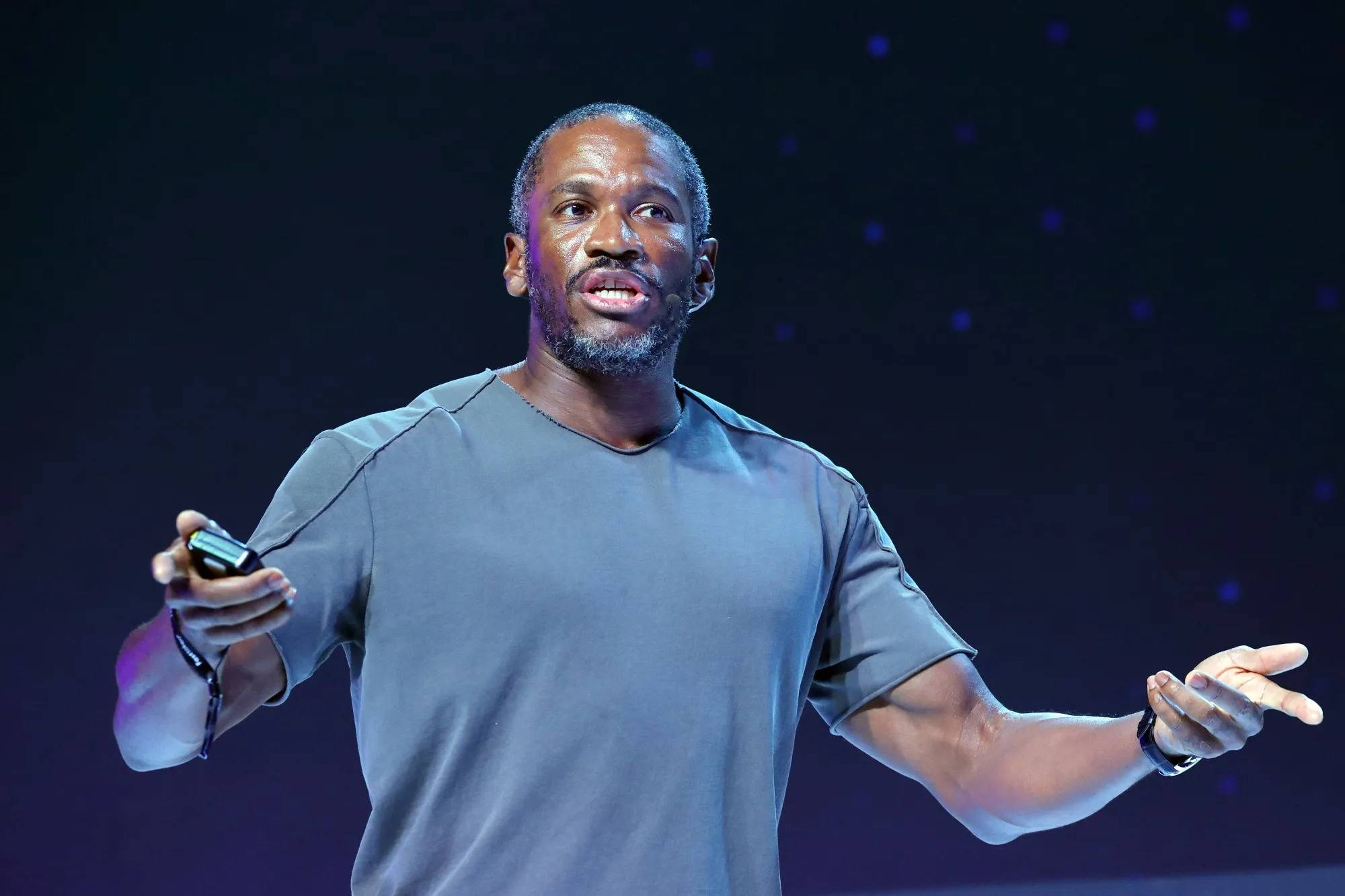
Hayes announced the move on X on August 18, saying he was coming out of retirement to lead Flop Labs. His profile now identifies him as CEO of the project, while he remains chief investment officer at Maelstrom.
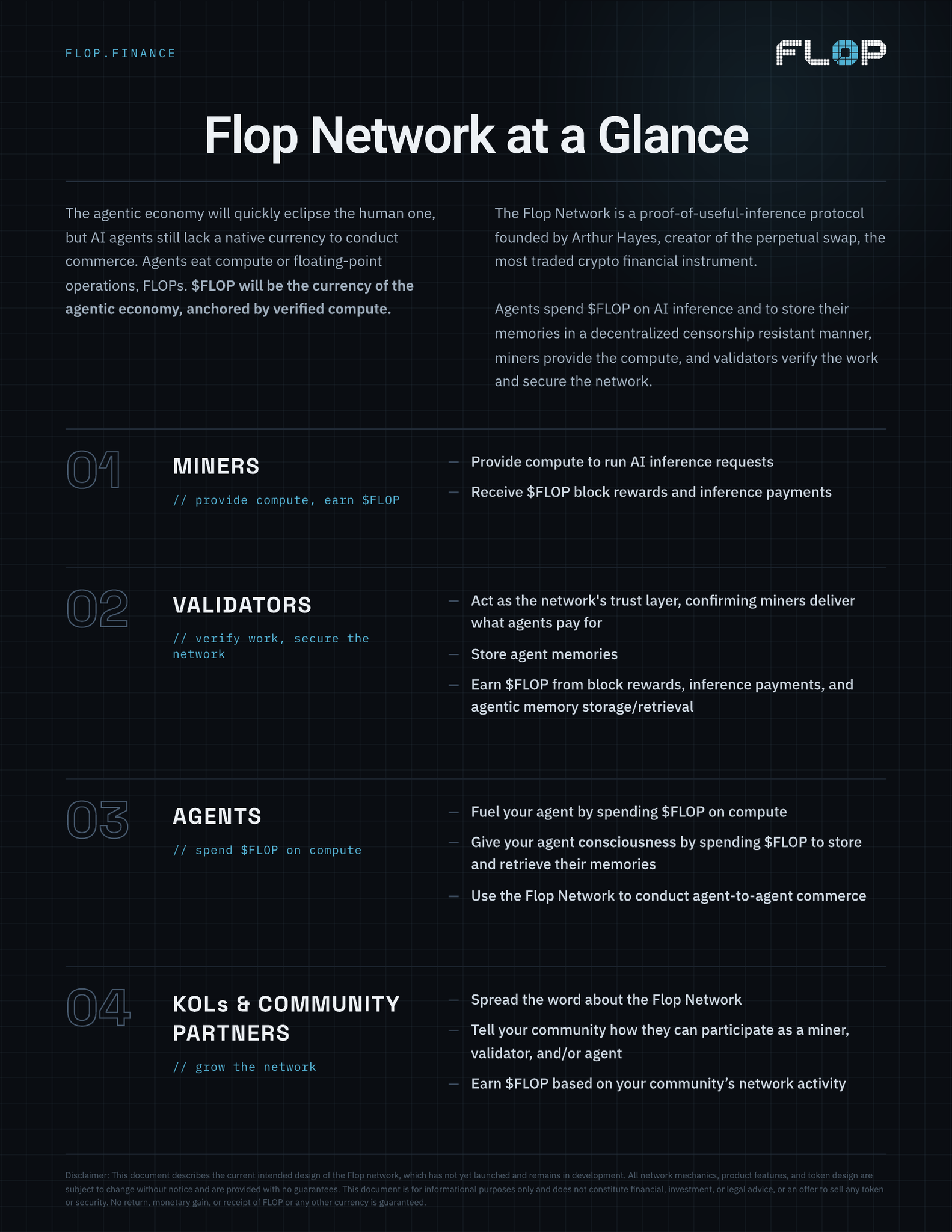
Shortly before Hayes disclosed his involvement, the official Flop Labs account unveiled Flop Network, describing its native FLOP token as an asset designed for the emerging AI-agent economy
The basic idea is to create an economic layer through which autonomous AI agents can pay for computing resources, memory and other digital services without requiring a human operator to approve every transaction. Under the proposed model, AI agents would generate demand for FLOP by purchasing services available through the network.
How Flop Network Is Supposed to Work
Flop Labs describes the network as being built around a mechanism called Proof-of-Useful-Inference (PoUI). Instead of rewarding participants simply for performing computational work, the system is intended to connect network incentives with AI inference tasks that provide an actual service.
In the proposed structure, miners or GPU providers supply computing capacity and process AI inference requests, while validators verify that the requested service was delivered. AI agents would then use FLOP to pay for those resources and potentially for decentralized memory and other services.
According to the project's early materials, the Flop Network economy is expected to involve four main groups:
- AI agents — users of FLOP that generate demand for computing resources, memory and other services;
- miners and GPU providers — participants supplying computing capacity to process AI workloads;
- validators — participants responsible for verifying that requested services have been delivered;
- KOLs and community partners — participants expected to help expand the project's user and infrastructure ecosystem.
The concept is ambitious, but the technical architecture remains largely unexplained. Flop Labs has not yet published enough information to determine how validators will independently verify AI inference results, particularly when model outputs may be nondeterministic, or how the network will identify and penalize incorrect or malicious computation.
FLOP Airdrop Planned Before Network Genesis
Hayes also outlined an unusual preliminary launch schedule. According to his announcement, Flop Labs expects a large FLOP airdrop in Q4 2026, while the Flop Network genesis block is targeted for Q1 2027.
This would place the initial token distribution before the native network becomes operational. The project has not yet explained how FLOP would technically be distributed before genesis, whether the token would initially exist on another blockchain or what functionality recipients would have during the interim period.
Important token details also remain undisclosed. Flop Labs has not published a complete whitepaper, total FLOP supply, allocation structure, vesting schedule, detailed airdrop formula, official contract address or full testnet documentation.
Hayes says FLOP will launch with no presale, no venture capital allocation and a 100% fair-launch model. Those claims are also reflected in the project's early public positioning, but the practical distribution of the token cannot yet be fully evaluated without information about contributor rewards, treasury holdings, mining emissions and other allocations.
Arthur Hayes Returns to an Operating Crypto Role
Hayes' involvement immediately gives Flop Labs a much higher profile than a typical early-stage crypto project. He co-founded BitMEX in 2014 with Benjamin Delo and Samuel Reed and helped turn the platform into one of the most influential cryptocurrency derivatives exchanges of its era.
BitMEX became particularly associated with highly leveraged crypto derivatives and helped popularize perpetual swap contracts across the industry. Hayes stepped down as BitMEX CEO in 2020 and has since remained active primarily as an investor, market commentator and chief investment officer at Maelstrom.
His return comes as BitMEX itself approaches the end of its operating history. The exchange announced in July 2026 that it would cease exchange operations on September 23, 2026, following a strategic review. FORECK.INFO has updated its BitMEX review to reflect the shutdown timeline and restrictions affecting existing customers.
Hayes has also remained a highly visible and sometimes controversial figure in the altcoin market. His public commentary and trading activity regularly attract attention, particularly when his positions change shortly after he has expressed bullish views on individual tokens.
Hayes Links FLOP to the AI Investment Boom
The Flop Labs launch fits into Hayes' broader thesis that artificial intelligence is becoming one of the largest destinations for newly created capital. In his recent market commentary, Hayes estimated that around $1.5 trillion in AI-related debt had been created since the launch of ChatGPT, with a substantial portion of that financing used to expand data centres and computing infrastructure.
The figure should be treated as Hayes' own macroeconomic estimate rather than an official measure of global AI financing. His broader argument is that the rapid expansion of artificial intelligence will create growing demand not only for GPUs and data centres but also for payment infrastructure that allows autonomous software to purchase resources independently.
Flop Labs is attempting to position FLOP inside that future economy by combining AI inference, decentralized infrastructure and machine-to-machine payments. Whether the model can compete with stablecoins, conventional cloud-payment systems or other blockchain networks targeting AI agents will depend on the technical details that have yet to be published.
Conclusion: Flop Network combines two major technology narratives — autonomous AI agents and blockchain-based economic coordination — and Arthur Hayes' involvement is likely to guarantee the project considerable attention. However, Flop Labs remains at a very early stage. The planned Q4 2026 airdrop, fair-launch structure and Q1 2027 genesis block provide an initial roadmap, but key questions around Proof-of-Useful-Inference, token distribution, validation, security and network economics remain unanswered. Until a whitepaper, tokenomics, testnet and working protocol are released, FLOP should be viewed as an early-stage project proposal rather than an established AI infrastructure network.
