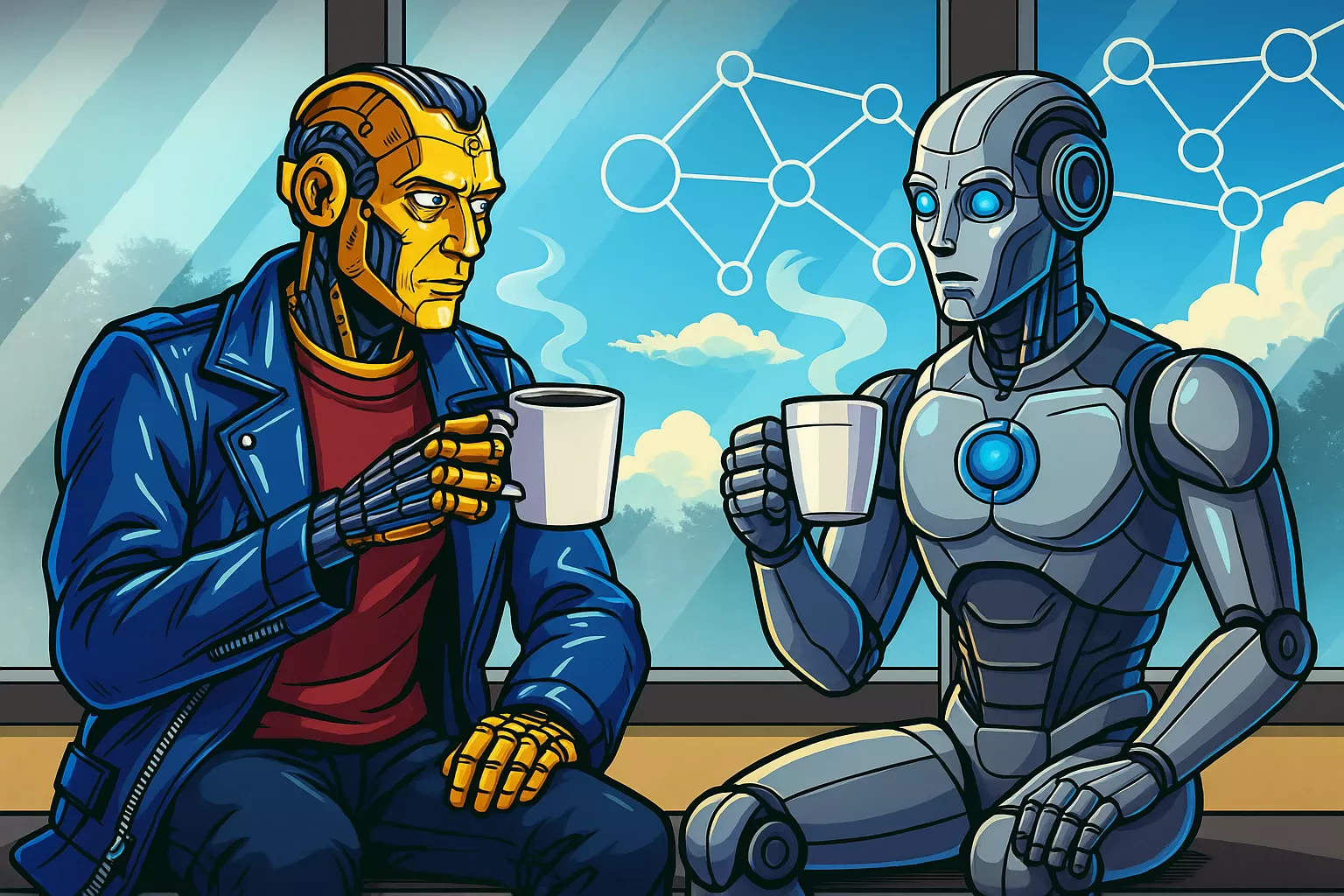

Humanoid robots that move almost like humans, grasp objects, perceive their surroundings and communicate are no longer science fiction. Since companies like Nvidia, Xiaomi, SoftBank and even Tether started pouring billions into humanoid robotics and autonomous systems, news about new models, partnerships and pilot projects has been appearing almost daily.
In parallel, a new niche is emerging in the crypto sector: after DePIN networks and AI agents, market attention is shifting toward robotics. This raises a natural question for investors: how much real value stands behind this trend – and which tokens are taking key positions in this emerging intersection of blockchain, AI and robotics?
How blockchains plug robots into the machine economy
The core idea is to connect real-world machines (humanoid, wheeled, ground-based, aerial) directly to a blockchain instead of steering them via centralized servers. Each machine receives a digital identity (ID) and its own crypto wallet, which means it can independently – without intermediaries – receive and send payments. In this way, a robot becomes a full-fledged participant in the digital economy.
The model is easy to illustrate with examples. A robot performs a task: a delivery, an industrial inspection, or a cleaning operation in a public space. The job is recorded on the blockchain as a smart contract. Sensors, cameras or other connected systems verify whether the task has been completed correctly. Only after this confirmation does the smart contract automatically release the payment – directly to the robot’s wallet. The resulting income is then distributed between the robot’s owner and investors who hold tokens representing fractional ownership in this “robot asset.”
According to Vance Spencer, General Partner at crypto VC firm Framework Ventures, this approach opens up a new field for DeFi. Robots, he argues, can serve as collateral in stablecoin looping strategies, much like rental properties are used in traditional finance. The model works as follows: an investor purchases a robot, tokenizes it on-chain and rents it out. The robot earns crypto for completed tasks, its token is deposited into DeFi as collateral, and the borrowed stablecoins are used to acquire additional robots – effectively creating leveraged exposure to a real-world, cash-generating asset.
Codec Flow: an operating system for AI-powered robots
Codec Flow operates one layer higher – on the software side. The project is building an OS-style platform for AI agents that can not only generate text, but also see, understand and execute physical actions.
Codec agents can analyze video feeds from cameras, recognize objects, make decisions and execute commands such as “pick up this object,” “move this load,” “inspect this area,” or “configure this machine.”
Codec provides:
-
cloud infrastructure,
-
AI models,
-
testing and development tools,
-
access to real robots and simulated environments.
The platform lowers the barrier to entry for companies that need robotics but lack the resources to build complex control software from scratch.
The CODEC token is used as payment for:
-
cloud desktops,
-
compute resources,
-
robot execution and task runs,
-
API access and tooling.
With a market cap below 10 million US dollars, the project remains early-stage and high risk.
IoTeX and Geodnet: data backbones for robotic networks
IoTeX
IoTeX sits at the intersection of IoT, DePIN and AI. The network connects devices – sensors, cameras, vehicles, industrial equipment – to Web3 applications while ensuring that device data is cryptographically verifiable via:
-
ioID – device identity;
-
W3bstream – data processing and verification.
The IOTX token:
-
pays for on-chain transactions,
-
is staked to secure the network,
-
incentivizes device owners to connect hardware to the network.
Its burn-to-certify model burns a portion of tokens when devices are registered and verified, creating a potentially deflationary effect over time.
The project’s market capitalization stands at around 93 million US dollars.
Geodnet
Geodnet specializes in GNSS data – a critical building block for navigation in robots, drones, cars and agricultural machinery. The network is built from independently operated ground stations that stream raw GNSS data and receive GEOD tokens as rewards. Developers and enterprises pay in GEOD to consume this data. The project’s market cap is around 62 million US dollars.
Virtuals: from AI agents to full-scale robotics
Virtuals Protocol started as a platform for tokenized AI agents that perform tasks in exchange for rewards. Now the project is expanding into robotics through its Virtuals Robotics initiative.
The vision is to bring digital agents into the physical world. AI agents interact with real robots:
-
service robots,
-
industrial arms,
-
logistics systems,
-
lab and research prototypes.
Virtuals focuses on data and capital infrastructure rather than building its own hardware. The protocol brings together:
-
developers,
-
robot operators,
-
investors,
-
holders of agent-related tokens.
The VIRTUAL token is among the most highly valued in this niche, with a market capitalization above 560 million US dollars.
Between hype and real value
The convergence of AI, robotics and blockchain could move the machine economy from theory into practice. Projects like peaq, Codec Flow, IoTeX, Geodnet and Virtuals are building the infrastructure for a future in which robots and AI agents will:
-
accept orders,
-
generate revenue,
-
pay for resources,
-
manage digital and real-world assets.
If robotics experiences its own “ChatGPT moment,” this segment could see an explosive rally – along with the infrastructure tokens that underpin it.
However, the risks are extremely high:
-
the sector is still in an experimental phase,
-
business models remain unproven,
-
regulatory frameworks are still unclear,
-
most projects are unlikely to achieve meaningful user adoption.
Anyone considering exposure to this space should recognize the very high risk, conduct thorough research and only invest capital they can afford to lose.
For those who prefer to participate via more traditional tools – buying crypto, staking or trading – choosing a reliable platform is crucial.
On FORECK.INFO we’ve compiled an up-to-date ranking of the best crypto exchanges that takes into account:
-
security and technical resilience,
-
real fees and hidden charges,
-
liquidity across major trading pairs,
-
quality of customer support and withdrawal speeds,
-
regulatory status and jurisdiction,
-
verified user feedback.
This ranking helps you choose an exchange suitable both for long-term investors and for active traders who want exposure to tokens in Robotics, AI, DePIN segments or classic assets like BTC, ETH, SOL and XRP on competitive and secure terms.
Thanks to comparison tables, in-depth reviews and market analysis on FORECK.INFO, you can quickly find the right platform for buying, holding and trading digital assets – especially against the backdrop of the emerging robotics trend, which could become one of the defining crypto themes in 2026 and beyond.