




Top Pick

- Fully licensed and regulated US exchange
- Strong focus on security and compliance
- User-friendly interface for beginners
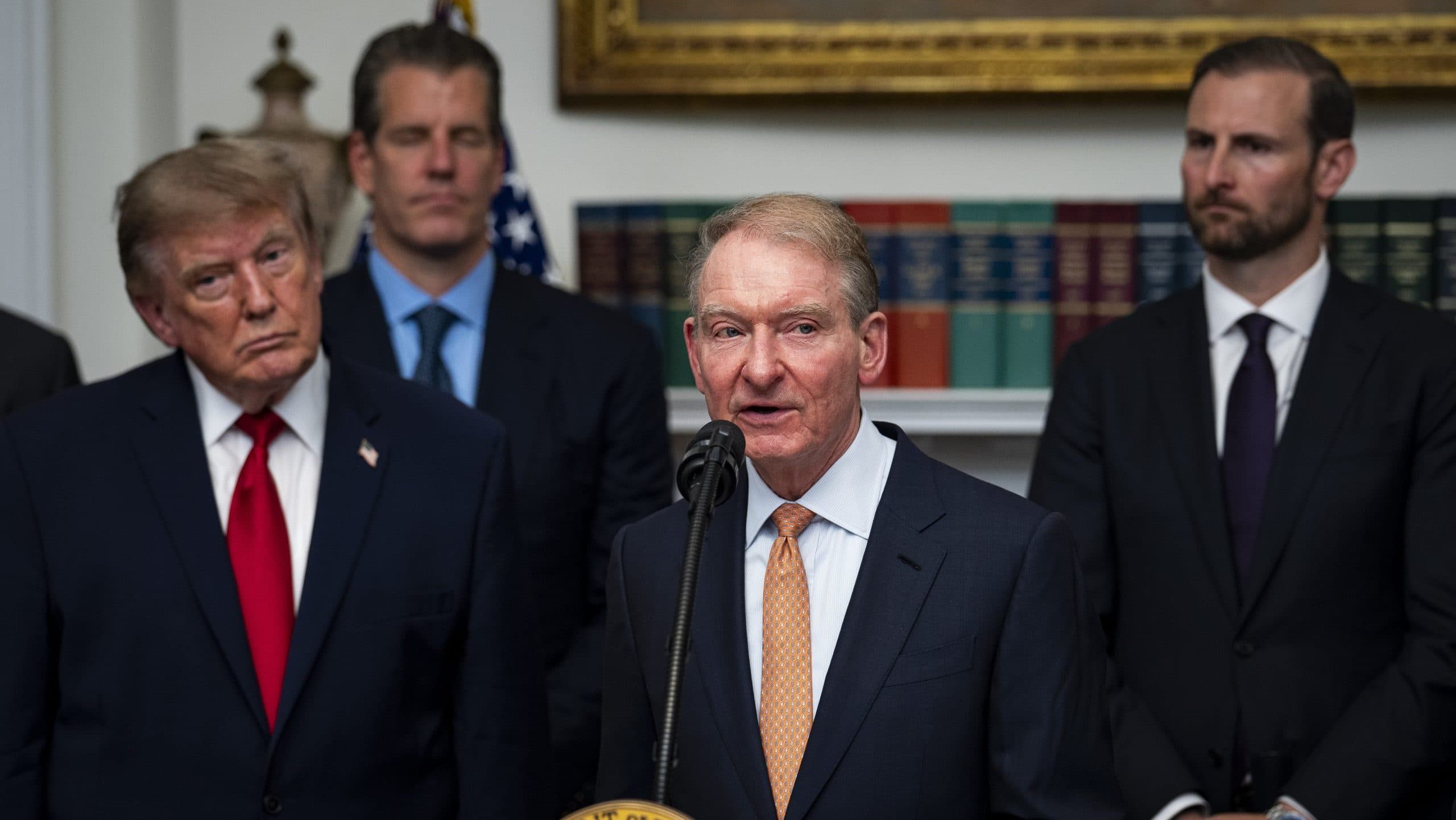
Six major blockchain organizations are calling on the US Securities and Exchange Commission (SEC) to make its classification of digital commodities part of binding crypto regulations. The proposal could affect how exchanges and investors handle tokens such as LINK, ADA, HBAR, APT, AVAX and XLM, particularly when these assets are traded on secondary markets.

 By John Isige
 Last week, the BTC/USD pair corrected lower under pressure from monetary factors, reaching a five-week low of 79720.00. It then recovered part of its losses and is currently trading near 82710.00.
 By John Isige
 The XRP/USD pair has been trading mostly within the sideways range of 1.5625–1.3671 (Murray [8/8]–[6/8]) for more than two months, periodically attempting to leave it. At present, the quotes have reached its lower boundary, and after consolidating below it, a decline towards 1.2695 (Murray [5/8]) and 1.1718 (Murray [4/8]) is expected. However, if the price breaks above the middle Bollinger Band at 1.4648 (Murray [7/8]), growth may continue towards 1.6420 (Fibonacci retracement 61.8%), 1.7578 (Murray [+2/8]) and 1.9531 (Murray [5/8], W1).
 By John Isige
 Ethereum's staking exit queue increased more than fivefold in just three days, reaching a peak of around 851,000 ETH after MetaMask began proactively withdrawing thousands of validators following a security incident.
 By John Isige
 In June, the ETH/USD pair reversed from the 1562.50 area (Murray level [2/8]), near two-year lows, and has since continued to rise with significant periods of sideways consolidation. The price is now approaching the 2812.50–2770.00 resistance area (Murray level [+2/8], 23.6% Fibonacci retracement). A consolidation above this zone may allow the pair to reach 3165.00 (50.0% Fibonacci retracement) and 3400.00 (January high). However, if the price consolidates below 2500.00 (Murray level [8/8]), where the asset traded for around a month, a correction toward 2187.50 (Murray level [6/8]) and 1875.00 (Murray level [4/8]) may develop.
 By John Isige
 Last week, the BTC/USD pair moved above 87000.00 but has since pulled back toward 86000.00, while maintaining its upside potential amid a significant decline in expectations for further monetary tightening by the US Federal Reserve.
 By John Isige
 The cryptocurrency market made a moderate recovery attempt this week. At the time of writing, BTC was trading near 86860.00 (+3.7%), ETH at 2758.00 (+2.4%), USDT at approximately 0.9995, BNB at 782.00 (+1.6%) and XRP near 1.5400 (+3.4%). Total market capitalization was close to 3.04 trillion dollars, while Bitcoin dominance remained near 59.0%. In the latest completed U.S. trading session on October 1, spot Bitcoin ETFs recorded a net inflow of 102.7 million dollars, while spot Ethereum ETFs posted a net outflow of 55.4 million dollars. The figures follow the recent surge in Bitcoin ETF inflows previously covered by FORECK.INFO.
 By John Isige
 Since the middle of the month, BTC/USD has resumed its advance, reaching a new January high of 87300.00 last week before correcting lower and stabilizing near 84375.00 (Murray level [7/8]), where it was trading at the time of writing under the influence of several opposing factors.
 By John Isige
 U.S. spot Bitcoin ETFs attracted nearly $1 billion in a single trading session, their strongest result of 2026 and the largest daily inflow in almost a year. Bitcoin’s rally also put the average ETF investor back in profit for the first time since January.


For crypto, the framework is similar to traditional financial markets but comes with its own twist. Here, price action turns on liquidity, adoption, regulation, and flows from institutions alongside retail sentiment. Network health—hash rate, staking, active wallets—adds another layer. Macro still matters too: rates, dollar strength, and risk appetite shape inflows and outflows. Then, as with any market, you use the chart—trend, support and resistance, momentum, and volume—to spot setups and manage risk.