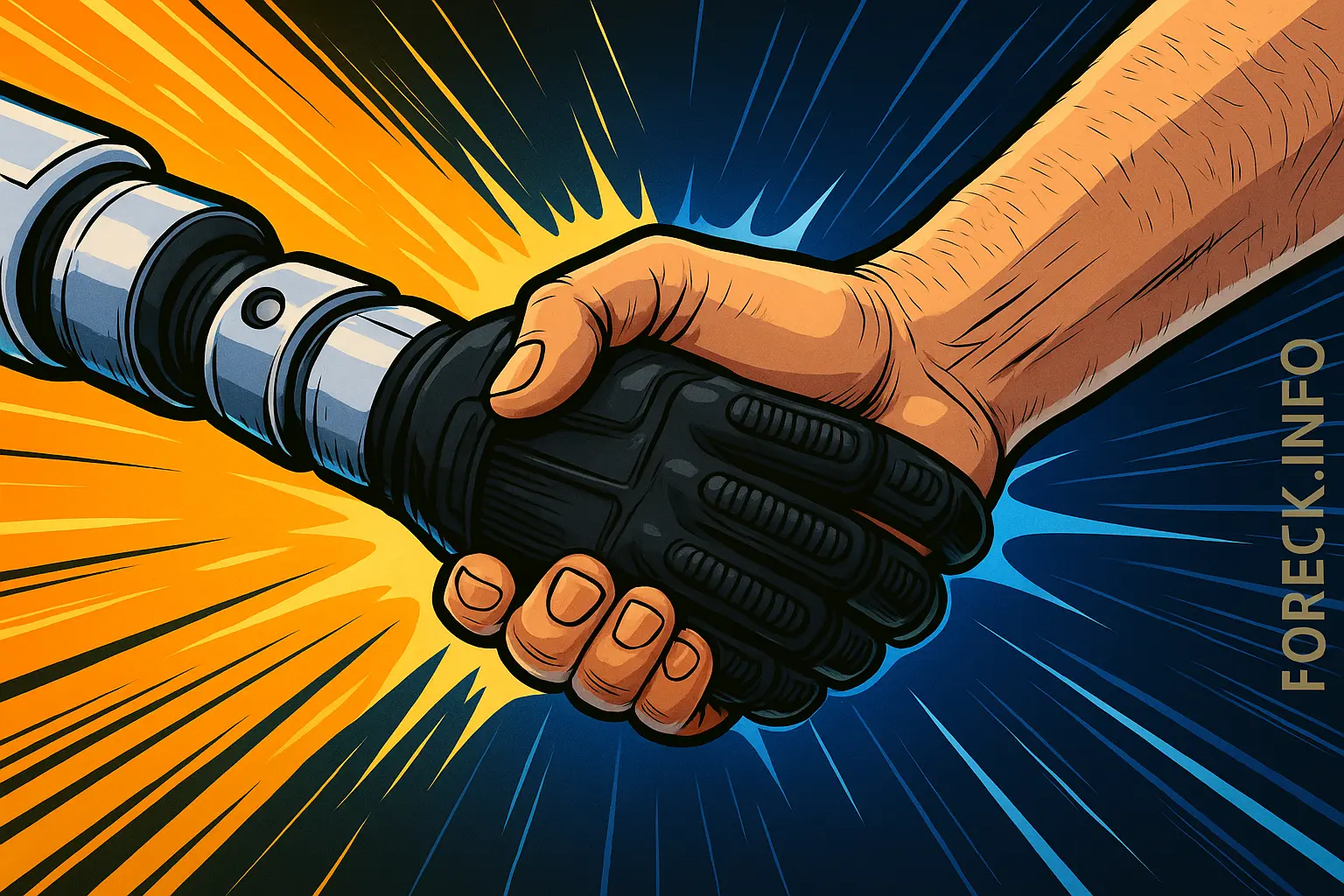

The future trust infrastructure is not being built on a single technology, but on the interplay between autonomous AI agents, geopolitically fragmented data spaces, disinformation threats, digital identity, and decentralized systems.
This is exactly the intersection of technologies analyzed by Nick McQuire, Managing Vice President for Emerging Tech at Gartner, in his talk at the Cardano Summit in Berlin. He poses several key questions: how is artificial intelligence reshaping Web3? What role will blockchain play in securing digital authenticity? And how will businesses react to the growing political fragmentation of the global data landscape?
Gartner is considered one of the most influential research and advisory firms in the world – its forecasts directly shape technology strategy and IT budgets. It is especially telling that in several future scenarios the company explicitly describes blockchain as a potential trust layer in an AI-dominated digital world.
Agentic AI: why autonomous systems are reshaping the internet – and why they need blockchain
Autonomous AI agents – specialized systems that independently perform tasks, make decisions, and orchestrate complex processes – have become one of the hottest trends in tech. According to Gartner, demand for such agentic systems has grown by 750% year-on-year. More than 600 vendors are competing for pilot projects, yet fewer than 20% of CIOs run production deployments today.
McQuire forecasts that by 2030, around 80% of global internet traffic will be generated by AI agents. This brings one central challenge into focus: how do we verify machine decisions? Most agents currently operate as opaque black boxes whose decision-making processes are difficult to audit.
Gartner argues that this opens a major application field for blockchain: an immutable blockchain ledger can serve as the verification and certification layer for autonomous agent decisions.
The market potential is huge: by 2030, around 40% of all AI spending – roughly 550 billion US dollars – is expected to flow into systems that coordinate agents, prevent harmful behavior, and certify machine outputs. That implies unprecedented demand for protocols focused on digital identity, zero-knowledge verification, verifiable computation, and reputation management.
Five technology shifts that will shape Web3
Gartner identifies 12 key trends for 2026, five of which have a direct impact on Web3 – and all of them intersect with blockchain:
1) “Geopatriation” – moving away from global cloud monopolies
Digital sovereignty is rapidly becoming a strategic priority. Today, 84% of the global cloud market is controlled by US providers and another 13% by China, leaving the rest of the world with a marginal share. Gartner expects that by 2030, around 70–75% of companies will rely on sovereign, regional, or federated cloud structures. For Web3, this opens a major opportunity: decentralized networks can offer independence, distribution, and censorship resistance – properties traditional cloud models struggle to provide.
2) Global Attack Surface Grid: AI expands the attack surface
As automation grows, so does the attack surface for cyber threats. Gartner expects more than half of security spending to shift toward proactive, predictive defense. On-chain data, cryptographic proofs, and decentralized audit systems become critical components for forensics and real-time protection.
3) Disinformation Security: defending against synthetic manipulation
Disinformation is becoming as dangerous as classic data breaches. In 2019, for example, a deepfake phone call resulted in a fraudulent transfer of 243,000 US dollars after the voice of a German executive was perfectly mimicked. The Beyond Meat case illustrates the impact at scale: from 236 US dollars down to around 0.50 – a loss of more than 99%, which the CEO partly attributes to sustained disinformation campaigns. Gartner expects that by 2030, counter-disinformation capabilities will be as mandatory as basic cybersecurity controls. Blockchain strengthens provenance, signatures, and verifiable audit trails for digital content.
4) Platforms for digital authenticity: a 25-billion-dollar market
By 2030, Gartner forecasts a 25-billion-dollar market for platforms that guarantee digital authenticity and sit at the intersection of cybersecurity, identity verification, AI validation, and digital rights management. In many of these architectures, blockchain is not an optional add-on but a foundational layer.
5) The next identity revolution: autonomous digital identities
According to the Gartner Futures Lab, by 2033 the average person could manage five to seven autonomous digital identities that interact contextually with AI agents and act on behalf of the user. This opens a massive growth field for decentralized identity (DID), DAOs, ZK-based reputation systems, and attestation standards such as EAS.
What this means for Bitcoin, Ethereum, and Web3
The trends Gartner describes – from agentic AI to sovereign infrastructure – have clear implications for leading blockchain networks.
-
Bitcoin gains strategic relevance as a neutral, censorship-resistant security layer for states and enterprises seeking digital independence.
-
Ethereum sits at the core of many technologies Gartner associates with digital authenticity: ZK-proofs, on-chain identity, data provenance, attestations, and transparent, verifiable computation.
Other L1 and modular networks – Cardano, ICP, Near, Solana, as well as L2 ecosystems – are building precisely the kind of technologies Gartner flags as critical: decentralized identity, verifiable off-chain computation, and robust provenance for digital assets and data.
AI triggers a new trust crisis – and Web3 may be the answer
Gartner’s analysis points to a clear conclusion: the more autonomous AI agents become, the more urgently the digital world needs a technical foundation for authenticity, identity, and accountability. In this view, blockchain is not a nice-to-have – it is a structural necessity.
In a digital reality where:
-
AI generates most of the internet traffic,
-
synthetic media distort information flows and behavior,
-
and governments push for digital sovereignty,
Web3 has a real chance to become the foundational trust layer. This is exactly where the next major crypto narrative could emerge.