
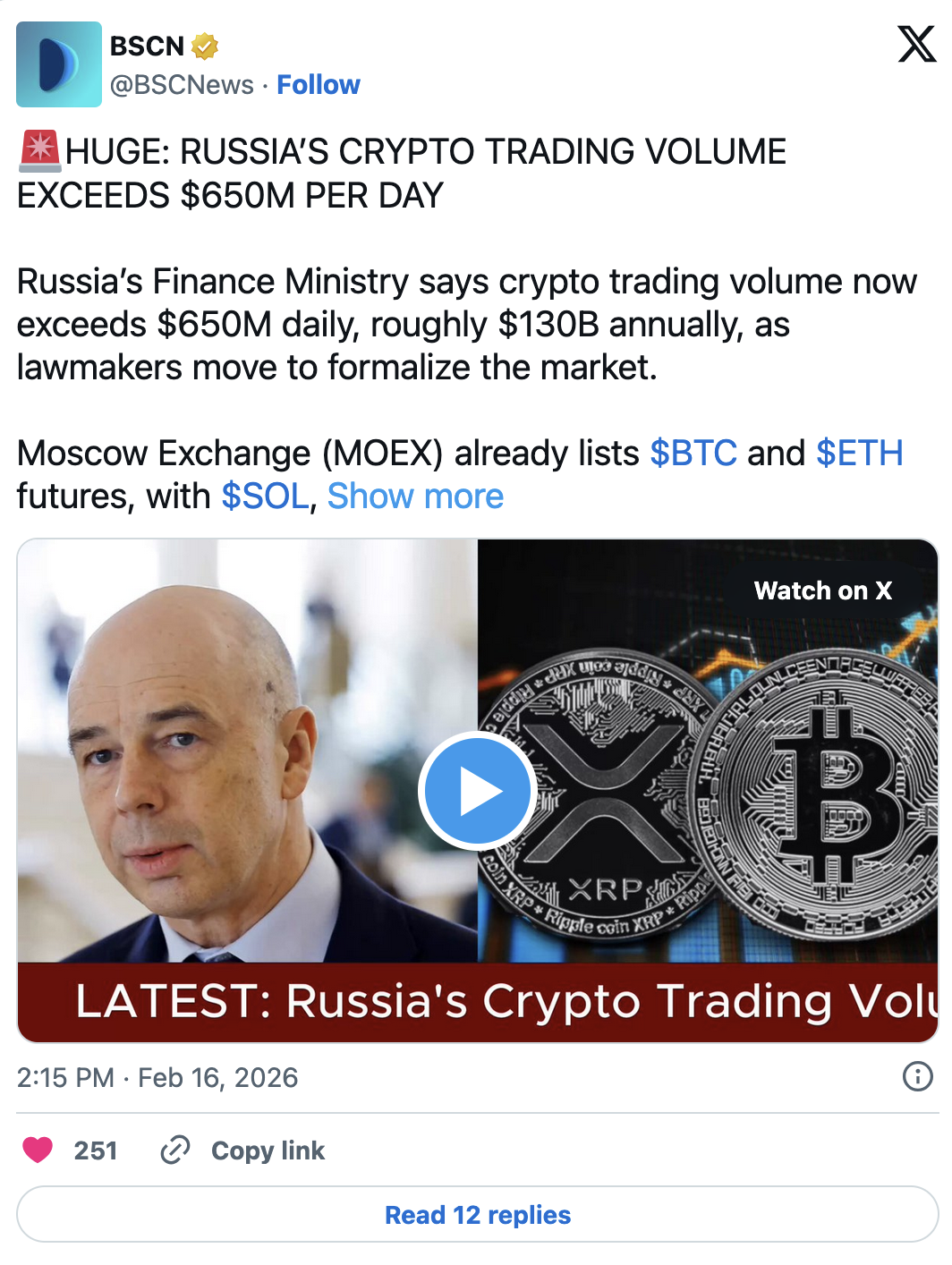
Russia’s Ministry of Finance said that cryptocurrency transaction volumes in the country reach around 50 billion rubles per day, or nearly $650 million. Most of this activity takes place outside the regulated financial system.
The statement comes as lawmakers prepare a bill to license crypto exchanges and brokers, which is expected to be considered during the State Duma’s spring session. According to officials, annual transaction volumes exceed $130 billion, while public participation continues to grow.
Daily volumes and public participation
Deputy Finance Minister Ivan Chebeskov presented these figures at the Alfa Talk event. He said that millions of citizens are involved in crypto trading, with total annual transaction volumes exceeding $130 billion.
“We have repeatedly said that millions of citizens are involved in cryptocurrency trading. This represents trillions of rubles in purchases and savings. Annual transaction volume in Russia exceeds $130 billion. All of this is currently taking place in an unregulated space, outside our control,” Chebeskov said.
Media outlets RBC and Interfax reported that the Finance Ministry relied on data from Rosfinmonitoring’s Transparent Blockchain platform. Officials stressed that the figures do not represent audited on-chain metrics, but they do reflect the scale of the market.
At the same time, a financial stability report from the Bank of Russia shows that by mid-2025, Russian users held around 933 billion rubles (approximately $12 billion) on foreign crypto exchanges operating outside Russia’s regulatory perimeter.
The same report, covering the second and third quarters of 2025, estimates the average monthly balance of Russian funds on exchanges at 933 billion rubles. These estimates were based on Rosfinmonitoring’s analysis of inflows and outflows across major international platforms.
Europe’s largest crypto market
According to Chainalysis, Russia ranks as Europe’s largest crypto market by volume. Between July 2024 and June 2025, the country received more than $376 billion in cryptocurrency inflows. By comparison, the United Kingdom recorded $273 billion over the same period.
Germany and Ukraine were the only other European countries to exceed $200 billion in crypto inflows, underscoring Russia’s central role in the region’s digital asset ecosystem.
At the same Alfa Talk event, Sergei Shvetsov, Chairman of the Supervisory Board of the Moscow Exchange, addressed the issue of fees flowing to foreign platforms. He said Russians pay around $15 billion in fees annually to overseas crypto exchanges.
Shvetsov noted that crypto exchanges and traditional exchanges together generate about $50 billion per year from digital asset trading, with roughly one-third of that amount linked to Russian participants.
“That means $15 billion is what our citizens and companies are leaving in gray domestic infrastructure and offshore infrastructure,” he said.
He added that the Moscow Exchange is interested in competing for this market, comparing its annual profit of about $1 billion with the potential $15 billion that could move into a regulated environment.
Draft bill and transition to regulation
Lawmakers are currently preparing a draft law that would introduce a licensing regime and compliance requirements for crypto exchanges and brokers. A vote is expected during the State Duma’s spring session.
Vladimir Chistyukhin, First Deputy Chairman of the Bank of Russia, said he expects the new rules to be adopted in the upcoming session. Under the proposal, licensed exchanges and brokers would be allowed to offer services including spot trading.
Exchange offices would be required to obtain specific licenses, with penalties imposed on those operating without authorization. At the same time, regulators plan to introduce a transition period to allow market participants to secure licenses and establish compliance procedures.
The Bank of Russia has also proposed a differentiated approach, under which access to certain crypto products could depend on an investor’s category.
With daily trading volumes approaching $650 million and hundreds of billions of dollars in annual turnover, a key question remains: can Russia bring this vast market under formal oversight during the spring session?