

At the same time, domestic macroeconomic data proved more supportive. According to Statistics New Zealand (Stats NZ), electronic card spending increased by 1.2% in November, or NZD 86.0 million, while core sector spending rose by 1.1%, or NZD 67.0 million. Investors highlighted the fact that all six major retail categories posted gains for the first time in a long period. Spending on durable goods accelerated by 2.1%, hospitality and accommodation rose by 1.3%, consumables increased by 0.4%, clothing sales jumped by 3.4%, fuel spending grew by 1.4%, and motor vehicle purchases advanced by 2.6%. As the data covers only the early phase of pre-holiday sales, momentum could extend into December’s figures.
The US dollar, which remains the key driver for NZD/USD, is also under pressure and is trading near 98.00 on the USDX. The move reflects both a lack of positive US data early in the week and subdued expectations ahead of tomorrow’s 15:30 (GMT+2) labour-market report, which will cover the October and November periods delayed by the government shutdown. In addition, on Thursday at the same time, the US will release CPI data, which may show a rise from 0.2% month-on-month and 3.0% year-on-year, with the core index also expected to edge higher from 0.2% and 3.0%, respectively.
Even so, this data is unlikely to significantly alter the Federal Reserve’s rhetoric. Policymakers appear inclined to pause further rate adjustments to assess the impact of measures already taken. According to the CME FedWatch Tool, the probability of rates remaining unchanged in January stands at 75.6%. At the final meeting of the year, the Fed cut rates by 25 basis points to a 3.5–3.75% range by a 9–3 vote. Governor Christopher Waller supported a larger 50-basis-point cut, while Chicago Fed President Austan Goolsbee and Kansas City Fed President Jeffrey Schmid voted to keep rates unchanged.
Support and resistance levels
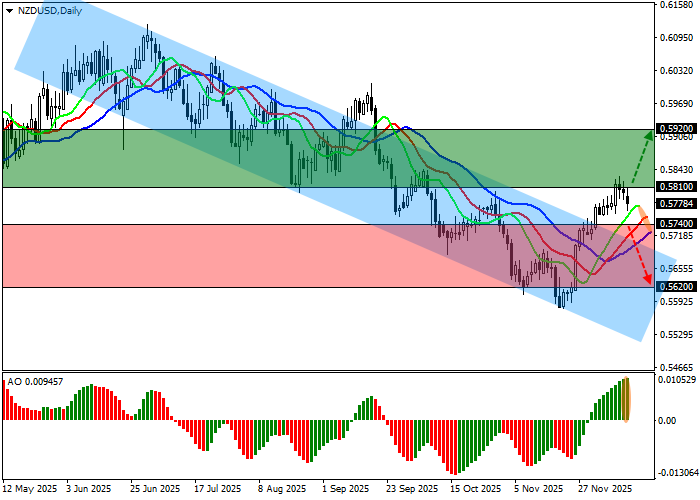
The instrument has reversed and is correcting lower, approaching the previously broken resistance line of the ascending channel with dynamic boundaries at 0.5750–0.5540.
Technical indicators are generating a buy signal that could strengthen further. The fast EMAs of the Alligator indicator are moving away from the signal line, while the AO histogram is forming rising bars above the zero line.
Support levels: 0.5740, 0.5620.
Resistance levels: 0.5810, 0.5920.
Trading scenarios and NZD/USD outlook
Long positions can be considered after a sustained move and consolidation above 0.5810, with a target at 0.5920. Stop-loss: 0.5760. Time horizon: 7 days or longer.
Short positions can be considered after a move and consolidation below 0.5740, with a target at 0.5620. Stop-loss: 0.5800.