

Pareto is a decentralised private-credit platform designed for institutional clients. It operates as an on-chain marketplace connecting professional lenders and borrowers through Credit Vaults.
By building compliant and programmable credit infrastructure, Pareto aims to expand DeFi beyond its traditional overcollateralised lending model. The platform allows approved institutional borrowers to access capital without depositing crypto assets worth more than the amount borrowed, potentially improving capital efficiency and making on-chain credit more accessible to professional investors.
What Is Pareto?
Pareto is an institutional private-credit marketplace that evolved from Idle Finance, one of Ethereum’s early yield-aggregation protocols. Its infrastructure is designed for asset managers, digital asset funds, trading companies and other professional market participants.
The protocol supports Credit Vaults deployed across several EVM-compatible networks. These vaults use smart contracts to manage deposits, lending cycles, interest accrual and withdrawals, while identity verification, borrower assessment and legal agreements are handled through additional off-chain processes.
Unlike traditional DeFi lending protocols such as Aave or Morpho, where borrowers generally provide collateral worth more than the value of their loans, Pareto can facilitate undercollateralised institutional credit.
Instead of relying entirely on liquid on-chain collateral, each Credit Vault works with approved borrowers and defined lending agreements. Curators establish the vault’s parameters, assess the borrower, monitor performance and manage the lending cycles.
Key Features
Institutional On-Chain Credit
Pareto is designed to bring private-credit transactions onto blockchain infrastructure while retaining compliance and risk-management processes familiar to traditional financial institutions.
The protocol has supported Credit Vaults involving institutional market participants such as Fasanara Digital, FalconX, Bastion Trading and Adaptive Frontier. The number of active vaults and their combined value may change as lending cycles begin, mature or receive additional liquidity.
Undercollateralised Lending Model
Most DeFi lending protocols require borrowers to lock assets worth more than the amount borrowed. This protects lenders through automatic liquidation but limits capital efficiency and makes the model unsuitable for many conventional businesses.
Pareto allows approved institutions to borrow without depositing an equivalent or larger amount of crypto collateral. This can make capital more productive, but it also introduces conventional credit and counterparty risks. If a borrower fails to repay, lenders cannot necessarily rely on an immediate on-chain liquidation to recover the full amount.
Pareto is part of a wider shift toward institutional on-chain lending infrastructure. Galaxy’s GOFR follows a different, fully managed model, but both products aim to reduce the operational barriers preventing professional clients from accessing DeFi credit markets.
Compliance Infrastructure
Only approved borrowers can receive funds from Pareto Credit Vaults. Lenders must also register and complete identity verification before providing liquidity.
The platform supports privacy-preserving Know Your Customer procedures and uses legally binding credit agreements alongside its smart contracts. This structure is intended to make the products more suitable for regulated institutions than permissionless lending pools with anonymous counterparties.
Flexible Lending Cycles
Pareto Credit Vaults operate through lending cycles that typically last between one and four weeks. Each vault can use a fixed or variable interest-rate model, with the curator able to update certain parameters between cycles in accordance with the underlying credit agreement.
The cycle-based structure gives borrowers predictable access to capital while allowing lenders to plan deposits and withdrawal requests around defined settlement periods.
Products and Features
Credit Vaults
Credit Vaults are smart contract-based lending vehicles created for institutional borrowers and professional liquidity providers.
Each vault is managed by a curator responsible for establishing or supervising key parameters, including:
-
The fixed or variable interest-rate model.
-
The duration of each lending cycle.
-
Deposit and withdrawal conditions.
-
Borrower eligibility requirements.
-
Identity-verification procedures.
-
Credit monitoring and risk controls.
-
Conditions established in the Master Loan Agreement.
Some Credit Vaults may also use senior and junior tranches. Senior lenders receive priority when funds are repaid, while junior participants accept greater risk in exchange for potentially higher returns.
USP — Pareto’s Synthetic Dollar
USP is a credit-backed synthetic dollar that provides exposure to the institutional loans originated through Pareto’s infrastructure. It should not be treated as equivalent to a conventional fiat-backed stablecoin such as USDC or USDT.
Users can mint USP by depositing supported stablecoins, including assets such as USDC or USDS, into the ParetoDollar smart contract. The underlying funds can then be allocated to approved Credit Vaults and other eligible yield sources.
Users may stake USP to receive sUSP, an ERC-4626 token designed to reflect the yield generated by the underlying credit portfolio. As interest accumulates, the amount of USP represented by each sUSP token may increase.
However, the yield is not risk-free. USP and sUSP holders remain exposed to the performance of the underlying borrowers, Credit Vaults, smart contracts and stablecoins used by the system. A borrower default or operational failure could reduce returns and potentially result in losses.
White-Label Infrastructure
Pareto also offers white-label infrastructure for banks, asset managers, neobanks and fintech companies seeking to launch branded on-chain credit products.
The service allows institutions to use Pareto’s underlying smart contracts and operational framework while creating their own customer-facing products. Depending on the implementation, the infrastructure may include:
-
Identity and compliance tools.
-
Custom Credit Vaults.
-
Liquidity-management systems.
-
On-chain reporting.
-
Risk-monitoring infrastructure.
-
Institution-specific product branding.
Pareto has not publicly stated that Sygnum Bank was the first client of this white-label service. Sygnum has participated in institutional tokenised-credit initiatives that use Pareto infrastructure, but this should not be presented as proof that it was the platform’s first white-label customer.
How Pareto Works
Pareto operates through a marketplace involving borrowers, lenders and curators.
The borrower is an approved institution seeking access to capital. Lenders provide stablecoins after completing the required registration and identity-verification procedures. The curator configures the vault, conducts or coordinates borrower assessment, establishes the lending terms and monitors the credit position.
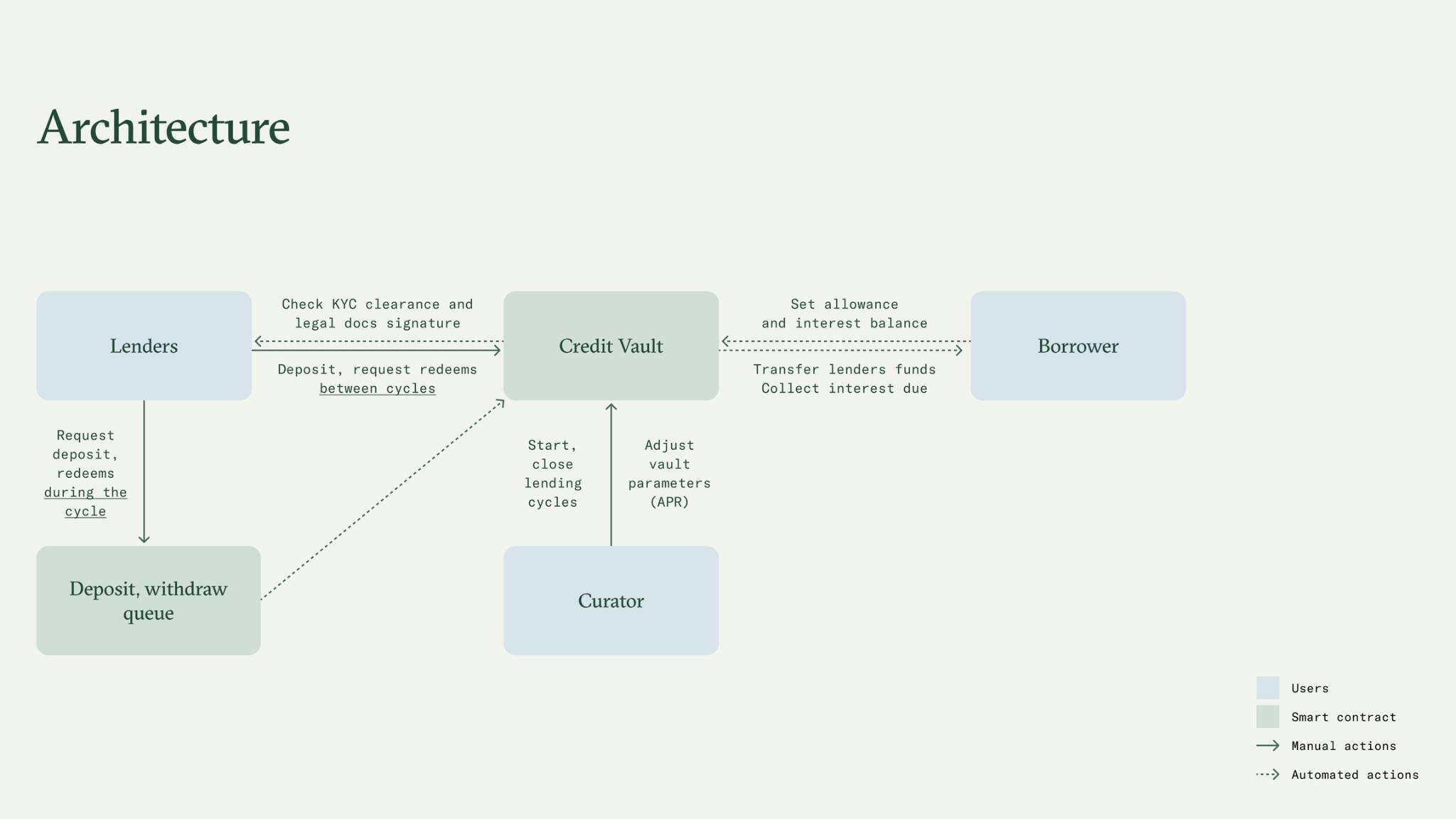
Before a lending cycle begins, verified lenders deposit supported assets into the Credit Vault. The curator then activates the cycle, and the deposited capital is sent directly to the borrower’s wallet.
Interest accrues according to the vault’s predefined interest-rate model. At the end of the lending period, the borrower must repay the required interest and any principal requested for withdrawal.
Withdrawals generally involve two stages. A lender first submits a redemption request, after which the borrower repays the relevant funds at the end of the following lending cycle. Once the assets have been returned to the vault, the lender can complete the claim.
Some vaults may provide an accelerated withdrawal process when interest rates change significantly or when other conditions defined in the credit agreement are met.
What Happens if a Borrower Defaults?
Undercollateralised lending creates materially different risks from conventional overcollateralised DeFi lending. Because the borrower may not have deposited enough liquid collateral to cover the loan, a missed repayment cannot always be resolved through automatic liquidation.
Pareto combines on-chain monitoring with legally binding agreements that may allow creditors to pursue recovery through off-chain legal procedures. The effectiveness of this process depends on the borrower’s financial position, the jurisdiction, the contractual structure and the availability of recoverable assets.
USP also has mechanisms intended to absorb part of the losses generated by its underlying Credit Vaults. However, these protections do not guarantee full repayment. Depending on the scale of a default, sUSP holders may ultimately absorb losses through a reduction in the value represented by their tokens.
Advantages of Pareto
Pareto’s model may offer several advantages for institutional borrowers and lenders:
-
More efficient use of capital than fully collateralised lending.
-
Transparent on-chain transaction and vault records.
-
Programmable interest and repayment structures.
-
Short and clearly defined lending cycles.
-
Identity verification and compliance support.
-
Access to institutional private-credit yield.
-
Integration with other blockchain-based financial applications.
Main Risks
The platform’s potential benefits must be considered alongside several significant risks.
Borrower Default Risk
The borrower may fail to repay principal or interest. Because loans can be undercollateralised, the vault may not hold enough immediately liquid assets to cover the loss.
Liquidity Risk
Lenders may need to wait until the end of a lending cycle or the following cycle to withdraw their capital. Funds may therefore be unavailable during periods of market stress.
Smart Contract Risk
Vulnerabilities in Pareto’s smart contracts, third-party integrations or supported blockchain networks could lead to operational disruption or financial losses.
Stablecoin Risk
Credit Vaults and USP rely partly on assets such as USDC and USDS. Problems involving the issuers, reserves, banking partners, regulation or market liquidity of those stablecoins could affect Pareto users.
Legal and Enforcement Risk
Off-chain credit recovery depends on enforceable contracts and legal systems. Recovering assets from a defaulting borrower may be expensive, slow or unsuccessful.
Curator and Governance Risk
Curators influence borrower selection, interest rates, lending cycles and risk controls. Poor assessment or conflicts of interest could negatively affect lenders. Governance decisions may also change protocol parameters and token structures.
From Idle Finance to Pareto
Pareto developed from Idle Finance, an Ethereum protocol originally focused on yield aggregation and risk-adjusted DeFi products.
A governance proposal published in December 2024 outlined a broader transition toward institutional on-chain credit, a new Pareto brand and revised tokenomics. The proposal positioned Credit Vaults as the project’s main growth product and described plans to replace the IDLE token with PAR.
PAR Tokenomics
The governance proposal outlined a transition from IDLE to a new PAR token. Eligible IDLE and stkIDLE balances recorded during the snapshot were intended to receive PAR allocations.
The proposal included:
-
A total supply of 18.2 million PAR tokens.
-
A one-to-one conversion for eligible IDLE balances.
-
Potential staking functions.
-
A proposed algorithmic token-buyback mechanism.
-
Possible fee sharing, subject to additional community approval.
-
Allocations for ecosystem incentives, liquidity, listings, contributors and fundraising.
The original plan targeted the end of the first quarter of 2025 for the token generation event. However, Pareto’s community later proposed postponing the PAR launch because of market conditions and the need to refine the launch strategy.
Pareto has not announced a confirmed replacement date. The PAR token should therefore not be described as scheduled to launch in 2026 unless the protocol publishes a new official timetable.
Does Pareto Have a Token Now?
The proposed PAR migration remains separate from the operation of Pareto’s Credit Vaults and USP products. Users should distinguish between existing protocol services and token plans that may still be subject to governance decisions, implementation changes and market conditions.
Any future PAR utility, exchange listing, incentive programme or distribution timetable should be confirmed through current Pareto governance announcements rather than older roadmap materials.
Conclusion: Pareto is attempting to connect institutional private credit with on-chain financial infrastructure through compliant Credit Vaults, undercollateralised lending and the USP synthetic dollar. The model could improve capital efficiency and make DeFi credit more practical for professional borrowers. However, it replaces some of the protection provided by automatic collateral liquidation with borrower assessment, legal agreements and active risk management. Its long-term success will depend on underwriting quality, borrower repayment performance, liquidity management and the protocol’s ability to handle defaults without imposing substantial losses on lenders or sUSP holders.
Sources
- Pareto Documentation — Credit Vaults
- Pareto Documentation — USP and sUSP
- Pareto Governance — Idle-to-Pareto Rebrand and PAR Token Proposal