
Odyssey is a multichain DeFi platform built around ERC-4337 smart accounts. It brings yield tools, decentralized trading interfaces and onchain portfolio management into a unified application.
The project aims to reduce fragmentation across the DeFi ecosystem by allowing users to manage multi-step onchain strategies through simplified and bundled transaction flows.
What Is Odyssey?
Odyssey is a DeFi platform developed by Odyssey Labs. It uses Account Abstraction technology to provide users with Smart Contract Accounts, or SCAs, that support programmable transaction execution. This architecture allows several DeFi operations to be grouped into a single workflow. Depending on the product and network, these operations may include swapping assets, supplying collateral, borrowing, managing yield positions and interacting with multiple protocols.
Unlike traditional DeFi applications that require users to visit and interact with each protocol separately, Odyssey positions itself as a unified onchain hub for yield, lending, asset management and decentralized trading.
However, bundling several actions into one interface does not remove the underlying smart-contract, liquidity, leverage or liquidation risks associated with the connected protocols.
Key Features of Odyssey
Smart Contract Account Technology
Odyssey’s architecture is based on ERC-4337, an Account Abstraction standard that enables programmable smart accounts without requiring changes to Ethereum’s consensus layer. Instead of relying only on a conventional externally owned account, each user can interact through a Smart Contract Account capable of executing more complex account logic.
The architecture provides several potential advantages:
- Multiple actions, such as deposits, swaps and lending operations, can be bundled into a single transaction flow.
- Paymasters may sponsor gas fees on supported networks, although gasless execution is not guaranteed for every transaction or blockchain.
- Individual positions can be isolated in separate smart-contract structures, helping prevent problems in one strategy from automatically affecting unrelated positions.
Position isolation may reduce the spread of certain risks between strategies, but it does not eliminate liquidation risk, smart-contract vulnerabilities or losses caused by market volatility.
Unified DeFi Experience
Odyssey aims to combine access to multiple decentralized markets in one interface. Rather than learning the separate workflows of every connected protocol, users can view and manage supported positions through a common dashboard.
The exact list of integrations and available features may change as Odyssey adds new protocols, networks and execution venues.
Odyssey Products and Features
Loopr
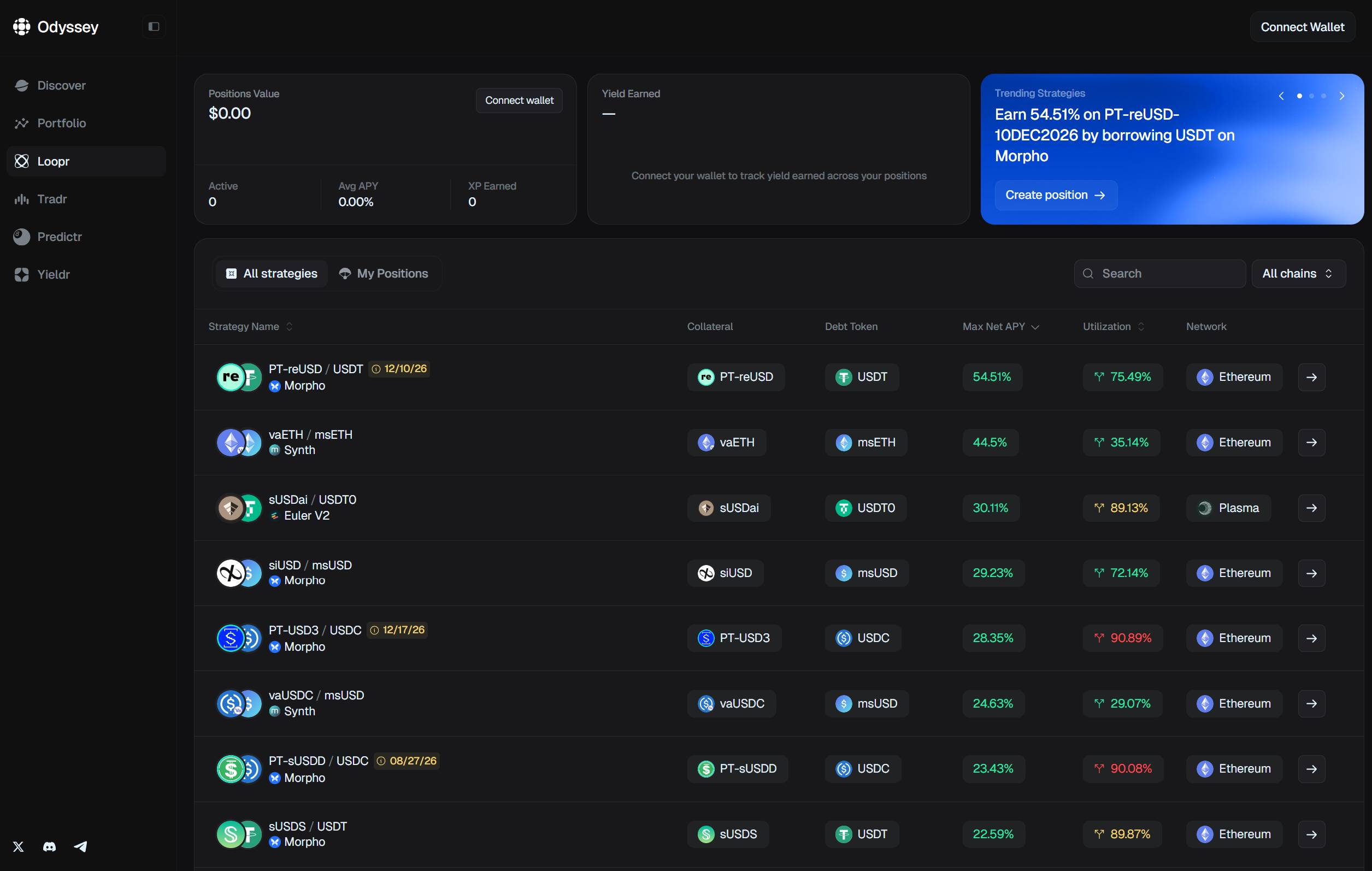
Loopr is Odyssey’s leveraged-yield module. It automates collateral-looping strategies that combine collateral deposits, borrowing and asset redeployment within a bundled workflow. Each Loopr position is isolated within the user’s smart-account environment, allowing strategies with different collateral, debt and risk parameters to be managed separately.
While automation reduces the number of manual steps, collateral looping increases exposure and may significantly increase liquidation risk. Displayed yields can also change as borrowing costs, token prices, liquidity and protocol incentives fluctuate.
Yieldr
Yieldr is Odyssey’s yield-discovery and aggregation module. It provides a unified view of vaults offered by different DeFi protocols and networks.
The module uses ERC-4626-compatible vault structures to standardize how supported products display and manage deposits, vault shares and accrued yield.
Depending on the vault, users may be able to review information such as the supported asset, estimated annual percentage yield and total value locked. These figures are dynamic and should not be interpreted as guaranteed returns.
Tradr
Tradr is Odyssey’s unified decentralized trading interface. It is intended to bring positions from multiple trading venues into a common dashboard, reducing the need to navigate separately between different applications. The product appears to remain under continued development and rollout. Available markets, networks and trading venues may therefore change over time.
Prediction-Market Module
Odyssey also presents prediction-market functionality as part of its wider onchain interface. The module is designed to display event-based markets alongside other decentralized positions.
Availability may depend on local law, age restrictions and the user’s jurisdiction. Prediction markets involve financial risk and may be regulated or prohibited in some countries.
Development Team
Odyssey is led by co-founder and CEO Zane Huffman, also known online as GREEN JEFF. Before leading Odyssey, Huffman worked in DeFi strategy and contributed to projects associated with Vesper Finance and Metronome. He also previously contributed articles to The Block and founded DEMOS.
The broader team behind Odyssey has experience with Vesper and Metronome, a synthetic-asset protocol that plays an important role in some of Odyssey’s leveraged-yield infrastructure. Odyssey has not publicly disclosed complete information about all of its founders and core team members in the materials reviewed for this article.
Investors and Funding
Odyssey has not publicly detailed a major fundraising round in the sources reviewed for this article. Any future funding announcements, token plans or investor disclosures should therefore be verified through official project communications.
Risks to Consider
Odyssey simplifies access to multiple DeFi tools, but it also introduces several layers of dependency. Users may be exposed to risks involving Odyssey’s smart accounts, connected lending protocols, token bridges, vaults, price oracles and third-party trading infrastructure. Leveraged-yield strategies may amplify both returns and losses. A decline in collateral value, an increase in borrowing costs or a reduction in available liquidity could result in liquidation or loss of capital.
Conclusion: Odyssey is building a unified DeFi interface around ERC-4337 smart accounts, with products covering leveraged yield, vault aggregation and decentralized trading. Its Account Abstraction architecture can reduce transaction complexity, but it does not remove the financial and technical risks of the underlying protocols. The project’s long-term value will depend on the reliability of its smart-account infrastructure, the quality of its integrations and the transparency of its risk controls.
Sources
- Ethereum Improvement Proposals — ERC-4337: Account Abstraction Using an Alternative Mempool
- Messari — Odyssey Finance: A Multichain DeFi Hub Built on ERC-4337