
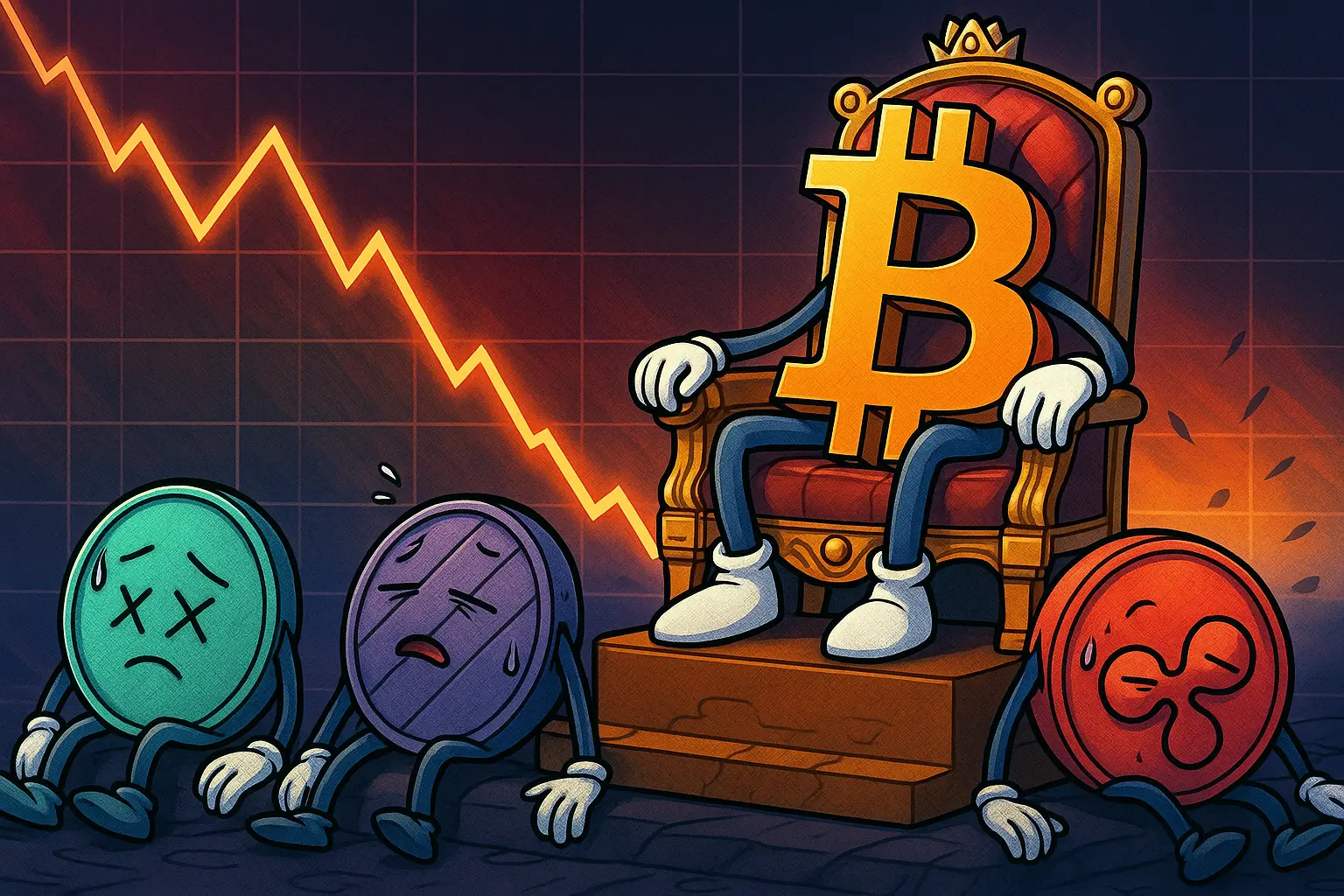
ETFs Changed the Crypto Cycle
In earlier cycles, Bitcoin usually rallied after a halving, reached a new high and then passed momentum to the rest of the market. This time, Bitcoin broke its previous record before the April 2024 halving, helped by the launch of US spot ETFs and the arrival of institutional capital.
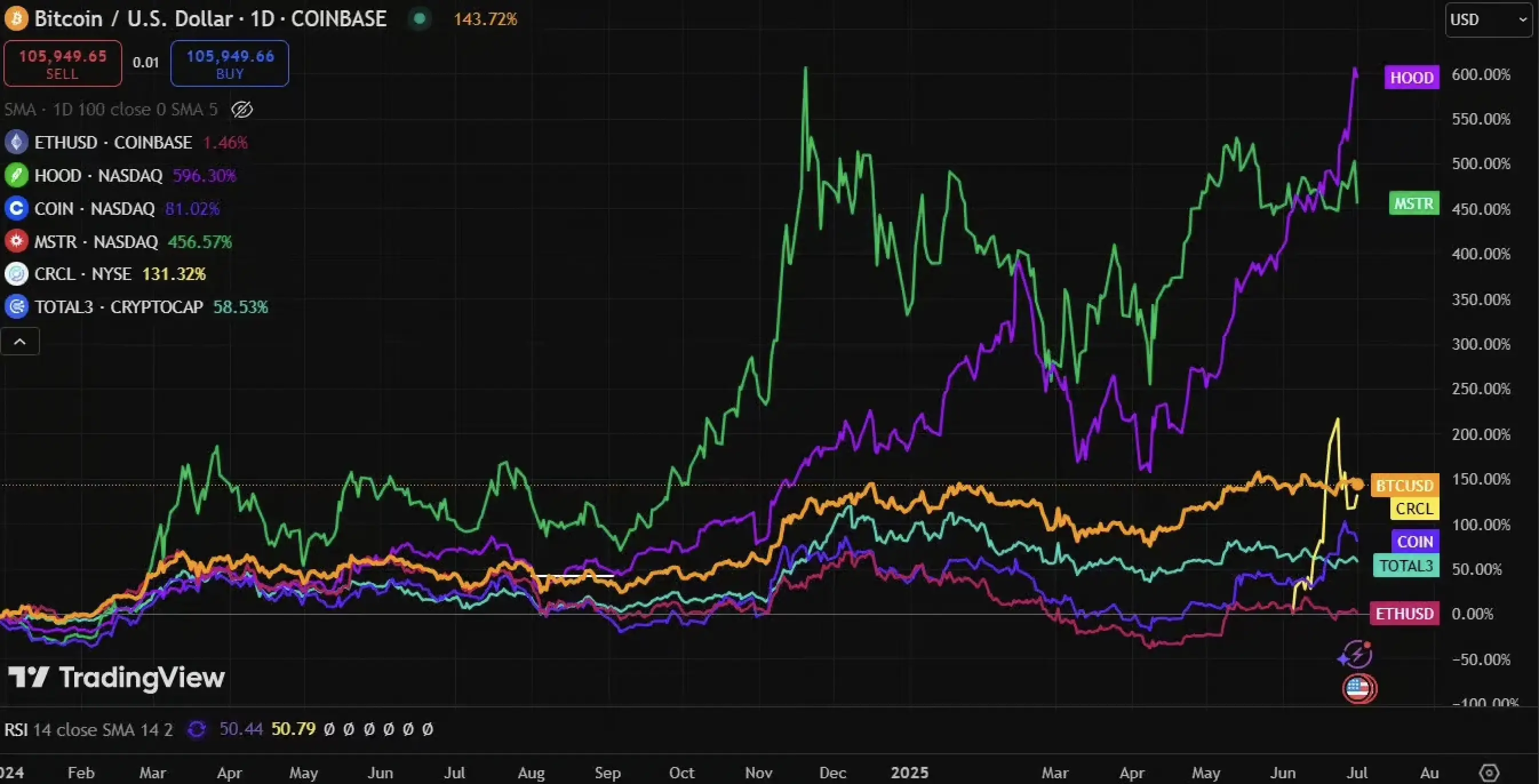
That capital has not spread evenly. Traditional investors can now buy Bitcoin and Ethereum through regulated funds, while companies such as Coinbase, Robinhood and Circle provide indirect exposure to the crypto industry through public markets.
Most altcoins remain outside that system. They have no ETFs, limited institutional custody and much thinner liquidity. Access has become one of the clearest dividing lines in the market.
The change is also visible in Bitcoin’s increasingly institutional market structure. TOTAL3, which tracks the crypto market excluding Bitcoin and Ethereum, has lagged badly even as BTC and several crypto stocks delivered strong gains.
Retail Investors Are More Cautious
The days when investors could buy almost any altcoin after a Bitcoin breakout and expect quick gains appear to be fading. Retail traders have suffered repeated losses, while trust in many new token launches has weakened.
A large part of the problem comes from token structure. Many projects enter the market with a small circulating supply and a much larger fully diluted valuation. Early investors and project teams may hold substantial allocations that are released gradually.
- Low float and high FDV: a small circulating supply can make a token look cheaper than it really is.
- Token unlocks: new supply from teams and early investors can create steady selling pressure.
- Weak transparency: vesting schedules and treasury spending are not always easy to understand.
- Thin liquidity: relatively small trades can cause sharp price swings.
These problems do not make every altcoin a bad investment, but they make it much harder to separate strong projects from tokens built mainly around early valuations and limited supply.
The market’s weak response to positive news is already visible. Even regulated products and major platform integrations failed to trigger an immediate rally in Solana and Arbitrum.
Why Strong Altcoins Also Suffer
The market increasingly resembles the economic idea of a “market for lemons.” When investors cannot easily judge quality, they begin to distrust the entire sector.
As a result, projects with real users and working technology often trade under the same pressure as weaker tokens. Some investors move back into Bitcoin, where supply and liquidity are easier to understand. Others choose memecoins, where speculation is obvious and nobody pretends that fundamentals drive the price.
Infrastructure and governance tokens are left somewhere in the middle: too complicated for pure speculation, but still difficult for institutions to buy through regulated channels.
The Next Altcoin Season May Be Smaller and More Selective
Two forces are holding the market back. Retail investors are tired of losses and aggressive token unlocks, while institutions still lack clear and convenient access to most altcoins.
This does not mean another altcoin season is impossible. It does mean that the next one may look very different. Instead of nearly every token rising together, capital is more likely to concentrate in a limited number of assets with strong liquidity, clearer legal status and genuine network activity.
Regulation Could Open New Doors
The US regulatory picture had already started to change by August 2025. President Donald Trump signed the GENIUS Act into law on July 18, creating a federal framework for payment stablecoins.
The law is important for issuers and payment companies, but it does not define the legal status of the wider altcoin market.
The CLARITY Act is more relevant in that respect. The House of Representatives passed the bill on July 17, although it had not yet passed the Senate or become law by August 1.
If adopted, the legislation could clarify the roles of the SEC and CFTC and give crypto companies a clearer route to registration. Dozens of applications for exchange-traded products linked to assets such as Solana, XRP, Litecoin and Dogecoin were also under review.
That could gradually bring more altcoins into regulated markets. Still, approval alone would not guarantee strong inflows or a broad market rally.
What Could Attract Institutional Capital?
Professional investors are unlikely to buy every token simply because regulation improves. They will focus on liquidity, legal risk, governance, token supply and real economic activity.
The strongest interest may centre on:
- stablecoin infrastructure and tokenised real-world assets;
- projects combining blockchain and artificial intelligence;
- established protocols with active users and transparent governance.
Even then, good technology is not enough. Investors will also ask whether the token itself captures value from network growth, fees or adoption.
Final Takeaway
The classic version of altcoin season is becoming less reliable. Institutional money remains concentrated in Bitcoin, Ethereum and listed crypto companies, while thousands of smaller tokens compete for limited liquidity.
Opportunities have not disappeared, but the market is becoming more selective. Projects with real adoption, understandable token economics and access to regulated infrastructure may outperform. Others could remain weak even if Bitcoin continues setting new records.
The old assumption that every Bitcoin rally will eventually lift the entire altcoin market is no longer enough. Investors now have to judge each project on its own merits.
