
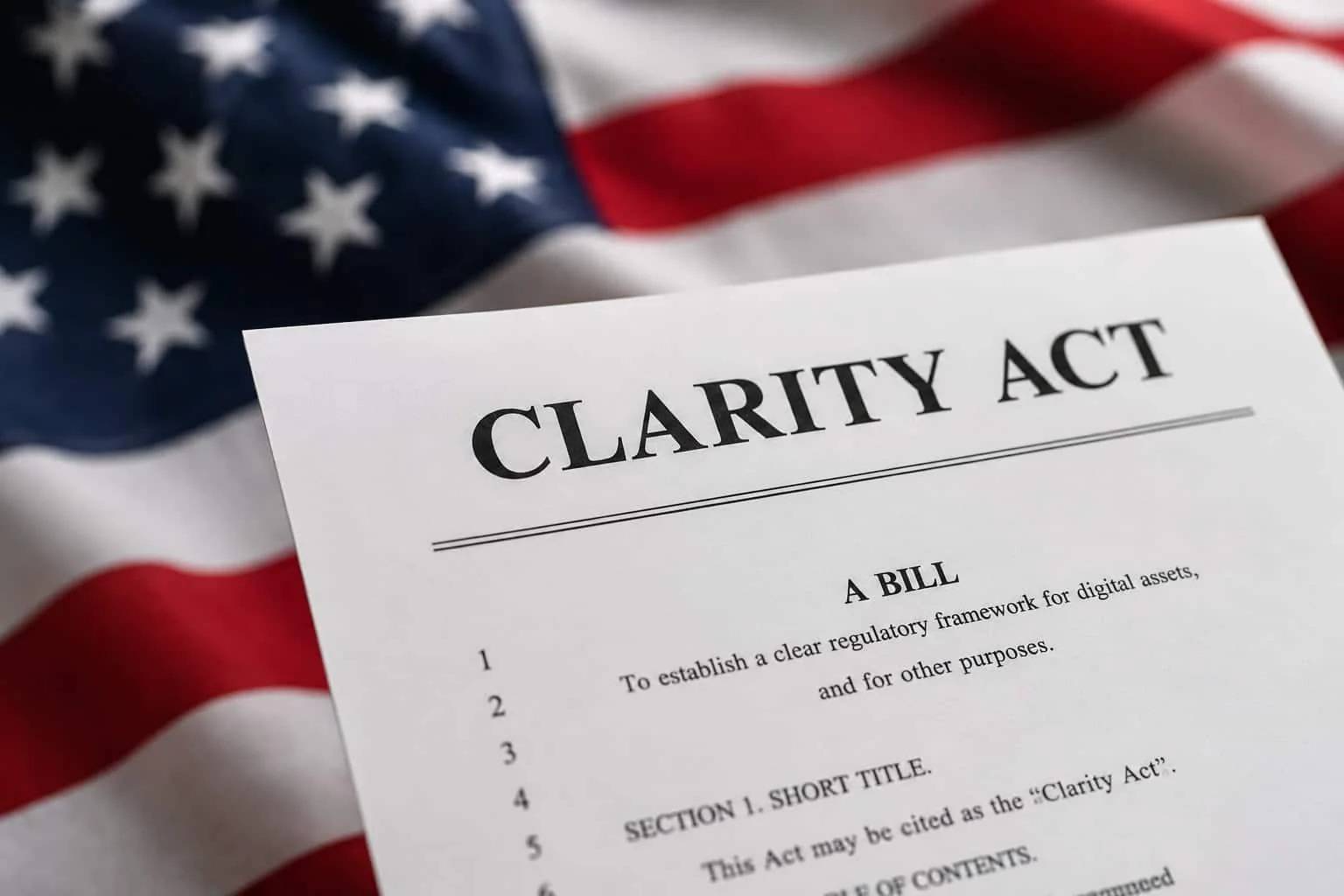
The three Republican senators leading the legislation — Cynthia Lummis, John Boozman and Tim Scott — said the new text incorporates 126 significant changes requested by Democrats, up from 114 changes included in the version released on September 10.
The CLARITY Act is intended to establish a comprehensive regulatory framework for the US crypto market, clarify when a digital asset should be treated as a security or commodity, and define the respective responsibilities of the Securities and Exchange Commission (SEC) and Commodity Futures Trading Commission (CFTC). The Senate proposal builds on the House-approved CLARITY Act.
US President Donald Trump has agreed to approximately 80% of a bipartisan proposal developed by Republican Senator Thom Tillis and Democratic Senator Ruben Gallego, according to a senior Republican aide. The compromise removes one of the largest obstacles to securing Democratic support for the legislation.
Under the revised language, ethics provisions would apply to the president, vice president, members of Congress, federal officials and employees, as well as their spouses. Individuals holding a significant financial interest in a company that issues digital assets would be required to divest that interest or place the assets in an independently managed blind trust. The current text does not impose equivalent restrictions on other family members, including children.
Trump’s latest concession is intended to attract additional votes for the CLARITY Act. The conflict-of-interest issue is particularly significant because the president and his family are closely associated with several crypto projects, including World Liberty Financial, the USD1 stablecoin and the TRUMP memecoin. Trump’s 2025 financial disclosure indicated that he received more than $1.4 billion in income connected to cryptocurrency ventures.
The updated version would also grant additional enforcement authority to state attorneys general. They could sue a crypto exchange that permits trading in a digital asset which a federal official is prohibited from issuing or holding a financial interest in under the conflict-of-interest provisions. The White House had previously opposed this point over concerns that state attorneys general could use their authority against political opponents.
Trump’s concession, however, does not resolve the main remaining dispute between the crypto and banking industries: stablecoin yield. The CLARITY Act would prohibit platforms from paying interest solely for holding a stablecoin, while continuing to allow rewards connected to its use, including payments and transactions.
Banks argue that this distinction is too broad and could allow stablecoins to compete directly with deposits. If customers transfer substantial amounts from bank accounts to obtain stablecoin rewards, banks could lose funding that would otherwise be used to provide loans to households and small businesses.
The revised version also introduces an emergency mechanism. The US Treasury secretary would be authorised to temporarily suspend stablecoin rewards if payment stablecoins trigger a sharp increase in withdrawals from community banks. This authority would remain available for 18 months after the legislation is enacted.
The American Bankers Association (ABA) argues that the current stablecoin-reward provisions remain unclear and could produce conflicting interpretations and subsequent litigation.
Pressure is not coming only from Democrats. Republican senators James Lankford and Mike Rounds have also reportedly raised concerns that some digital assets could compete with bank deposits and weaken the banking sector’s ability to provide credit.
The dispute transformed Congress’s summer recess into a large-scale lobbying campaign. Stand With Crypto said supporters contacted Congress by telephone or email nearly 50,000 times in August, while banking associations sent representatives to meet senators in their home states. Crypto companies and aligned political groups have reportedly committed at least $190 million to political activity ahead of the midterm elections.
In addition to stablecoin rewards and ethics restrictions, the CLARITY Act would modify DeFi rules, narrow the circumstances in which software developers must register as money transmitters and introduce a civil liability safe harbour.
DeFi protocols that are not genuinely decentralised could be required to register with the CFTC and comply with the Bank Secrecy Act (BSA). These requirements would be limited to spot transactions involving digital assets classified as commodities, preventing prediction markets from automatically falling within the same framework. The bill would also impose restrictions on related-party transactions and conflicts of interest while clarifying the application of state consumer-protection laws.
On September 15, the Senate is expected to hold a cloture vote to determine whether the CLARITY Act can formally advance to debate. The measure needs at least 60 votes to overcome this procedural hurdle. Republicans hold 53 Senate seats, meaning that even if every Republican supports the motion, at least seven Democratic or independent votes would still be required. The procedure is explained in the Senate’s official cloture rules.
In May, the Senate Banking Committee advanced its version of the market-structure legislation by a 15–9 vote, with Democratic senators Ruben Gallego and Angela Alsobrooks supporting it. Both warned that their committee votes did not guarantee support when the legislation reached the full Senate.
Even if the CLARITY Act clears the 60-vote threshold on September 15, lawmakers will still be racing against the congressional calendar. The Senate has only about three working weeks before its state work period begins on October 5. Time is even more limited in the House, which is scheduled to work for only four days in September before leaving Washington on September 17.
This makes the legislative process particularly urgent. If the Senate passes an amended version, the House must approve the same text before the legislation can be sent to President Trump for his signature. The midterm elections are scheduled for November 3. Lummis has warned that if Congress fails to pass the legislation during the current session, the next realistic opportunity for comprehensive crypto market-structure legislation may not come until 2030.
FORECK.INFO previously examined why the Senate delay left the legislation facing an increasingly narrow political window.
Trump’s latest concession has nevertheless improved expectations. Following the release of the revised CLARITY Act, the probability of the legislation passing in 2026 rose from approximately 22% to 32% on Polymarket. The prediction market, however, still assigns a higher probability to the bill failing to become law before the end of the year.
