

Balancer reportedly considers winding down after restructuring attempts
According to an unverified draft described as “Orderly Winddown of Balancer and Distribution of the Treasury,” the long-running automated market maker Balancer may consider ending its operations after several restructuring attempts failed to return the project to sustainable growth. As of 15 September 2026, the document could not be found on the official Balancer governance forum or Snapshot, so its terms should be treated as unconfirmed.
Under the reported plan, Balancer would wind down in stages. The remaining treasury assets would then be distributed to BAL holders in proportion to their holdings before the DAO was formally dissolved.
The draft is said to remain at the discussion stage, with a Snapshot vote reportedly planned for 25–29 September 2026. Until an official proposal and vote are published, Balancer continues to operate normally and users do not need to make changes solely on the basis of this report.
The reported author, Marcus Hardt, argues that Balancer has considered closure after repeated restructuring efforts failed to generate enough revenue for long-term operations, particularly following heavy losses from an exploit in November 2025.
Reports about the incident estimated that approximately $116 million in assets was removed from the protocol, including 6,850 osETH, 6,590 WETH, 4,260 wstETH and other tokens. Balancer reportedly said that v3 was not affected because of its different architecture, although the incident still damaged confidence and activity across the protocol.
Balancer Labs, the company that developed the protocol from its early days, was later reported to have dissolved amid financial and legal pressure. The project moved toward a more decentralised structure and introduced cost reductions, halted BAL issuance, simplified tokenomics and redirected protocol revenue to the DAO, hoping Balancer v3 would become a new growth driver.
However, the restructuring reportedly produced limited improvement. Most revenue continued to come from Balancer v2, while v3 did not generate enough income to offset the protocol’s decline.
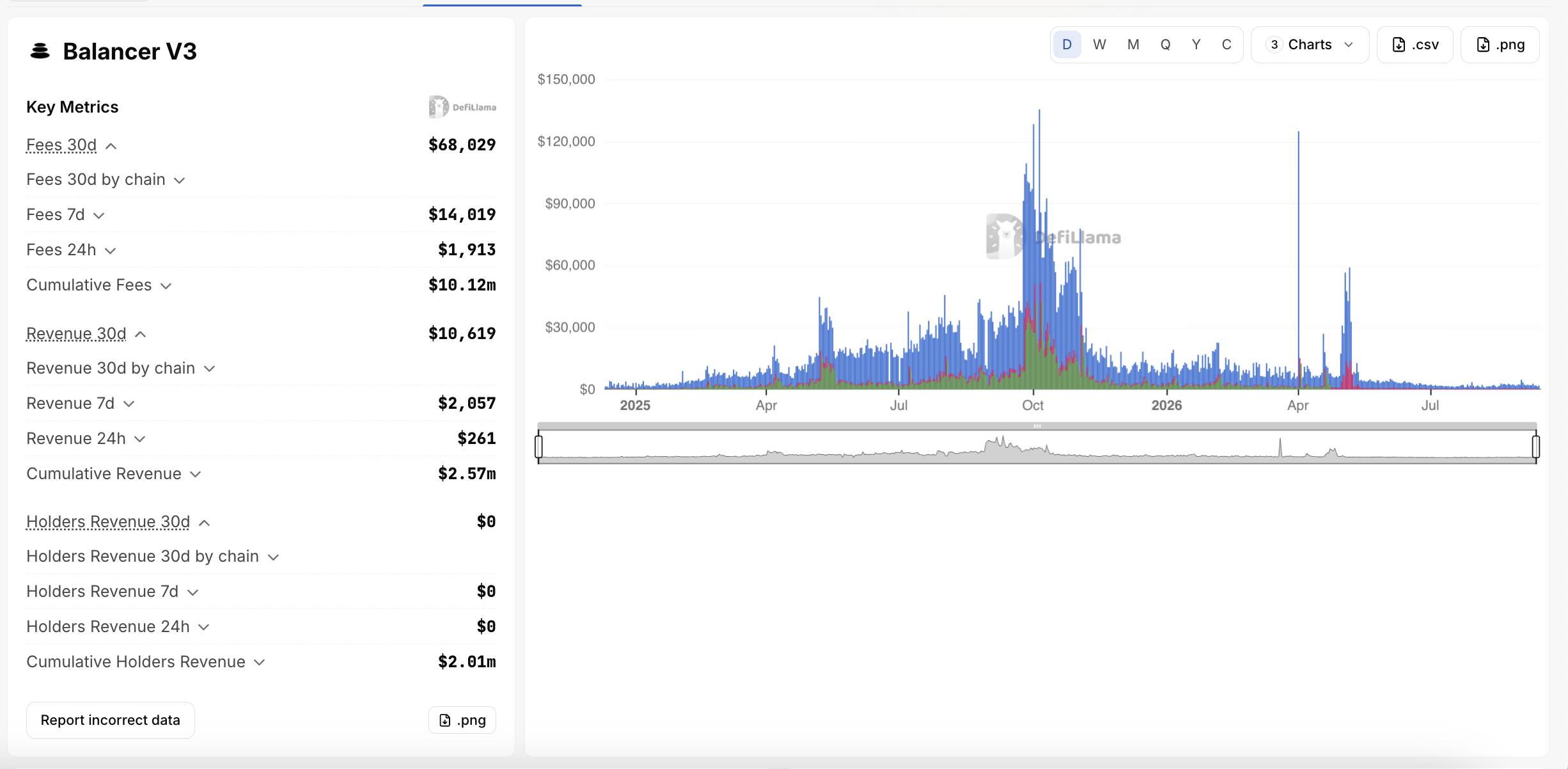
The supplied data attributed to DefiLlama says Balancer’s total value locked fell from more than $815 million before the exploit to $58.9 million, including approximately $27.43 million in v2 and $25.95 million in v3. These historical snapshots should be checked again immediately before publication because DeFi metrics change continuously.
Over the reported seven-day period, Balancer v2 generated approximately $23,700 in fees and $11,800 in revenue. Balancer v3 generated about $14,000 in weekly fees, while daily revenue was said to be near $2,000.
These figures are far below Balancer’s position during the 2020–2021 DeFi boom, when it ranked among the market’s ten largest protocols by TVL, held billions of dollars in liquidity and served as liquidity infrastructure for projects including Aave, Lido, Gnosis and CoW Protocol.
BAL holders could receive assets in proportion to their holdings
If the reported proposal is formally published and approved, Balancer would not close immediately. Instead, activity would be reduced in stages, giving liquidity providers time to withdraw funds and allowing the DAO to prepare the distribution of its remaining treasury assets.
Balancer would first publish instructions for withdrawing assets directly from smart contracts or through third-party tools. By 30 October 2026, pausable pools would reportedly switch to withdrawal-only mode. Other pools could continue operating, but protocol fees would be set to zero where the smart contracts allow it. Balancer would then maintain only the minimum infrastructure required to support withdrawals and complete its remaining obligations.
The central element of the reported plan is the distribution of the entire treasury to BAL holders. The treasury is currently estimated at no less than $9 million, excluding assets said to be undergoing an inventory across multiple wallets and blockchains.
To receive a proportional share, holders would burn BAL in exchange for assets owned by the DAO. The distribution is reportedly planned in three rounds beginning in late May 2027. The first would last six months, the second would run for the following two months and distribute remaining assets and revenue, and a final distribution would take place about six months later.
The plan would also cancel BIP-919, an earlier proposal that contemplated using treasury assets to buy back BAL.
Liquidity providers would be advised to stop supplying liquidity during the transition, before pools gradually move into withdrawal-only mode at the end of October.
At the same time, the DAO would revoke governance permissions, discontinue the bug bounty programme, shut down infrastructure and dissolve related legal entities. The reported proposal allocates $400,000 to the wind-down: $180,000 for implementation and $220,000 as a contingency reserve. Any unused funds would return to the treasury for distribution to BAL holders.
The final decision would belong to the community
Hardt reportedly argues that the central question is not whether Balancer has enough money to continue operating, but whether the remaining treasury should be returned to BAL holders while it retains meaningful value or spent on a strategy that, in his view, no longer shows a credible path to success.
If the community rejected a formally submitted proposal, Balancer would continue under its existing restructuring plan, including the previously approved DAO budget and the BAL buyback programme contemplated by BIP-919.
The reported proposal comes amid a wider contraction in the crypto industry. FORECK.INFO has also covered the planned CoinEx shutdown, another example of the pressure facing crypto platforms in 2026. BitMEX, Zapper and Loopring have also been cited among projects reducing or ending operations.
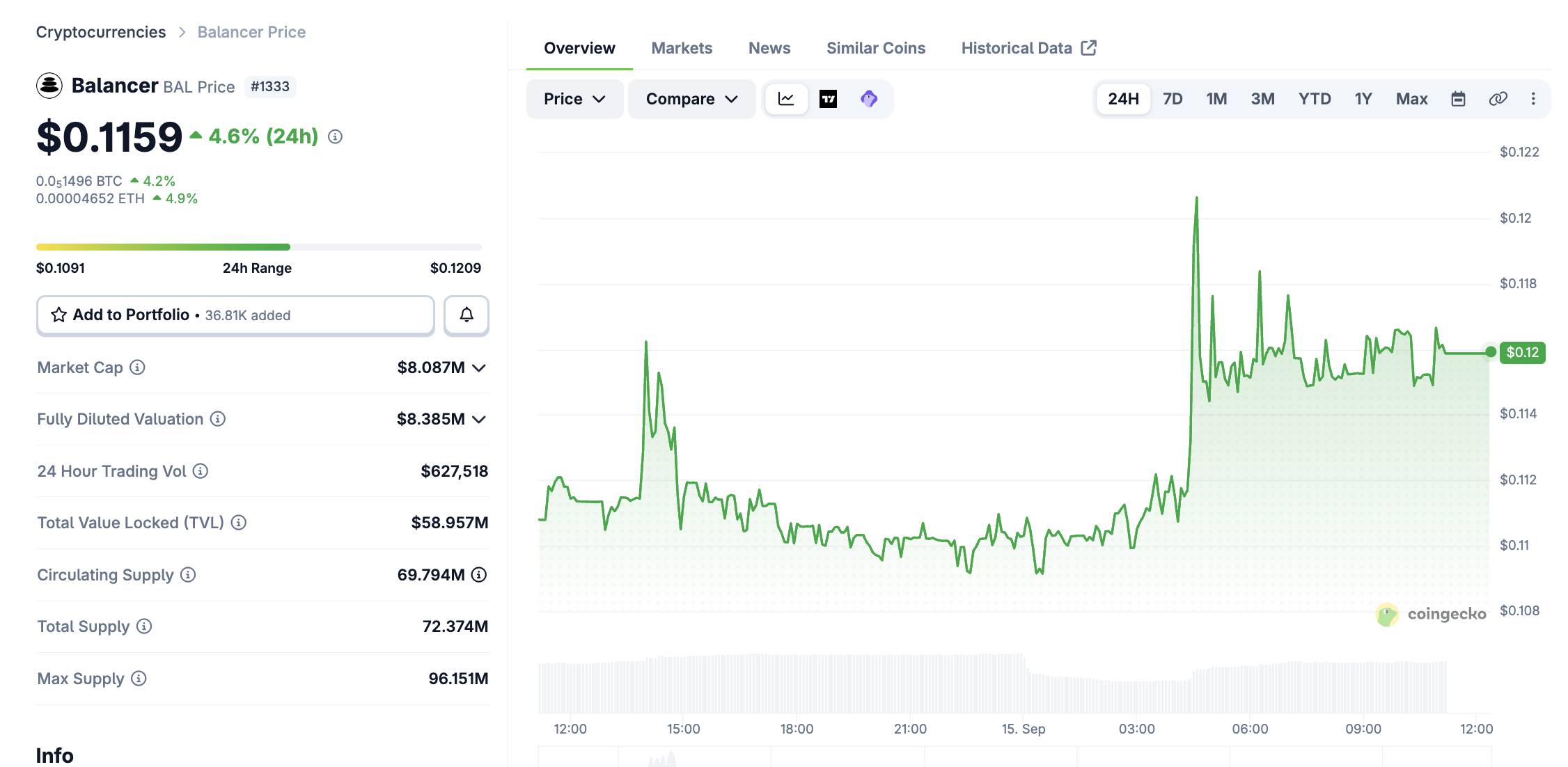
Following the report, BAL was said to have gained more than 4.6% over 24 hours to approximately $0.115. The token nevertheless remained about 98.8% below its reported all-time high of $74.45. Both figures are time-sensitive and should be refreshed at publication.
