
Top Pick

- Fully licensed and regulated US exchange
- Strong focus on security and compliance
- User-friendly interface for beginners

The cryptocurrency market strengthened earlier this week but came under sharp selling pressure on Thursday, erasing much of its previous gains. In the latest market snapshot, Bitcoin (BTC) is trading near 81600.00 (+0.9%), Ethereum (ETH) at 2400.00 (+2.1%), Tether (USDT) at 0.9991 (–0.01%), BNB at 744.00 (+5.1%) and XRP at 1.3250 (+4.8%). Total cryptocurrency market capitalization has declined to approximately $2.73 trillion, while Bitcoin dominance has increased to 60.0%. From October 19 to 22, US spot Bitcoin ETFs recorded net inflows of $439.1 million, while Ethereum ETFs saw outflows of $225.1 million. The market remains volatile despite the recovery attempt discussed in our previous crypto weekly review.

 By Andrew Bennett
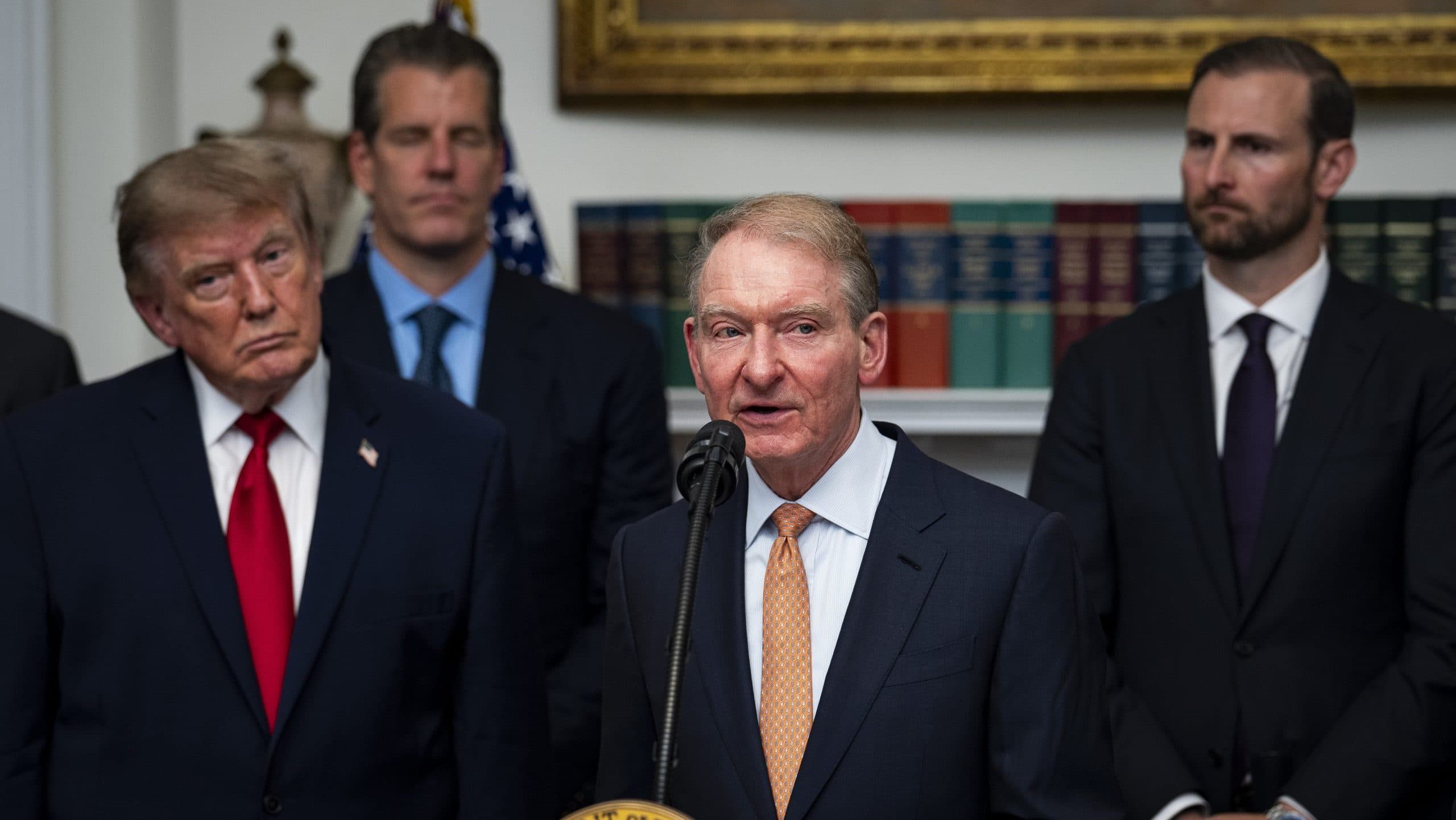
 A landmark moment for the crypto industry: JPMorgan, Circle, Galaxy, and Solana have issued a debt instrument on a public blockchain for the first time.

 By John Isige
 During the current week, the XRP/USD pair continued to develop its downward momentum in line with the broader market trend, testing a five-week low at 1.8554 (Murray level [–1/8]). Bearish sentiment among investors is being reinforced by uncertainty surrounding the future course of US Federal Reserve monetary policy, as well as by expectations of a potential peaceful resolution of the Russia–Ukraine conflict under a Republican White House administration, which is weighing on demand for defensive assets.
 By Andrew Bennett
 Negative sentiment continues to dominate the crypto market. Fear, FUD, and persistent sell-offs are shaping the overall trading backdrop, while Bitcoin—the largest cryptocurrency—has retreated sharply from its highs. Compared with its all-time peak near $126,000, BTC has lost around 28.8% of its value, as macroeconomic uncertainty continues to weigh heavily on risk assets.
 By John Isige
 ETH/USD is developing a medium-term bearish trend while pulling back toward a longer-term uptrend. However, over the past three weeks, price action has mostly consolidated in a sideways range of 3170.00–2765.00 (50.0% Fibonacci retracement; Murray level [–2/8] — 61.8% Fibonacci retracement; Murray level [1/8]) as investors stay cautious amid monetary-policy and geopolitical uncertainty. The pair is currently hovering near the lower boundary of this range, and a sustained break below it could open the way toward 2187.50 (Murray [–1/8]) and 1875.00 (Murray [–2/8]). If price breaks above 3437.50 (Murray [3/8]), a bullish breakout from the descending channel becomes more likely, with upside targets at 4062.50 (Murray [–5/8], 23.6% Fibonacci retracement) and 4687.50 (Murray [7/8]).
 By John Isige
 Bitcoin Price Forecast: Could a Carry Trade Unwind Trigger Another Major Drop?
 By John Isige
 Bitcoin has once again moved deep into negative territory, while overall market sentiment has fallen to extreme lows.
 By John Isige
 Since the end of last month, the BTC/USD pair has been trading mostly within a sideways range of 93,750.00–87,500.00 (Murray level [3/8]–Murray level [2/8]). Last week, prices reached the upper boundary of this range amid monetary policy easing by the U.S. Federal Reserve.
 By John Isige
 Since mid-September, investors have withdrawn Bitcoin worth around $17 billion from cryptocurrency exchanges. What does this mean for the BTC rate?
 By John Isige
 In the wild crypto year of 2024, Dogecoin, Bonk and similar tokens made many investors rich — until the crash came. According to one expert, there is no way back.
 By John Isige
 The Bitcoin price is holding near $90,700 today, down about 0.2% over the past 24 hours. Ethereum (ETH/USD) trades around $3,190 (+0.1%), while XRP has edged up to $2.04, gaining roughly 0.25%.
 By Andrew Bennett
 U.S. lawmakers have formally urged the Securities and Exchange Commission (SEC) to allow Bitcoin and digital assets to be included in 401(k) retirement plans. In a letter dated December 11, members of the House Financial Services Committee asked SEC Chair Paul Atkins to take the necessary steps. The initiative supports President Donald Trump’s August 2025 executive order instructing regulators to modernize retirement investment rules. If implemented, these changes could open trillions of dollars in retirement capital to alternative assets.
 By John Isige
 This week, the cryptocurrency market attempted to move higher on the back of monetary support, but a number of leading assets have since returned to a corrective phase. Bitcoin (BTC) is trading near 92,500.00 (+2.4%), Ethereum (ETH) around 3,260.00 (+5.7%), USDT near 1.0002 (–0.01%), XRP at 2.0300 (–0.7%), and BNB around 890.00 (–0.6%). Total market capitalization stands at $3.14 trillion, with Bitcoin dominance at 58.7%. At the same time, Bitcoin ETF balances declined by $237.5 million, while Ethereum ETFs saw outflows of $233.9 million.


For crypto, the framework is similar to traditional financial markets but comes with its own twist. Here, price action turns on liquidity, adoption, regulation, and flows from institutions alongside retail sentiment. Network health—hash rate, staking, active wallets—adds another layer. Macro still matters too: rates, dollar strength, and risk appetite shape inflows and outflows. Then, as with any market, you use the chart—trend, support and resistance, momentum, and volume—to spot setups and manage risk.