
New scaling technologies are set to fundamentally reshape Ethereum. Vitalik Buterin says the blockchain trilemma is effectively solved — with a roadmap stretching toward 2030.
Ethereum co-founder Vitalik Buterin argues that the long-debated blockchain trilemma has been solved from a technical standpoint. In his view, a new wave of scaling and privacy technologies puts Ethereum in a position to deliver strong security, meaningful decentralization, and far higher data throughput at the same time. Still, Buterin urges patience: bringing this architecture to a fully secure, production-hardened state will take years and likely extend beyond the current decade.
A new architecture is redefining Ethereum’s capabilities
In a post on X, Buterin said the combination of Zero-Knowledge Virtual Machines (ZK-EVMs) and PeerDAS has already changed Ethereum’s technical foundation in a major way. This is not an incremental upgrade — it is a structural redesign of how the network can scale.
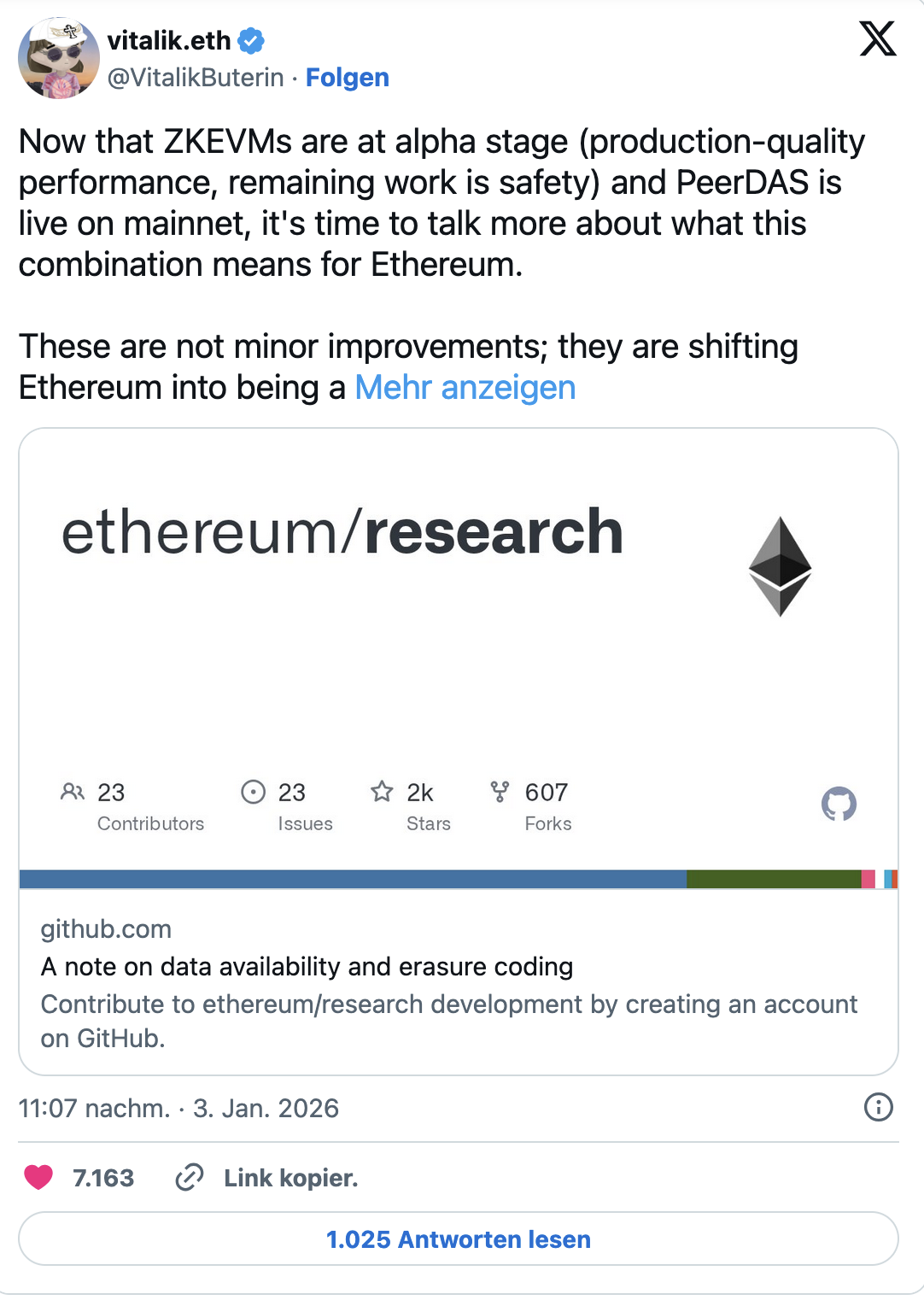
ZK-EVMs make it possible to cryptographically verify transactions and smart contracts without revealing all underlying data. PeerDAS, in turn, improves how large amounts of data are distributed and sampled across the network. Together, these technologies can significantly raise Ethereum’s data capacity without sacrificing the security guarantees of a decentralized ledger.
Buterin describes the direction as a kind of “BitTorrent with consensus”. In other words, Ethereum could eventually handle data volumes comparable to large file-sharing networks while still maintaining a global consensus mechanism. That is where he sees the practical resolution of the blockchain trilemma.
The trilemma is “solved,” but not fully hardened yet
Despite the progress, Buterin adds an important caveat. While the trilemma may be solved technically — not just in theory — the new architecture is not yet fully mature from a security perspective. Some components are already live on mainnet, while others work in production environments but still require extensive hardening and long-term testing.
By current estimates, ZK-EVMs may only become the dominant method for block validation in the 2027–2030 window. Only then could Ethereum validate transactions faster and cheaper without fully exposing base data. Until that point, the network remains in a transitional phase.
Step-by-step scaling instead of a sudden model shift
Ethereum is not planning a radical overnight change. Instead, the roadmap prioritizes gradual upgrades. In the near term, developers expect an increase in the gas limit. This becomes more feasible with newer protocols that separate the roles of transaction proposing and block building, allowing the workload per block to be distributed more efficiently.
Longer term, Ethereum is moving toward distributed block building, where no single actor assembles an entire block end-to-end. Instead, blocks could be constructed through multiple processes distributed across regions. The goal is to reduce censorship risk and spread operational load more evenly across the network.
Buterin frames this as an ideal end state. Even if it is not immediately required, Ethereum should be technically capable of supporting such a mode when needed.
Competitive pressure continues to intensify
This shift is unfolding amid rising competition. Faster and cheaper blockchains keep pressuring Ethereum to deliver scaling improvements sooner. Developers face a familiar tradeoff: pushing ambitious engineering goals while preserving stability and security.
Buterin’s tone is less celebratory than pragmatic. Ethereum now has the tools to overcome the trilemma — but how quickly the vision becomes reality depends on years of engineering work and careful implementation.
What the technological leap means for Ethereum
Ethereum is approaching a deep structural transformation. The combination of ZK-EVMs and next-generation data distribution raises the network’s technical ceiling and addresses one of blockchain’s core limitations. At the same time, Buterin stresses that true, high-security scaling takes time. The trilemma may be solved — but the path to a fully realized architecture is still long.