
In particular, a new round of U.S.–Iran talks on the “nuclear deal” is set to take place today in Geneva. Earlier statements by U.S. President Donald Trump about potentially “very serious” consequences for the Islamic Republic if no consensus is reached, as well as reports that the White House is considering limited military strikes on infrastructure to increase pressure on Tehran, continue to fuel market uncertainty. At present, U.S. armed forces are expanding their military presence in the Middle East — described by experts as the largest in decades — including guided-missile destroyers designed for air and missile defense. It appears unlikely that Washington would limit its response to new economic sanctions alone, leaving investors notably cautious.
At the same time, market participants are closely watching shifting monetary policy expectations amid incoming data and the broader external environment. According to the CME FedWatch Tool, the probability of a U.S. rate cut in June has fallen to 40.0% from 50.0% a week earlier, while mid-summer is now viewed as the most likely window for the first easing move, with odds of around 65.0%. Chicago Fed President Austan Goolsbee recently noted that the Federal Reserve could return to a dovish stance by year-end if inflation continues to move steadily toward the 2.0% target, but warned that policymakers should not rely on productivity gains to offset adverse price pressures — a key argument previously raised by Kevin Warsh, a candidate for Fed chair. Similar views were expressed by Boston and Richmond Fed Presidents Susan Collins and Thomas Barkin, who agreed that clear macroeconomic signals are required before adjusting interest rates.
Meanwhile, the February economic expectations index from the Centre for European Economic Research (ZEW) jumped sharply to 9.8 points from –4.7 in January, pointing to improved business sentiment. However, analysts say the data provided only limited support to the Swiss franc, as markets remain focused on persistent risks to the global economy and the monetary policy stance of the Swiss National Bank. SNB Chairman Martin Schlegel previously stated that officials are prepared to tolerate isolated months of negative inflation and do not view this as alarming, as the bank focuses on the medium-term outlook and expects inflation to accelerate in the coming quarters. He also did not rule out foreign exchange interventions if necessary. On Friday at 10:00 (GMT+2), Switzerland will publish fourth-quarter GDP data — a key indicator of economic health — and stronger annual growth from the previous 0.5% would support the franc.
Support and Resistance Levels
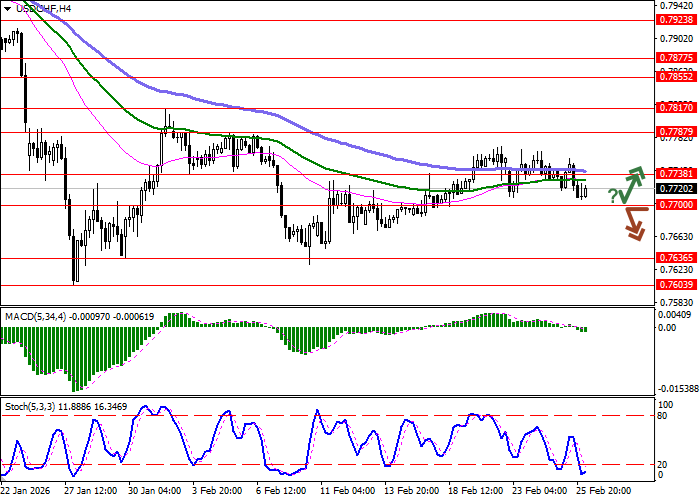
On the daily chart, Bollinger Bands are trending lower, while the price range is narrowing, reflecting mixed trading dynamics in the near term. The MACD maintains a weak buy signal, remaining above its signal line. The Stochastic oscillator continues to point to a fully bearish trend in the very short term.
Resistance levels: 0.7738, 0.7787, 0.7817, 0.7855.
Support levels: 0.7700, 0.7636, 0.7603, 0.7560.
Trading Scenarios and USD/CHF Forecast
Short positions can be opened after a firm break below the 0.7700 level, targeting 0.7636. Stop loss — 0.7738. Time horizon: 1–2 days.
A rebound from the 0.7700 support level followed by a breakout above 0.7738 could signal new long positions, with a target at 0.7817. Stop loss — 0.7700.
Scenario
| Timeframe | Intraday |
| Recommendation | SELL STOP |
| Entry Point | 0.7695 |
| Take Profit | 0.7636 |
| Stop Loss | 0.7738 |
| Key Levels | 0.7560, 0.7603, 0.7636, 0.7700, 0.7738, 0.7787, 0.7817, 0.7855 |
Alternative Scenario
| Recommendation | BUY STOP |
| Entry Point | 0.7740 |
| Take Profit | 0.7817 |
| Stop Loss | 0.7700 |
| Key Levels | 0.7560, 0.7603, 0.7636, 0.7700, 0.7738, 0.7787, 0.7817, 0.7855 |