
More than 120 crypto projects have shut down, filed for bankruptcy or effectively disappeared in 2026, putting the digital asset industry through one of its broadest consolidation waves in years.
122 Crypto Projects Listed by RootData in 2026
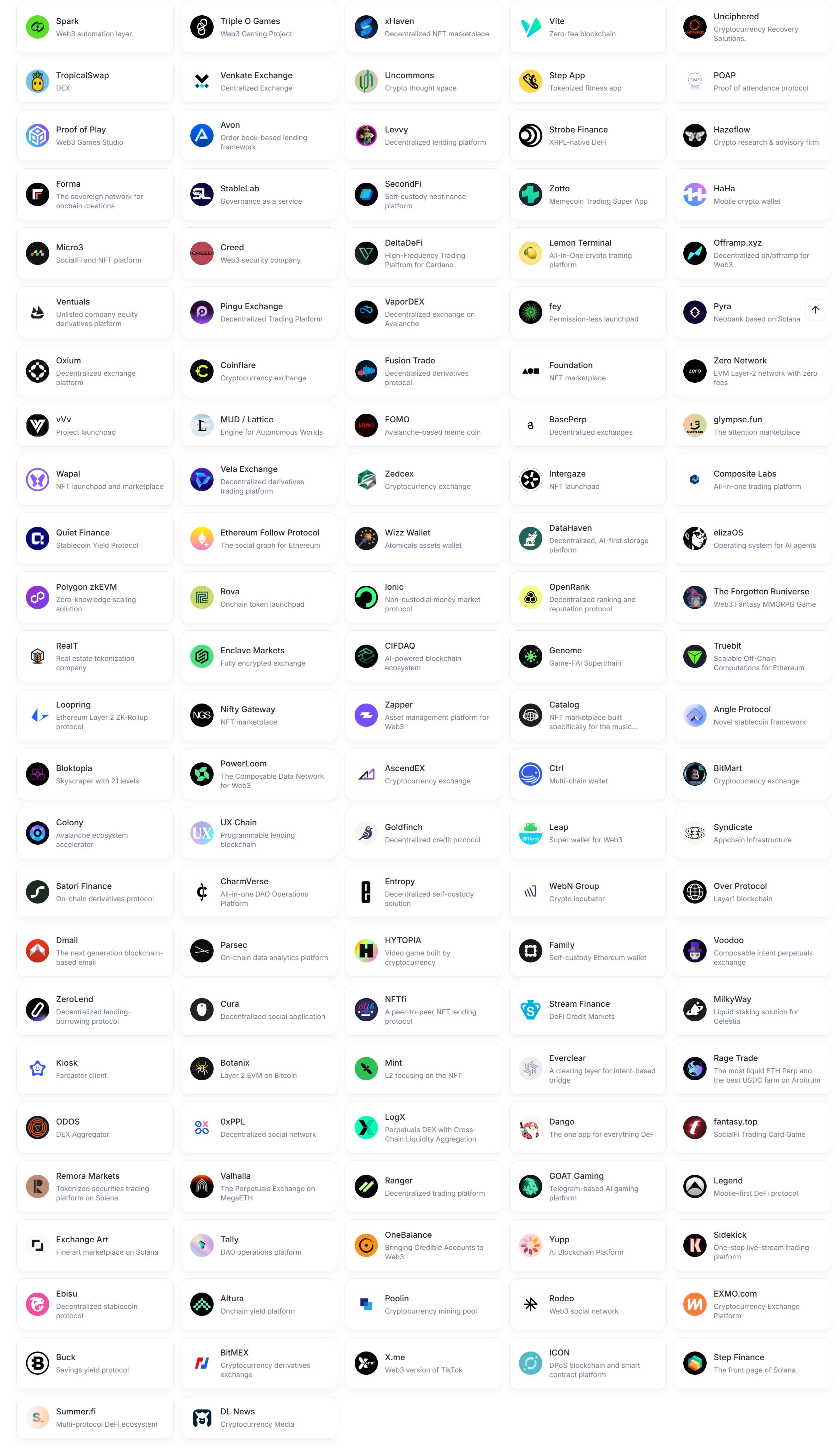
As of August 10, 2026, RootData's Crypto Dead Projects List included 122 projects across exchanges, DeFi, blockchain infrastructure, wallets, NFT platforms and other crypto sectors. The list covers different outcomes, including shutdowns, wind-downs and discontinued projects, so inclusion does not necessarily mean that every company ceased all operations on the same date.
- Spark
- Triple O Games
- xHaven
- Vite
- Unciphered
- TropicalSwap
- Venkate Exchange
- Uncommons
- Step App
- POAP
- Proof of Play
- Avon
- Levvy
- Strobe Finance
- Hazeflow
- Forma
- StableLab
- SecondFi
- Zotto
- HaHa
- Micro3
- Creed
- DeltaDeFi
- Lemon Terminal
- Offramp.xyz
- Ventuals
- Pingu Exchange
- VaporDEX
- fey
- Pyra
- Oxium
- Coinflare
- Fusion Trade
- Foundation
- Zero Network
- VVV
- MUD / Lattice
- FOMO
- BasePerp
- glympse.fun
- Wapal
- Vela Exchange
- Zedcex
- Intergaze
- Composite Labs
- Quiet Finance
- Ethereum Follow Protocol
- Wizz Wallet
- DataHaven
- elizaOS
- Polygon zkEVM
- Rova
- Ionic
- OpenRank
- The Forgotten Runiverse
- RealT
- Enclave Markets
- CIFDAQ
- Genome
- Truebit
- Loopring
- Nifty Gateway
- Zapper
- Catalog
- Angle Protocol
- Bloktopia
- PowerLoom
- AscendEX
- Ctrl
- BitMart
- Colony
- UX Chain
- Goldfinch
- Leap
- Syndicate
- Satori Finance
- CharmVerse
- Entropy
- WebN Group
- Over Protocol
- Dmail
- Parsec
- HYTOPIA
- Family
- Voodoo
- ZeroLend
- Cura
- NFTfi
- Stream Finance
- MilkyWay
- Kiosk
- Botanix
- Mint
- Everclear
- Rage Trade
- ODOS
- 0xPPL
- LogX
- Dango
- fantasy.top
- Remora Markets
- Valhalla
- Ranger
- GOAT Gaming
- Legend
- Exchange Art
- Tally
- OneBalance
- Yupp
- Sidekick
- Ebisu
- Altura
- Poolin
- Rodeo
- EXMO.com
- Buck
- BitMEX
- X.me
- ICON
- Step Finance
- Summer.fi
- DL News
The final weeks of July highlighted how broad the pressure has become. Crypto Exchanges BitMEX announced that its exchange will close on September 23, 2026, following a strategic review. BitMart began an orderly wind-down on July 26, with trading scheduled to end on August 26 and the platform expected to formally cease operations on January 31, 2027. Movement Labs, meanwhile, filed for Chapter 11 bankruptcy protection. Storj Labs also entered Chapter 11, although its case is materially different: the company says its network and services continue operating while it restructures legacy liabilities.
BitMart said it made its decision after evaluating its operating conditions, market environment and future strategic direction. Its BMX token fell sharply following the announcement, dropping roughly 58% over 24 hours according to market data reported at the time.
After years in which crypto companies could expand through venture capital, token issuance and aggressive incentive programs, the industry is being forced back toward more traditional measures of business sustainability. Projects increasingly need to demonstrate that they can retain users and generate enough revenue to support their operations.
Coin Bureau founder Nick Puckrin has suggested that publicly announced closures may represent only part of the picture, arguing that for every project whose shutdown becomes public, several others may be quietly heading in the same direction. He described the process as a possible form of creative destruction ahead of the industry's next cycle.
Ethereum Layer-2 Networks Face Consolidation
Ethereum layer-2 networks are one of the clearest examples of how quickly supply can outgrow actual demand. As rollup technology became cheaper and easier to deploy between 2023 and 2025, the number of new networks expanded rapidly. But attracting developers, liquidity and long-term users proved much harder than launching the chains themselves.
Ben Fisch, CEO and co-founder of Espresso Systems, has argued that the problem is not layer-2 technology as a whole but the proliferation of general-purpose chains attempting to offer very similar products. In his view, the sector is now consolidating around networks that have clearer use cases and sustainable demand.
Moonbeam illustrates that transition, although describing the entire project as simply “dead” would be misleading. Its Polkadot parachain ended operations on July 31, 2026, as Moonbeam began transitioning to a new deployment on Base. Users and ecosystem projects were given a migration window to move assets before the Polkadot-based network was sunset.
The oversupply of chains, however, is only part of the problem. A deeper weakness lies in the financial models many crypto projects relied on during previous market cycles.
Protocols frequently paid contributors in native tokens, rewarded liquidity with tokens, financed ecosystem development through token incentives and held large portions of their treasuries in their own assets. When token prices were rising, that structure could extend runway and support rapid expansion. When prices declined, the same mechanism worked in reverse: treasury values contracted while salaries, infrastructure costs and other expenses remained.
Users and Volume Do Not Guarantee a Sustainable Business
Tally is a useful example. The DAO governance infrastructure provider supported more than 500 organizations, including Uniswap, Arbitrum and ENS. According to figures reported when its shutdown was announced, the platform processed more than $1 billion in payments and helped support governance involving as much as $80 billion in on-chain value.
Despite that scale, Tally concluded that it had not found a sustainable venture-backed business model around DAO governance tooling and began winding down. The shutdown subsequently prompted discussion within the Uniswap community about maintaining alternative governance infrastructure.
Everclear exposed a similar contradiction: substantial usage does not necessarily translate into sufficient revenue.
The cross-chain settlement protocol reached roughly $500 million in monthly transaction volume but said its solver-based business failed to develop enough commercial depth. Its push toward enterprise partners also took longer than expected, and the project's runway expired before those integrations could generate enough revenue. Everclear subsequently wound down its Foundation and Labs entities.
The broader funding environment has made recovery more difficult. Galaxy Research recorded approximately $4 billion of venture investment across 355 crypto and blockchain deals in the first quarter of 2026. Capital invested fell 50% quarter over quarter, while deal count declined 16%. Only eight new crypto-focused venture funds raised capital during the quarter, the lowest number since Q3 2020.
A separate analysis by Tiger Research and RootData, published by CoinGecko, shows a more nuanced picture. Crypto attracted approximately $13.3 billion during the first half of 2026, but the number of funding rounds fell to 435 — 78% below the 1,978 rounds recorded at the 2022 peak.
Capital has increasingly concentrated in larger, later-stage deals and acquisitions. Payments and stablecoins were among the strongest segments, helped by major transactions including Mastercard's acquisition of stablecoin infrastructure company BVNK for up to $1.8 billion. Mastercard announced the deal in March and completed the acquisition on August 3, 2026.
Security Breaches Can Become a Final Blow
If weak revenue gradually erodes a project's runway, security incidents can turn financial stress into an immediate crisis.
TRM Labs recorded approximately $972 million stolen across 207 crypto hacks and exploits during the first half of 2026. That was less than half the roughly $2.3 billion lost during H1 2025, but the number of incidents more than doubled from 83 to 207, making it the highest six-month incident count in TRM's dataset.
Blockaid separately estimated losses of more than $1 billion and described H1 2026 as the most-hacked half-year on record by number of verified incidents, rather than by total dollar value stolen. Differences between security firms reflect differences in methodology, incident classification and datasets.
TRM's analysis also shows why incident count alone can be misleading. Infrastructure and operational compromises represented only about 15% of incidents but accounted for roughly 76% of the funds stolen. Smart contract exploits were more numerous but generally caused smaller individual losses.
Two April attacks dominated the half-year totals. TRM estimated losses of approximately $285 million from Drift Protocol and $292 million from KelpDAO, or roughly $577 million combined. The firm attributed approximately $643 million — about 66% of all funds stolen during H1 2026 — to North Korea-linked activity.
That environment has made recovering from a major security incident much harder.
Step Finance announced that it was winding down in February after a January security breach drained roughly $40 million from treasury and fee wallets. The Solana-focused platform said attempts to obtain financing or secure an acquisition had failed, leaving it without a viable path forward.
The risk can also survive the project itself.
In July, the Lazy Summer Protocol suffered an exploit of approximately $6.04 million involving its USDC vaults. Post-incident analysis linked part of the attack path to a stale on-chain valuation associated with assets affected by the earlier collapse of Stream Finance in late 2025.
The case highlights what can be described as “zombie protocol” risk: contracts, dependencies and financial positions can remain on-chain after the teams responsible for maintaining the original projects have disappeared or stopped active development.
Which Crypto Projects Are Still Growing?
The projects proving most resilient tend to share several characteristics: active users, recurring demand and revenue that does not depend entirely on appreciation of their own tokens.
Hyperliquid is one example. According to DefiLlama data checked in August 2026, the platform had generated roughly $1.45 billion in cumulative fees, comfortably above the $1 billion threshold it crossed earlier in the year. Its continued fee generation demonstrates the difference between token-driven growth and a product for which users repeatedly pay.
Aave remains another major example. DefiLlama showed approximately $14.9 billion in total value locked as of August 10, 2026, keeping it among the largest DeFi lending protocols despite the difficult market environment.
Ether.fi has also broadened its model beyond liquid restaking. The project now operates a payments and card product alongside its staking and yield businesses. Research published earlier in 2026 estimated that its Cash business had grown to roughly half of protocol revenue, illustrating how some DeFi platforms are trying to diversify away from dependence on a single crypto-native revenue source.
The 2026 shakeout therefore looks different from the collapse of 2022.
That earlier crisis was dominated by a series of interconnected failures involving Terra, Celsius, FTX and other highly leveraged companies and protocols. In 2026, there is no comparable single epicenter.
Instead, the market is going through a broader process of elimination. Undifferentiated networks are being consolidated, startups without sustainable revenue are running out of capital, security failures are proving increasingly difficult to recover from, and business models built primarily around continuous token appreciation are facing a much tougher test.
Sources
- Galaxy Research — Crypto and Blockchain Venture Capital, Q1 2026
- TRM Labs — H1 2026 Crypto Hacks Report
- Storj — Chapter 11 Restructuring Announcement