
After a token generation event, many projects face the same operational challenge: building sufficient market liquidity without surrendering control of treasury assets to a centralized market maker.
Arrakis Finance addresses this problem through non-custodial liquidity management. Instead of operating as a consumer-facing AMM where users swap assets directly, the platform manages liquidity on existing decentralized exchanges on behalf of token issuers.
What Is Arrakis Finance?
Arrakis Finance is a non-custodial onchain market maker designed primarily for token issuers. Project teams deposit their token and a quote asset into a self-custodial vault, select a strategy and define the main operating parameters. Arrakis then manages the liquidity position on supported decentralized exchanges. Its market-making system monitors price, volatility and inventory before submitting rebalance instructions to the vault when adjustments are required.
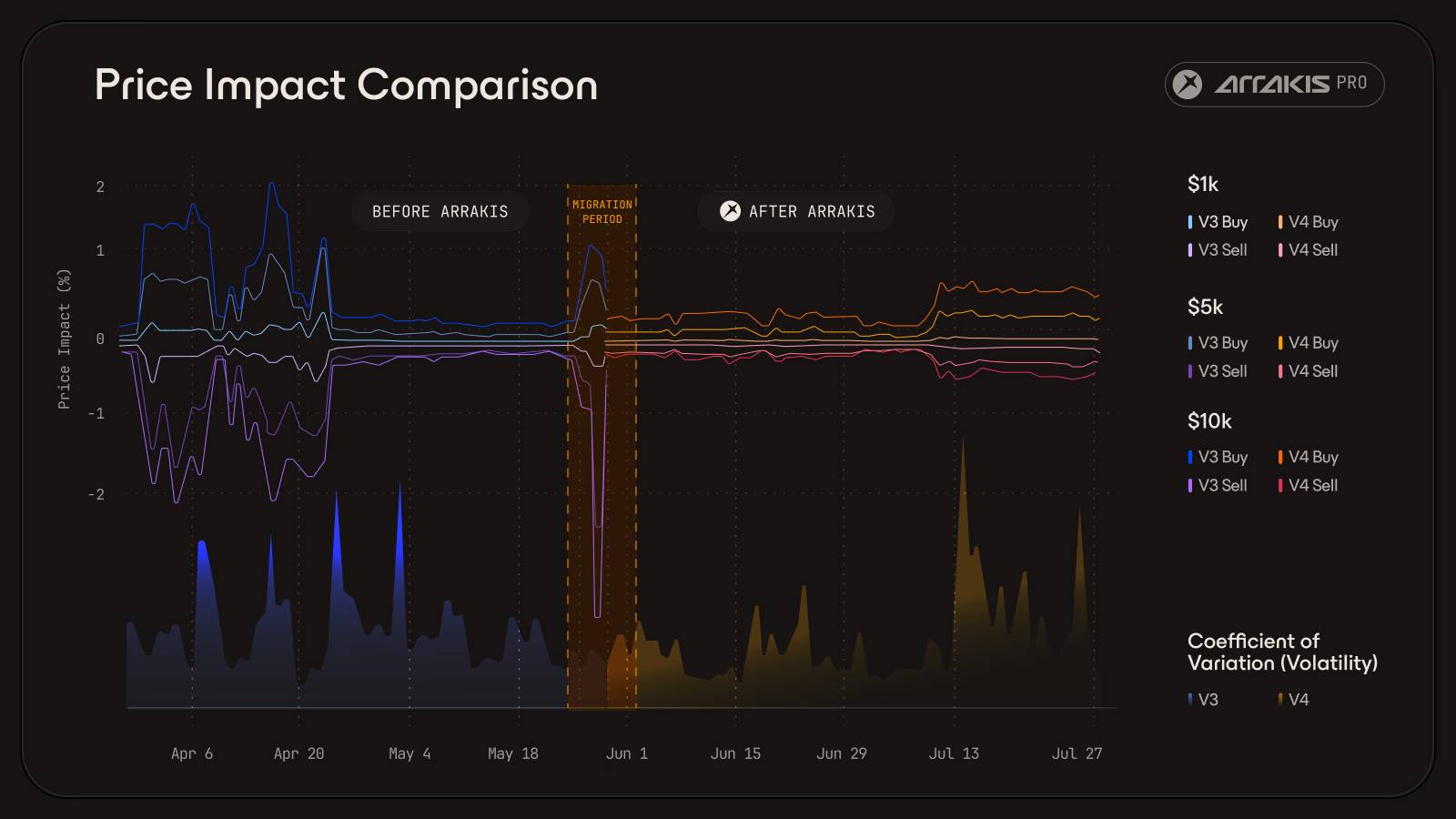
The platform does not guarantee that a token’s price will remain stable. Instead, its purpose is to maintain usable liquidity around the prevailing trading price, reduce price impact and keep concentrated liquidity from moving out of range.
Readers unfamiliar with this market structure can review FORECK.INFO’s guide to how decentralized exchanges and automated market makers work.
How Arrakis Finance Works
A token issuer may be a protocol, company, DAO or development team responsible for creating and distributing a digital asset. After launch, the issuer needs sufficient liquidity so users can buy or sell the token without excessive slippage. Managing concentrated liquidity manually can be demanding. Teams must monitor market conditions, reposition liquidity ranges and manage the balance between their own token and the quote asset, such as ETH or a stablecoin. Arrakis Pro combines self-custodial onchain vaults with an offchain market-making system. The vault holds the assets, while the external system calculates strategy updates and submits them for execution onchain.
On EVM networks, ownership of an Arrakis Pro vault is represented by an NFT. The holder of that NFT controls the underlying assets and can pause the strategy, withdraw funds or approve changes. Updates to certain core vault parameters are subject to a two-day timelock, giving the owner time to review the change or exit.
Key Features of Arrakis Finance
Issuer-Controlled Liquidity
Arrakis uses a non-custodial model. The issuer retains ownership of the assets deposited into the vault rather than transferring them to a conventional centralized market maker. The team can pause management, modify approved parameters or withdraw its assets. However, this does not eliminate smart-contract, market, oracle or strategy risks.
Active Liquidity Management
Concentrated liquidity positions provide greater market depth per dollar of capital than passive full-range positions, but they require regular management. When the market price moves outside the selected range, the position may stop facilitating trades and earning fees. Arrakis monitors market price, volatility and the vault’s inventory distribution. The strategy may then reposition liquidity, adjust its ranges or rebalance the assets according to the selected configuration.
The official documentation does not state that every rebalance is executed through TWAP. The exact execution process depends on the chain, DEX, vault module and strategy being used.
Support for RWAs, Solana and Hyperliquid
Arrakis has expanded beyond conventional crypto project tokens to support yield-bearing assets, tokenized treasuries, commodities, equities and other real-world assets. These markets require a different approach because their reference value may be determined outside the liquidity pool. This broader development is also visible in Uniswap v4 infrastructure for tokenized assets.
On Solana, Arrakis uses the Hadron PropAMM model to make markets through the Jupiter and Titan aggregators rather than using the same vault-and-module architecture deployed on EVM networks. The expansion connects Arrakis with Solana’s growing DeFi ecosystem.
On Hyperliquid, Arrakis supports market making for spot and perpetual markets through a delegated model. The asset issuer supplies the capital, while Arrakis manages execution. This differs from the self-custodial EVM vault structure and should be evaluated under its own operational and counterparty framework.
Arrakis Finance Products
Arrakis Pro
Arrakis Pro is the platform’s main liquidity-management product. It allows token issuers to deploy and manage markets without building an internal quantitative market-making operation. A team selects a supported chain and DEX, deposits its project token together with a quote asset and chooses a strategy that matches the token’s stage of development. The available strategies include Bootstrap for token-heavy inventories at launch, Flagship for more mature markets, Yield-Bearing Asset for tokens whose value increases through an exchange rate, and Treasury Diversification for gradually converting project tokens into quote assets.
Arrakis then manages liquidity ranges, inventory and rebalancing. Trading fees generated by the underlying positions remain part of the vault’s economic performance, subject to the applicable strategy and service terms.
Price Convergence
Price Convergence is a Uniswap v4 hook designed for assets whose value is linked to an external reference. An AMM normally updates its internal price only when users trade. This can create a gap between the pool price and the reference value of a tokenized commodity, treasury product, equity or non-USD stablecoin. During each rebalance, Price Convergence reads the configured reference, updates the pool’s internal price and redeploys liquidity around the corrected level in the same transaction.
The reference may come from an oracle, an onchain net asset value feed or an ERC-4626 vault exchange rate. Price Convergence is not itself an oracle, and its accuracy depends on the reliability of the selected data source and the frequency of rebalancing.
The feature currently requires Uniswap v4 and should not be presented as a standard capability of every Arrakis deployment.
Development Team
Arrakis Finance’s current website does not provide a complete public roster of its leadership team. Historical reporting from 2022 identified Ari Rodriguez and Hilmar Orth as the founders of Arrakis Finance. Rodriguez previously worked as a senior smart-contract engineer at Gelato Network, while Orth was a co-founder of Gelato.
Because team structures can change, their current operational roles should not be assumed without a newer confirmation from the company.
Investors and Funding
Arrakis Finance has previously disclosed external funding. In 2022, the project raised $4 million in a seed round involving Uniswap Labs Ventures, Accel, Polygon Ventures, Robot Ventures and other investors. The round reportedly had no single lead investor and was completed through a simple agreement for future tokens, or SAFT.
Tokenomics
As of July 31, 2026, Arrakis Finance’s current website and official documentation do not identify a live native token, contract address or active token generation schedule. However, it would be inaccurate to state that the project has never considered issuing a token, as its 2022 financing was structured through a SAFT. Until Arrakis publishes a new official announcement, any claims about a future token, ticker, allocation or airdrop should be treated as unconfirmed or historical.
Conclusion
Arrakis Finance is infrastructure for projects that need actively managed onchain liquidity without transferring ownership of their treasury assets to a traditional market maker. Its main advantage is the separation between asset custody and strategy execution: token issuers control the vault, while Arrakis manages liquidity within an agreed framework.
The model can reduce the operational burden of managing concentrated liquidity, but it does not eliminate price volatility, impermanent loss, smart-contract risk or dependence on external price feeds. Projects still need to evaluate each strategy, supported venue and custody model carefully.
Sources
- Arrakis Finance — Arrakis Pro Documentation
- Arrakis Finance — Supported DEXs, Solana and Hyperliquid
- The Block — Arrakis Finance Raises $4 Million