
TermMax is a decentralized fixed-rate lending protocol designed to make borrowing costs and lender returns more predictable than in variable-rate DeFi markets. According to figures released by the project in August 2026, TermMax had expanded across 10 EVM-compatible networks, with more than 60 fixed-rate markets, 40 strategy vaults and 1.5 million registered wallets.
What Is TermMax?
TermMax is a decentralized lending and borrowing protocol that offers fixed rates and defined maturity dates across EVM-compatible networks. Unlike platforms such as Aave and Compound, where borrowing rates change according to liquidity-pool supply and demand, TermMax allows users to establish their rate when a position is opened and keep it until maturity.
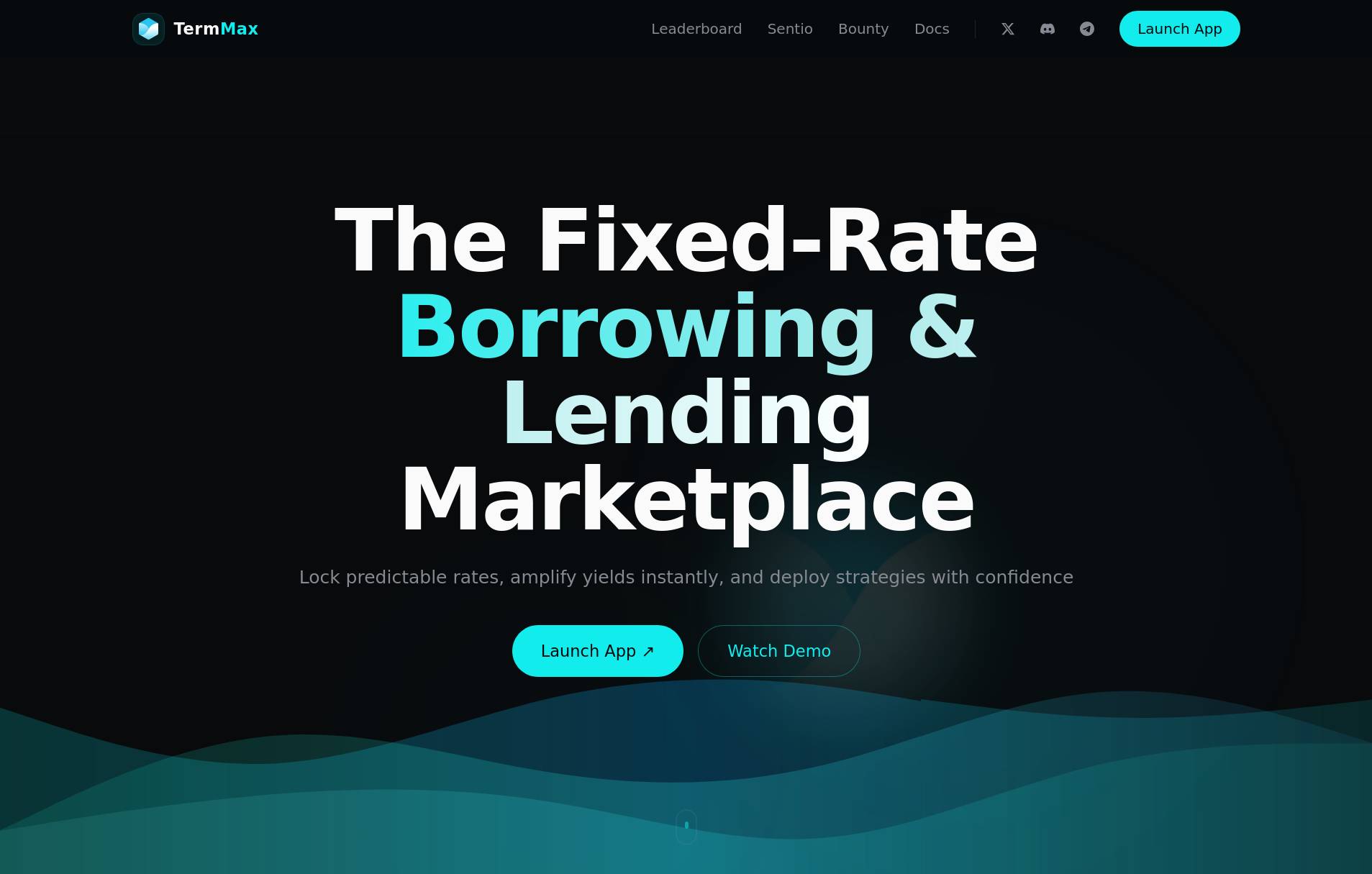
The protocol tokenizes lending positions through three specialized assets: Fixed-Rate Tokens (FT), X Tokens (XT) and Gearing Tokens (GT). This structure converts more complex debt obligations into transferable onchain positions.
TermMax markets and strategy vaults are managed by professional curators rather than relying entirely on automatically adjusted lending pools. Fixed rates reduce uncertainty, although users remain exposed to collateral, liquidity and smart-contract risks.
Key Features of TermMax
Fixed Rates and Known Maturity Dates
When a transaction is executed, its rate and maturity are fixed. Lenders acquire FT at a discount and can redeem the tokens at face value when the market matures. The difference between the purchase price and the redemption value determines the lender’s fixed return.
Borrowers can calculate their repayment costs when opening a position instead of being exposed to changing variable rates throughout the loan term.
Curator-Managed Markets
TermMax uses a curator model under which specialist firms manage strategy vaults and isolated markets. Curators can select markets, allocate liquidity and define target rate ranges based on their strategies and risk assessments.
TermMax has identified Keyrock, Hardcore Labs, Edge Capital and Origami among the organizations operating or developing curated strategies on the protocol.
Improved Capital Efficiency
TermMax V2 introduced Atomic Orders, which allow the same underlying liquidity to be displayed across several markets. The capital can only be used once: when an order is filled in one market, the available amount is updated across the others in the same transaction.
Unmatched capital can also be allocated to selected variable-rate protocols or ERC-4626 vaults. This allows funds to continue generating a base return while waiting for a fixed-rate order to be executed.
Main TermMax Products
Fixed-Rate Lending
Fixed-rate lending is TermMax’s main product. Each market specifies the collateral asset, borrowed asset and maturity date.
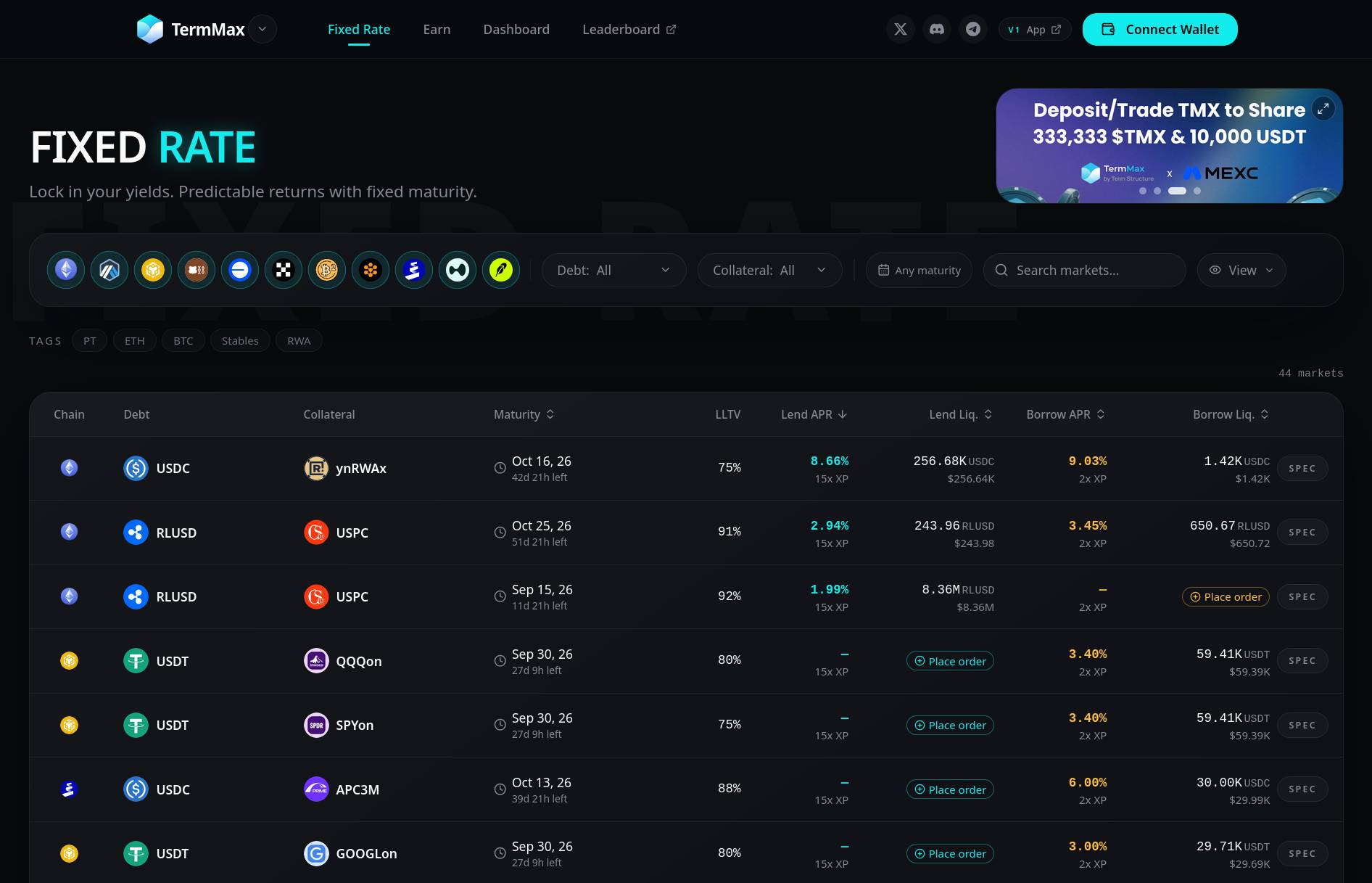
Lenders exchange the debt asset for FT at a discount and redeem each FT for one unit of that asset at maturity. Borrowers deposit collateral into a GT position and use the corresponding XT market to establish the net proceeds and fixed cost of their loan.
The TermMax order aggregator can route transactions across available orders and markets, helping users find suitable rates without manually comparing every position.
Strategy Earn Vaults
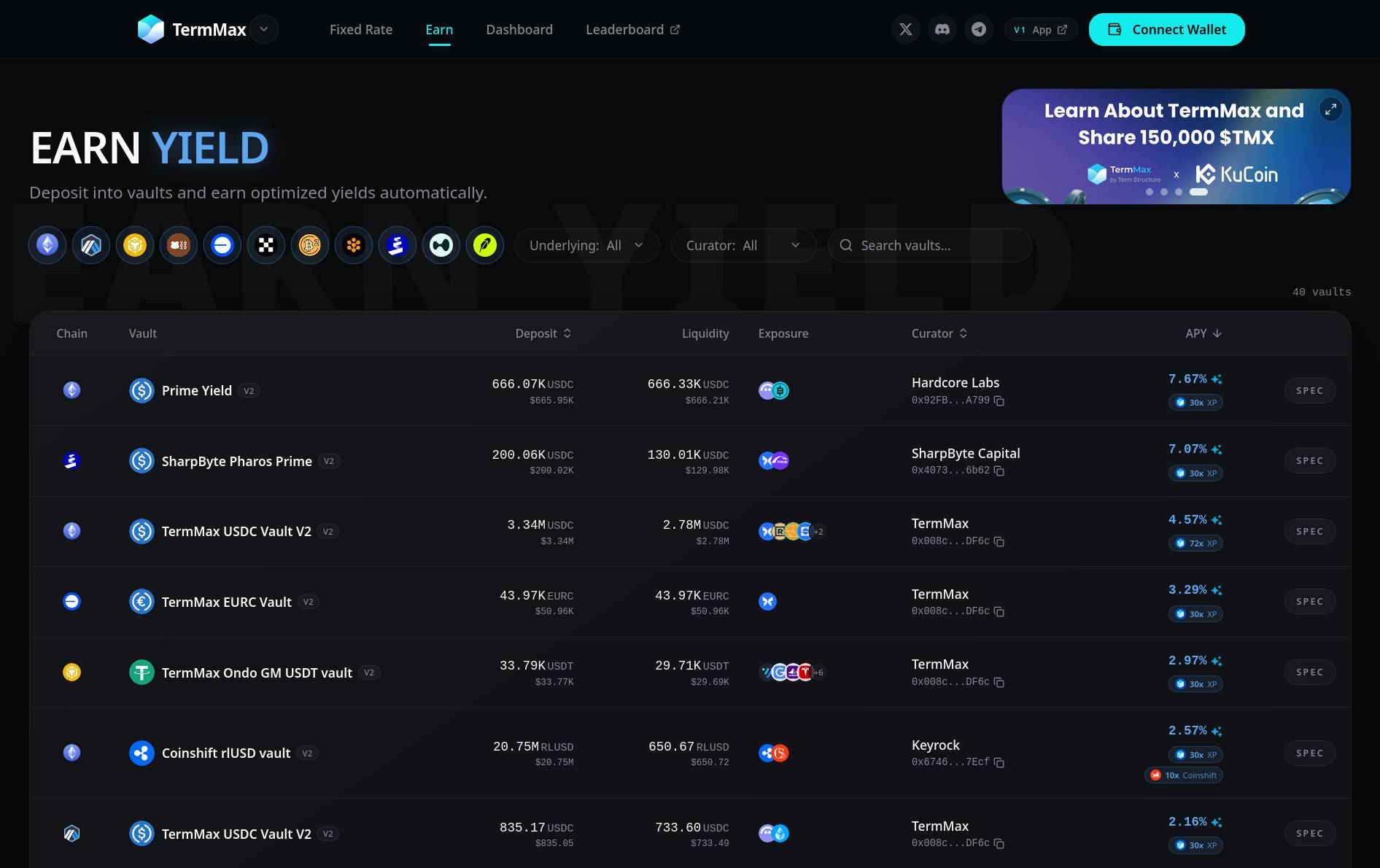
Strategy Earn Vaults allow users to deposit assets into strategies managed by curators. The curator allocates the capital across isolated markets according to the vault’s stated mandate and risk parameters.
TermMax reported operating 40 strategy vaults in August 2026. The product reflects a broader move toward simplified DeFi workflows, also examined in FORECK.INFO’s guide to Odyssey.
TermMax Alpha
TermMax Alpha is an options-style market designed for leveraged exposure with a predetermined cost. Buyers can open call or put positions by paying an upfront premium, which represents their maximum possible loss.
The strike price and expiration date are established when the position is opened. Buyers are not subject to margin calls or forced liquidation before expiry, and supported contracts can use physical delivery when exercised. However, the buyer may lose the entire premium if the option expires without value.
TermPrime
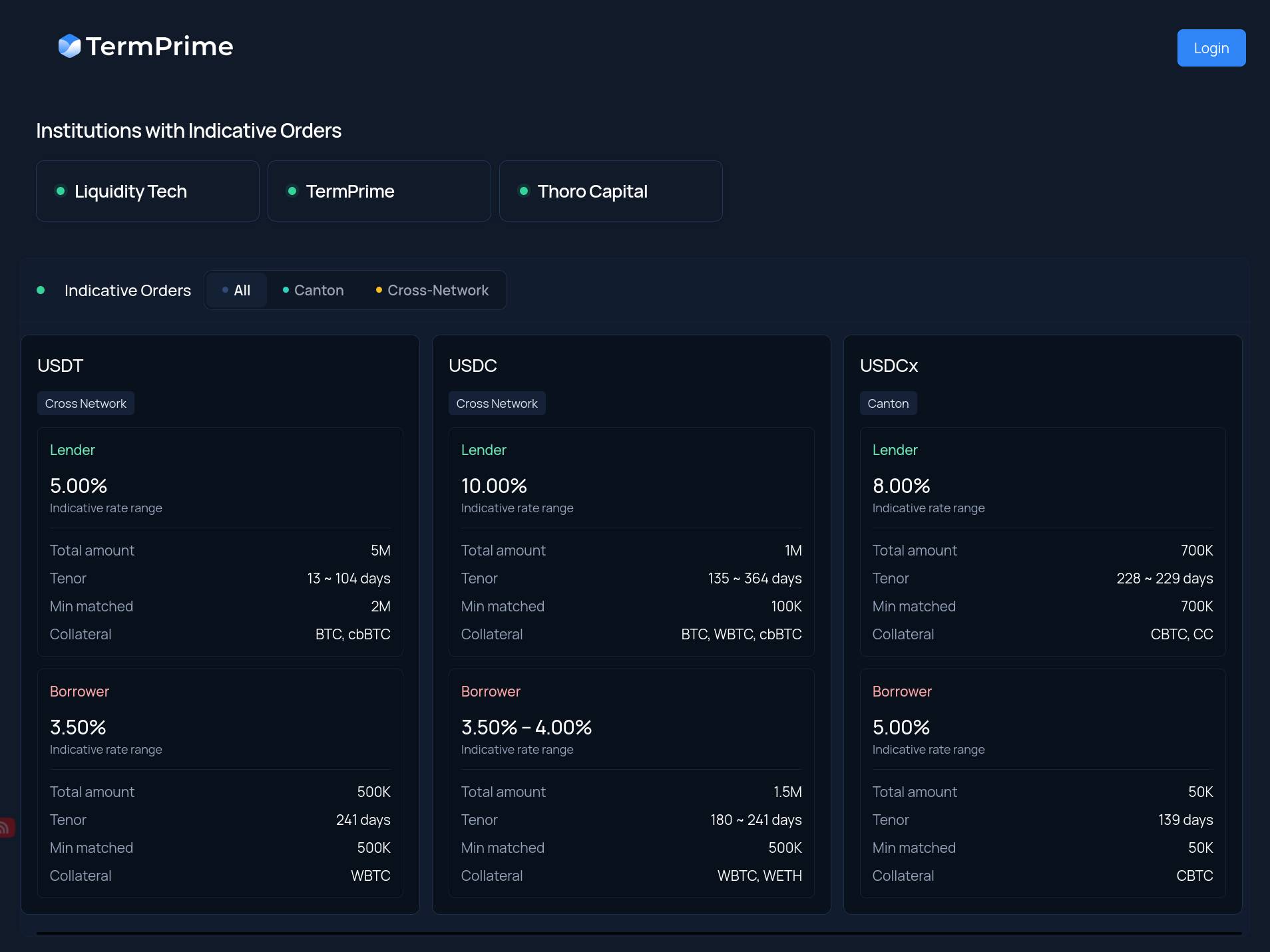
TermPrime is TermMax’s institutional financing product. It operates on Canton Network and provides permissioned counterparties with fixed-rate, fixed-term lending markets designed for private institutional transactions.
The first live TermPrime transaction was completed in June 2026. TermMax later reported that the network had expanded to nine institutional counterparties.
How TermMax Works
TermMax uses tokenized debt positions to provide fixed-rate lending and borrowing. Its structure revolves around three principal tokens:
- Gearing Token (GT): An ERC-721 token representing an individual borrowing or leveraged position. It records the collateral held in the position and its outstanding debt.
- Fixed-Rate Token (FT): A zero-coupon-bond-style token representing the right to receive one unit of the debt asset at maturity.
- X Token (XT): An ERC-20 token that complements FT and represents the remaining value within the tokenized position. FT and XT are created as a pair linked to one unit of the debt asset, although their separate market prices can change before maturity.
The main lending process works as follows:
- For borrowers: The borrower deposits collateral into a GT position and obtains fixed-term financing through the FT and XT market. The price at which the related tokens are exchanged determines the effective borrowing cost.
- For lenders: The lender purchases FT below face value. At maturity, each eligible FT can be redeemed for one unit of the corresponding debt asset, producing a return based on the initial discount.
A borrower can normally settle the position in two ways:
- Direct repayment: Repay the required amount using the borrowed asset.
- Repayment with FT: Acquire the necessary FT from the market and use it to close the corresponding debt obligation.
Additional mechanisms include:
- Curator management: Curators manage vault allocations, market selection and target rates according to their chosen strategies.
- Liquidation and physical delivery: Positions can be liquidated if their collateral ratio falls below the required threshold. If standard liquidation cannot fully recover the debt, the remaining collateral may be distributed proportionally to eligible FT holders after maturity.
Development Team

TermMax was founded by:
- Jerry Li, Co-founder and CEO: An institutional-markets executive who previously served as a managing director at Deutsche Bank and led its Global Emerging Markets business in Greater China.
- Vincent Li, Co-founder and CTO: A technology entrepreneur who previously co-founded and served as CTO of Termsoup.com before leading TermMax’s technical development.
Investors and Partners
TermMax says it has raised more than $8 million from investors including Cumberland DRW, HashKey Capital, Decima Fund, Longling Capital and MZ Web3 Fund.
In August 2026, the project announced a strategic investment from YZi Labs after participating in the fund’s EASY Residency Season 3. The size of the investment was not disclosed.
TMX Tokenomics
Token Information
| Project | TermMax |
| Token | TMX |
| Primary network | Ethereum |
| Contract | 0x3c2F61f2E27C865981D2e7aAf6b2CDf823030039 |
| Total fixed supply | 1,000,000,000 TMX |
The TMX token generation event took place on August 25, 2026. The supply and distribution schedule are described in the official TMX whitepaper.
TMX Allocation
- Community — 15%: No cliff or vesting period; available at the token generation event.
- Ecosystem — 29%: One-month cliff followed by linear vesting over 48 months.
- Liquidity provision — 5%: No cliff or vesting period.
- Foundation — 5%: Three-month cliff followed by linear vesting over 12 months.
- Advisors — 3%: Twelve-month cliff followed by linear vesting over 30 months.
- Development team — 15%: Twelve-month cliff followed by linear vesting over 30 months.
- Investors — 28%: Twelve-month cliff followed by linear vesting over 24 months.
TMX Use Cases
TMX is used for protocol governance. Holders can stake TMX to receive sTMX, which provides voting rights and access to enhanced governance functions.
Governance responsibilities may include adjusting market risk parameters, approving or removing curators and deciding how designated ecosystem resources are used. Protocol documentation also identifies FT and XT trading fees, borrowing fees and liquidation-related fees as potential sources supporting the treasury and incentive programs.