

Metals are not reacting to geopolitical tensions as sharply as they did in recent years. In terms of scale, the military conflict between the United States and Iran has already become the most significant in the modern history of the Persian Gulf region, and on the very first day of the conflict Iran’s Supreme Leader Ali Khamenei was killed. Against expectations of a quick end to the operation, the US dollar rose to 100.00 on the USDX. However, after the closure of the Strait of Hormuz, through which around 20.0% of global energy shipments pass, and retaliatory attacks by Tehran on neighboring states that damaged production infrastructure, investors began reallocating capital into hydrocarbons, with oil prices briefly reaching $117.0 per barrel.
At the moment, the bulk of global capital is split between oil and the US dollar, while gold is experiencing a lack of volatility. Still, this situation does not appear long-lasting. As military action continues, geopolitical instability reduces the predictability of traditional financial assets, which increases demand for defensive instruments. Against this backdrop, gold is showing resilience, with prices holding steadily in the range of about $5,000–$5,200 per ounce, while a record high of $5,594 per ounce was previously recorded. At the same time, a structural shift is becoming visible in central bank behavior: in 2025 alone, global regulators purchased more than 1,000 tonnes of gold, increasing total official reserves to around 36,000 tonnes. This points to a long-term strategy by states to reduce dependence on dollar-denominated assets and build an alternative reserve framework amid growing political and economic risks.
Therefore, in the medium term, diversification of investment flows is likely to occur primarily in favor of precious metals, and major financial institutions are already reflecting this trend in their forecasts. A number of analysts expect the average gold price to reach around $5,000 per ounce by the end of 2026, while in stress scenarios estimates rise to the $5,300–$5,400 range per ounce. The key driver is not only investment demand from funds and private capital, but also the institutional strategy of sovereign reserves. For example, the National Bank of Poland has increased its holdings to about 543.0 tonnes and plans to raise them to 700.0 tonnes, while a number of emerging-market countries already keep a substantial share of their reserves — between 40.0% and 70.0% — in gold.
In addition, according to the latest report from the US Commodity Futures Trading Commission (CFTC), the number of net speculative positions in the asset reached 160.1K, up from 159.2K a week earlier, while the number of real-money positions stood at 124.006K on the buy side and 23.151K on the sell side.
Beyond the underlying fundamental factors, technical indicators also support the possibility of further upside. On the weekly chart, the price remains above the support line of a broad ascending triangle pattern with boundaries at 5350.0–5100.0.
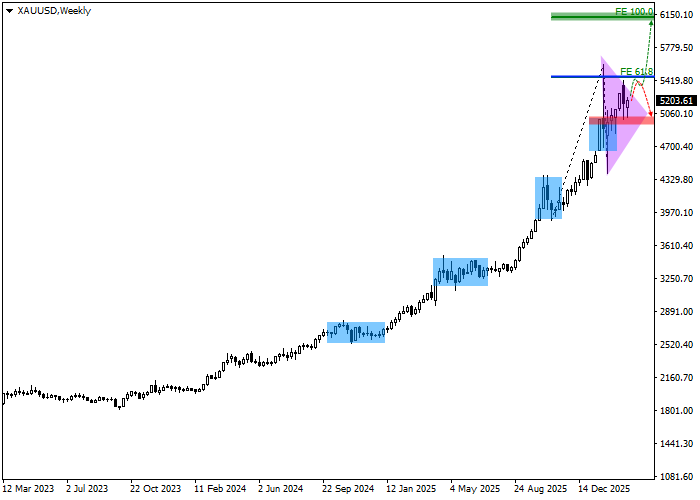
At the moment, an ascending channel is forming with dynamic boundaries at 5500.0–5100.0, where the initial trend level at the 61.8% Fibonacci extension of 5460.0 acts as the point of trend acceleration toward the main trend level at the 100.0% Fibonacci extension of 6120.0.
Key levels are best considered on the daily timeframe.
As the chart shows, the price has rebounded from the support line of the ascending channel, and its position close to the yearly high of 5580.0 confirms sufficient trading volume for a breakout above that level. If the price declines toward 4950.0, the bullish scenario would either be canceled or postponed, and open long positions should be closed. The target zone is located around 6120.0, which coincides with the 100.0% Fibonacci extension of the main trend. After reaching this level, profits on open long positions should be taken.
A more precise assessment of entry levels should be made on the four-hour timeframe.
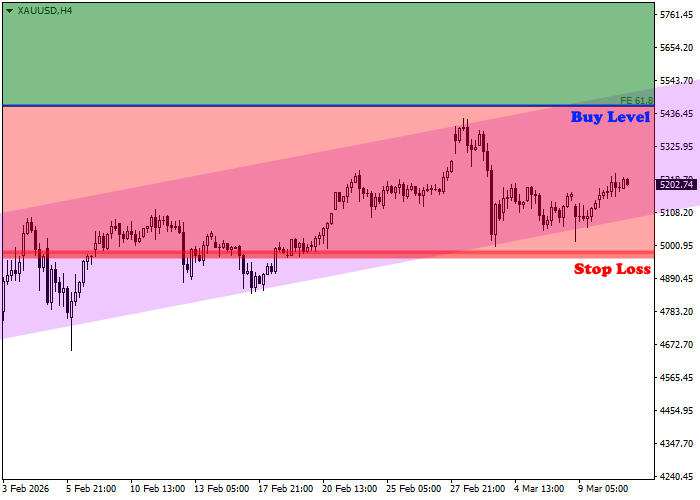
The entry level for long positions is located at 5460.0, which coincides with the intermediate yearly high. After a breakout above this mark and consolidation above the breakout level of the local triangle pattern, no significant resistance levels would remain on the path toward the target at 6120.0, making long positions viable.
Given the instrument’s average daily volatility of 7120.0 points over the past month, the move toward the 6120.0 target zone could take approximately 57 sessions. If volatility increases, however, this period could be reduced to 46 days.
