

According to The Guardian, the UK Climate Change Committee believes that the country’s transition to net-zero emissions by 2050 could ultimately cost less than the consequences of the current oil crisis. Experts argue that the shift would improve public health, strengthen the economy, and protect the country from future financial shocks. The organization estimates that reaching this goal will require around 100.0 billion pounds by 2050 — a figure comparable to the potential cost of energy imports if the Strait of Hormuz remains blocked. Committee chair Nigel Topping emphasized that it is now critical for the United Kingdom to move away from costly dependence on fossil fuels and accelerate the transition toward renewable energy sources.
Meanwhile, the pound has fallen by 1.45% since the start of hostilities in the Middle East, as the UK economy remains highly dependent on oil and gas imports. British government bonds have also come under pressure, showing the sharpest moves among major bond markets. The yield on two-year bonds rose by about 50 basis points, compared with increases of 38 basis points in Italy and 30 basis points in Australia.
The currency is also under pressure following the latest GDP data. In January, the three-month GDP indicator increased from 0.1% to 0.2%, matching forecasts. However, the monthly GDP figure came in at 0.0%, below expectations of 0.2% and the previous reading of 0.1%. Industrial production declined by –0.1% compared with preliminary estimates of 0.3%, while manufacturing output rose by only 0.1% versus expectations of 0.2%. As the national economy slows and energy costs rise, traders are reducing exposure to the pound.
Nevertheless, potential changes in the Bank of England’s monetary policy could support the currency. While analysts expected two interest-rate cuts earlier this year, markets are now pricing in the possibility of a 50-basis-point rate increase instead.
The U.S. dollar is receiving additional support from macroeconomic data. Initial jobless claims last week totaled 213.0K, slightly below the forecast of 214.0K. The Atlanta Federal Reserve’s GDPNow estimate for the first quarter rose to 2.7%, compared with previous expectations of 2.1%. Meanwhile, inflation remains at 2.4% year-on-year.
Support and Resistance Levels
The long-term trend has shifted downward: the price has settled below the support level of 1.3434 and the EMA (190), heading toward the December low at 1.3200 and the November low at 1.3020. The nearest resistance level, from which short positions may be considered, is now at 1.3455. The RSI (14) indicator is approaching the oversold zone but has not yet entered it, allowing room for additional selling pressure.
The medium-term trend also turned bearish at the end of February after a breakout below the support zone of 1.3549–1.3517, moving toward zone 2 (1.3229–1.3197). If the price reaches the resistance area of 1.3605–1.3573, bearish positions may be considered with targets at 1.3428 and 1.3253. A breakout below zone 2 could open the path toward zone 3 (1.2909–1.2877).
Resistance levels: 1.3455, 1.3564, 1.3700.
Support levels: 1.3200, 1.3020, 1.2760.
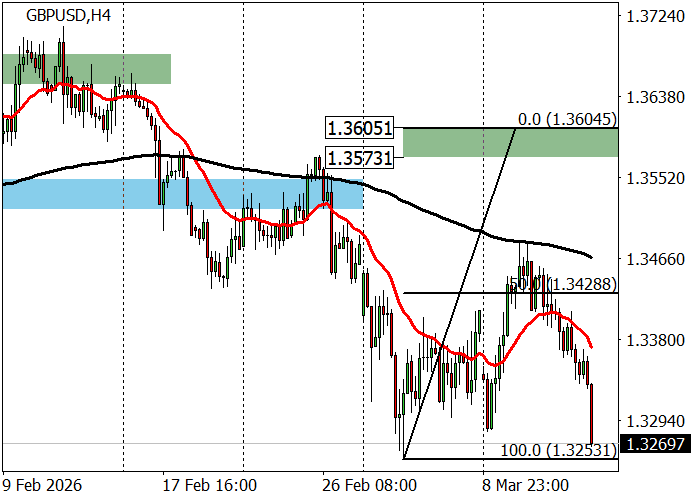
Trading Scenarios and GBP/USD Forecast
Short positions can be opened from the level of 1.3365 with a target of 1.3200 and a stop-loss at 1.3420. Implementation period: 9–12 days.
Long positions can be opened above the level of 1.3455 with a target of 1.3565 and a stop-loss at 1.3400.
Scenario
| Timeframe | Weekly |
| Recommendation | SELL LIMIT |
| Entry point | 1.3365 |
| Take Profit | 1.3200 |
| Stop Loss | 1.3420 |
| Key levels | 1.2760, 1.3020, 1.3200, 1.3455, 1.3564, 1.3700 |
Alternative Scenario
| Recommendation | BUY STOP |
| Entry point | 1.3460 |
| Take Profit | 1.3565 |
| Stop Loss | 1.3400 |
| Key levels | 1.2760, 1.3020, 1.3200, 1.3455, 1.3564, 1.3700 |
