
The situation in the United Kingdom appears more stable than in the EU. According to a report on the impact of economic challenges on national businesses, in February about 41.0% of companies with ten or more employees reported that their labor costs had increased over the past quarter, which is 6.0% higher than in the previous period. Meanwhile, 55.0% of organizations in this category expect personnel expenses to rise further in the next period, 20.0% higher than earlier forecasts.
In January, hourly wages increased in 18.0% of companies, while 17.0% reported labor shortages, unchanged from previous figures. Around 20.0% of businesses experienced difficulties recruiting staff, which is 9.0% less than in the previous quarter, while 47.0% noted a shortage of qualified specialists. Overall, at the beginning of the year only 4.0% of businesses reported suspending operations due to economic difficulties, with about 2.0% planning to close completely.
The US dollar is strengthening and is currently trading around 99.10 on the USDX amid rising geopolitical tensions in the Middle East. Investors are shifting capital away from real assets and reallocating it into safe-haven instruments and debt securities, which supports both bonds and the US dollar in which they are denominated.
On Tuesday, US President Donald Trump stated that the deployment of mines in the Strait of Hormuz — through which up to 20.0% of global oil traffic previously passed — could lead to unprecedented consequences for Iran. He added that there is no official confirmation of such actions, although reports have already appeared in the media. It is believed that only several dozen blocking devices are currently located in the waters, while Tehran still retains up to 90.0% of its fleet of small boats, potentially allowing the number of floating explosive devices to increase significantly.
Trump noted that removing such obstacles from the strait could be considered a step toward resolving the conflict. Against this backdrop, Brent Crude Oil prices have risen above $100 per barrel for the first time in several months, gaining more than 9.0%, which increases the likelihood of further global inflationary pressure. In February, the Consumer Price Index increased from 0.2% to 0.3% month-over-month and reached 2.4% year-over-year, while the core CPI — excluding food and energy — climbed to 2.5%, in line with analysts’ expectations.
Support and resistance levels
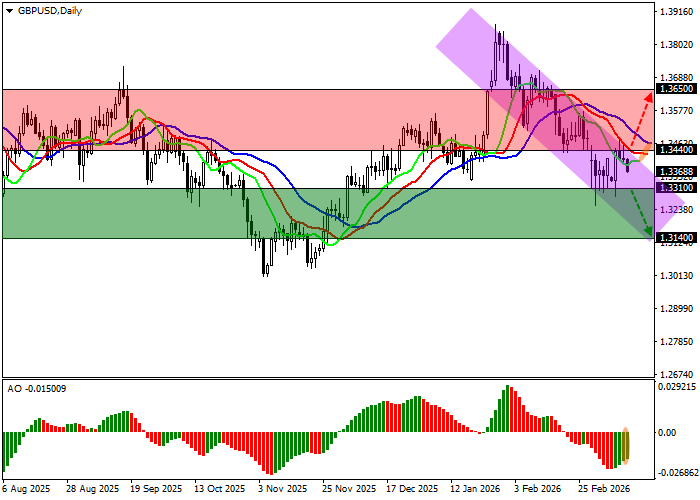
On the daily chart, the instrument is correcting below the resistance line of a descending channel with dynamic boundaries at 1.3450–1.3150.
Technical indicators strengthen the sell signal: the fast EMAs of the Alligator indicator remain below the signal line and are moving further away from it, while the AO histogram forms downward bars in negative territory.
Resistance levels: 1.3440, 1.3650.
Support levels: 1.3310, 1.3140.
Trading scenarios and GBP/USD forecast
Short positions may be opened after the price declines and consolidates below the 1.3310 level with a target at 1.3140 and a stop-loss at 1.3400. Implementation period: 7 days or more.
Long positions may be opened after the price rises and consolidates above the 1.3440 level with a target at 1.3650 and a stop-loss at 1.3340.
Scenario
| Timeframe | Weekly |
| Recommendation | SELL STOP |
| Entry Point | 1.3305 |
| Take Profit | 1.3140 |
| Stop Loss | 1.3400 |
| Key levels | 1.3140, 1.3310, 1.3440, 1.3650 |
Alternative scenario
| Recommendation | BUY STOP |
| Entry Point | 1.3445 |
| Take Profit | 1.3650 |
| Stop Loss | 1.3340 |
| Key levels | 1.3140, 1.3310, 1.3440, 1.3650 |
