

In January, retail sales rose by 4.5% year-on-year versus a forecast of 2.8% and a previous reading of 1.9%, while monthly growth reached 1.8% compared with expectations of 0.2% and a prior figure of 0.4%. Core retail sales increased by 5.5% versus 3.6% and 2.5%, respectively. According to preliminary data, the February composite PMI edged up from 53.7 to 53.9 points, exceeding the consensus estimate of 53.3, while the services PMI slipped slightly from 54.0 to 53.9 versus expectations of 53.5. These figures point to a potential overheating of the economy and rising inflation risks, which could prompt the Bank of England to raise interest rates from the current 3.75%, supporting the pound and making it more attractive to foreign investors. In this scenario, the pair could reach the 1.3547 level. The regulator’s next meeting is scheduled for March 19, although analysts remain cautious about predicting the outcome, as monetary policy decisions will depend on incoming data. In January, the consumer price index fell from 3.4% to 3.0%, in line with expectations, and if the downward trend continues, policymakers may revert to a more dovish stance, supporting economic recovery and, consequently, the national currency.
Meanwhile, US traders are focusing on the Conference Board Consumer Confidence Index, due for release tomorrow at 17:00 (GMT+2). The indicator, based on a survey of 5,000 US households and reflecting their assessment of current conditions and expectations, is projected to rise from 84.5 to 87.6 points. Markets are also assessing comments from Kevin Hassett, chief economic adviser to US President Donald Trump, who said that the authors of a report by the New York Federal Reserve should face sanctions for poor-quality research. The report claims that the costs of tariffs introduced by the White House are largely passed on to consumers: 90.0% of import duties last year were effectively paid by households, with losses reaching 94.0% from January to August, 92.0% from September to October, and 86.0% since November. Commenting on these remarks, Minneapolis Fed President Neel Kashkari described them as another example of pressure on the US Federal Reserve.
Support and Resistance Levels
The long-term trend remains bullish. In January, the instrument reached resistance at 1.3847, corrected to the 1.3547 support level, and then continued lower toward 1.3434, where the long-term 190-period moving average is located. Together, they form a strong demand zone, from which long positions may be considered with targets at 1.3547 and 1.3700.
The medium-term trend turned bearish last week after the price broke below the 1.3549–1.3517 support area and moved toward zone 2 (1.3229–1.3197). Short positions may be considered on a pullback from the 1.3786–1.3754 resistance zone with targets at 1.3609 and 1.3434. However, a breakout above the 1.3786–1.3754 area would reverse the trend to the upside.
Resistance levels: 1.3547, 1.3700, 1.3847.
Support levels: 1.3434, 1.3360, 1.3190.
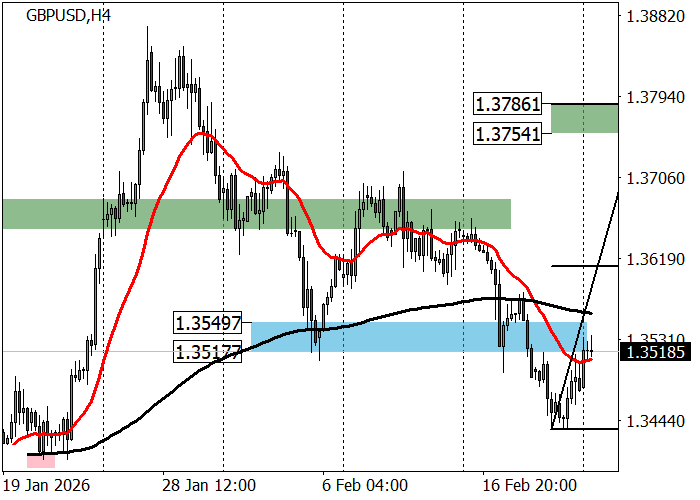
Trading Scenarios and GBP/USD Forecast
Long positions may be opened from the 1.3463 level with a target at 1.3700 and a stop-loss at 1.3392. Time horizon: 9–12 days.
Short positions may be opened below the 1.3392 level with a target at 1.3190 and a stop-loss at 1.3485.
Scenario
| Timeframe | Weekly |
| Recommendation | BUY LIMIT |
| Entry point | 1.3463 |
| Take Profit | 1.3700 |
| Stop Loss | 1.3392 |
| Key levels | 1.3190, 1.3360, 1.3434, 1.3547, 1.3700, 1.3847 |
Alternative Scenario
| Recommendation | SELL STOP |
| Entry point | 1.3390 |
| Take Profit | 1.3190 |
| Stop Loss | 1.3485 |
| Key levels | 1.3190, 1.3360, 1.3434, 1.3547, 1.3700, 1.3847 |
