
The US currency is receiving support amid growing expectations of significant monetary policy tightening by the US Federal Reserve, driven by recent news of Jensen Huang's return as CEO of NVIDIA Corp. He had previously stepped down amid controversy and scrutiny over suspected unauthorized shipments of advanced chips to China. Experts believe this will accelerate growth in the country's artificial intelligence (AI) technology sector and contribute to economic recovery, which, in turn, could intensify inflationary pressure, prompting the regulator to return to a hawkish cycle. It is worth noting that, according to the Chicago Mercantile Exchange's (CME) FedWatch Tool, the probability of a 50-basis-point interest rate increase in December was estimated at zero yesterday but has now returned to 6.5%, while the probability of a 25-basis-point increase stands at 93.5%. Recent comments from members of the Federal Open Market Committee (FOMC) continue to confirm their readiness to take decisive action. New York Federal Reserve Bank President John Williams noted that persistently high inflation requires tighter credit conditions, emphasizing that the pace of tightening will depend on incoming economic data, while not ruling out consecutive increases in borrowing costs at several regulatory meetings.
The decline in the pair was limited by preliminary November business activity data from the United Kingdom: the services PMI declined from 52.8 to 52.0 points, the manufacturing PMI fell from 52.8 to 52.7 points, and the composite indicator decreased from 52.9 to 52.3 points instead of the expected decline to 51.9 points, remaining in expansionary territory. Experts note that these statistics indicate UK economic growth of approximately 0.6% in the fourth quarter of the current year, which could also prompt the Bank of England to raise interest rates. The regulator's Chief Economist Huw Pill pointed to this possibility on Monday, stating that inflation had been at target for only three of the past 62 months and that monetary policy measures must be taken now to ensure a sustained reduction in inflation.
Overall, the fundamental conditions for a further decline in GBP/USD remain in place.
Support and Resistance Levels
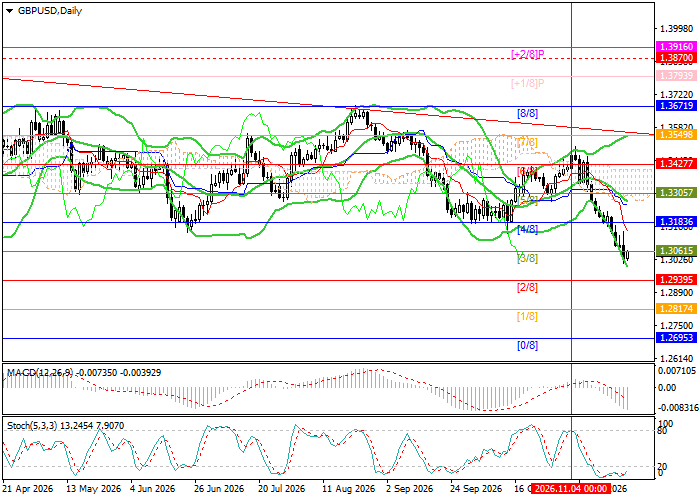
The trading instrument has fallen below 1.3061 (Murrey Math level [3/8]) and may continue its downward movement toward 1.2817 (Murrey Math level [1/8]) and 1.2695 (Murrey Math level [0/8]). However, if the price breaks above the middle Bollinger Band at 1.3305 (Murrey Math level [5/8]), it is likely to reach the targets of 1.3549 (Murrey Math level [7/8]) and 1.3671 (Murrey Math level [8/8]).
Technical indicators maintain a sell signal: the Bollinger Bands are turning downward, the MACD histogram is expanding in negative territory, while the Stochastic Oscillator has entered the oversold zone, leaving room for a limited correction.
Resistance levels: 1.3305, 1.3549, 1.3671.
Support levels: 1.2817, 1.2695.
GBP/USD Trading Scenarios and Exchange Rate Forecast
Short positions may be opened from 1.3005, with targets at 1.2817 and 1.2695 and a stop-loss at 1.3110. Expected timeframe: 5–7 days.
Long positions may be opened above 1.3305, with targets at 1.3549 and 1.3671 and a stop-loss at 1.3210.
Scenario
| Timeframe | Weekly |
| Recommendation | SELL STOP |
| Entry Point | 1.3005 |
| Take Profit | 1.2817, 1.2695 |
| Stop Loss | 1.3110 |
| Key Levels | 1.2695, 1.2817, 1.3305, 1.3549, 1.3671 |
Alternative Scenario
| Recommendation | BUY STOP |
| Entry Point | 1.3305 |
| Take Profit | 1.3549, 1.3671 |
| Stop Loss | 1.3210 |
| Key Levels | 1.2695, 1.2817, 1.3305, 1.3549, 1.3671 |
