
The eurozone services PMI declined from 51.4 to 51.2 points, while the manufacturing PMI increased from 52.7 to 52.9 points, and the composite indicator remained unchanged at 51.7 points. Data for Germany, the European Union's largest economy, was positive, with the corresponding indicators rising from 52.5 to 54.0 points, from 54.2 to 55.0 points, and from 53.4 to 55.0 points, respectively. For France, the region's second-largest economy, the statistics were weak: the services PMI increased from 46.2 to 46.6 points, but the manufacturing indicator declined from 49.5 to 47.9 points, while the composite PMI fell from 46.6 to 46.2 points. These figures raised concerns among experts that the French economy, weakened by protests and political instability, could significantly slow the region's gross domestic product (GDP) growth, affecting the European Central Bank's (ECB) willingness to raise interest rates again. Yesterday, Bank of Lithuania Governor Gediminas Šimkus pointed to this possibility, stating that monetary policy tightening would take place in December but would be insufficient to contain inflation, while the regulator would not rush into another adjustment in borrowing costs.
The US dollar, by contrast, is experiencing increased demand from investors, although preliminary November business activity data was weak: the services PMI declined from 56.1 to 54.7 points, the manufacturing PMI fell from 54.9 to 54.6 points, and the composite indicator decreased from 55.9 to 54.6 points. However, investors ignored these statistics amid Jensen Huang's return as CEO of NVIDIA Corp. The announcement raised hopes for accelerated development of artificial intelligence (AI) technologies, resulting in stock market gains and a stronger dollar. The resolution of the company's leadership crisis also strengthened expectations of a continuation of the US Federal Reserve's hawkish cycle. According to the Chicago Mercantile Exchange's (CME) FedWatch Tool, while the probability of a 50-basis-point interest rate increase in December was previously estimated at zero, it has now returned to 6.5%.
Overall, the fundamental conditions for a further decline in EUR/USD remain in place.
Support and Resistance Levels
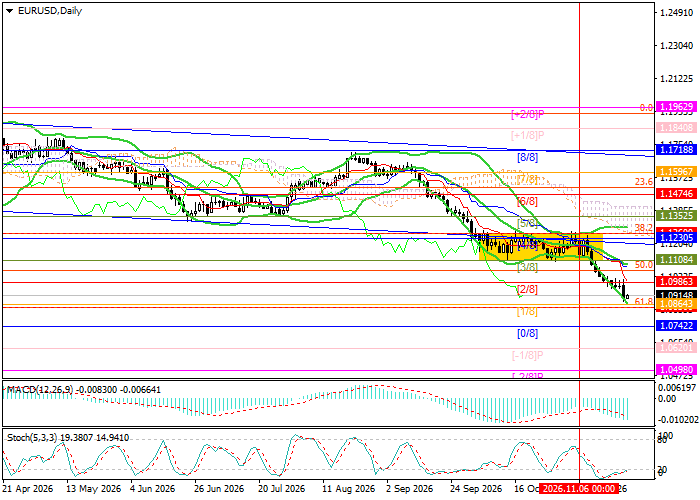
The trading instrument has exited the sideways range of 1.1260–1.1108 (38.2% Fibonacci retracement, Murrey Math level [3/8]), breaking through its lower boundary and approaching 1.0850 (61.8% Fibonacci retracement). A break below this level is expected to lead to the targets of 1.0620 (Murrey Math level [–1/8]) and 1.0498 (Murrey Math level [–2/8]). However, if the price consolidates above the upper Bollinger Band at 1.1260 (38.2% Fibonacci retracement), an upward movement toward 1.1474 (Murrey Math level [6/8]), 1.1596 (Murrey Math level [7/8]), and 1.1718 (Murrey Math level [8/8], the upper boundary of the descending channel) is likely.
Technical indicators maintain a sell signal: the Bollinger Bands are turning downward, the MACD histogram is expanding in negative territory, while the Stochastic Oscillator has reached the oversold zone, leaving room for a limited correction.
Resistance levels: 1.1260, 1.1474, 1.1596, 1.1718.
Support levels: 1.0850, 1.0620, 1.0498.
EUR/USD Trading Scenarios and Exchange Rate Forecast
Short positions may be opened below 1.0850, with targets at 1.0620 and 1.0498 and a stop-loss at 1.0990. Expected timeframe: 5–7 days.
Long positions may be opened above 1.1260, with targets at 1.1474, 1.1596, and 1.1718 and a stop-loss at 1.1150.
Scenario
| Timeframe | Weekly |
| Recommendation | SELL STOP |
| Entry Point | 1.0850 |
| Take Profit | 1.0620, 1.0498 |
| Stop Loss | 1.0990 |
| Key Levels | 1.0498, 1.0620, 1.0850, 1.1260, 1.1474, 1.1596, 1.1718 |
Alternative Scenario
| Recommendation | BUY STOP |
| Entry Point | 1.1260 |
| Take Profit | 1.1474, 1.1596, 1.1718 |
| Stop Loss | 1.1150 |
| Key Levels | 1.0498, 1.0620, 1.0850, 1.1260, 1.1474, 1.1596, 1.1718 |
