
At the end of last week, Statistics Canada released construction sector data showing that the total value of building permits increased by 6.8% month-on-month, or CAD 821.3 million, while the annual figure rose by CAD 3.3 billion to CAD 149.7 billion. The trend in capital investment provides a moderately positive backdrop for the Canadian dollar, although the key catalyst for price movement will be the inflation report due tomorrow at 15:30 (GMT+2). The consensus forecast points to a 0.1% monthly increase after a 0.2% decline previously, which could slow annual inflation from 2.4% to 2.2%. At the same time, according to LSEG Data & Analytics and a Reuters survey of economists, the annual headline rate may remain at 2.4% in January, while core inflation is expected to ease from 2.8% to 2.7%, signaling gradual normalization amid cooling domestic demand and stabilizing housing prices.
The fundamental backdrop for the future path of monetary policy remains mixed. Randall Bartlett, Deputy Chief Economist at Desjardins Group, notes that the slowdown in food inflation in January was largely driven by technical tax adjustments, including a temporary suspension of the federal sales tax on dining services and certain goods for two months. This is a one-off factor and does not change the structural component of price pressures. In an earlier report, the Bank of Canada highlighted that higher import costs—partly linked to the Canadian dollar’s weakness earlier in the year and disruptions in trade flows from the United States—have made a significant contribution to rising food prices. An additional factor for assessing inflation risks will be housing starts data, where a decline from 282.4 thousand to 266.0 thousand is expected, reflecting a gradual cooling of the sector. Taken together, these factors support a more cautious tone from policymakers and reduce the likelihood of an early shift toward monetary easing at upcoming meetings.
As for the US dollar, it continues to trade unevenly and is holding near 96.8 points on the USDX today. Friday’s US inflation data failed to trigger a stronger bullish move. The consumer price index rose by 0.2% month-on-month in January, compared with 0.3% in December, slowing the annual rate from 2.7% to 2.4%. Core inflation, excluding volatile components such as food and energy, increased by 0.3% month-on-month, while the annual pace eased from 2.6% to 2.5%. These figures adjusted expectations for the Federal Reserve’s next steps, although markets continue to price in a prolonged period of tight monetary conditions. According to the CME FedWatch Tool, based on federal funds futures, the probability of rates remaining in the 3.50–3.75% range after the March 18 meeting stands at 90.8%. As a result, market participants continue to assume a pause in the rate cycle, limiting the upside potential for further US dollar strengthening.
Support and resistance levels
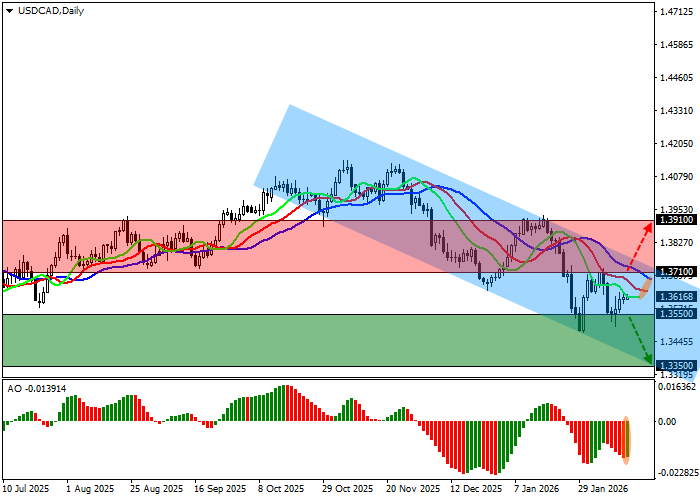
On the daily chart, the instrument is approaching the resistance line of a channel with boundaries at 1.3660–1.3400.
Technical indicators maintain a sell signal generated in mid-last month: the EMA range on the Alligator indicator is widening, with fast EMAs moving away from the signal line, while the AO histogram is forming new corrective bars below the zero line.
Support levels: 1.3550, 1.3350.
Resistance levels: 1.3710, 1.3910.
Trading scenarios and USD/CAD forecast
Short positions may be considered after a confirmed break below 1.3550, targeting 1.3350. Stop-loss — 1.3650. Time horizon: 7 days or more.
Long positions may be considered after a sustained move above 1.3710, targeting 1.3910. Stop-loss — 1.3600.
Scenario
| Timeframe | Weekly |
| Recommendation | SELL STOP |
| Entry point | 1.3545 |
| Take Profit | 1.3350 |
| Stop Loss | 1.3650 |
| Key levels | 1.3350, 1.3550, 1.3710, 1.3910 |
Alternative scenario
| Recommendation | BUY STOP |
| Entry point | 1.3715 |
| Take Profit | 1.3910 |
| Stop Loss | 1.3600 |
| Key levels | 1.3350, 1.3550, 1.3710, 1.3910 |
