

An increasing number of experts are leaning toward further monetary tightening following last week’s bilateral meeting between Bank of Japan Governor Kazuo Ueda and Prime Minister Sanae Takaichi. Former BoJ board member Makoto Sakurai told Reuters that the probability of an interest rate hike at the March meeting remains high, and policymakers could use the current timing—along with a visit by a Japanese government representative to the United States—to signal readiness for continued normalization of monetary conditions. Sakurai added that intensified consultations between the two countries’ financial authorities on FX matters may indicate Washington’s interest in stabilizing the yen. In his view, “hawkish” measures would be the most effective way to support the national currency without direct intervention. Meanwhile, in January the nationwide CPI fell by –0.2% m/m and eased from 2.1% to 1.5% y/y, while the core index excluding fresh food declined from 2.4% to 2.0%, remaining at the upper bound of the 1.0–1.5% target range and allowing room to adjust borrowing costs. In addition, sustained wage growth following the latest round of labor negotiations increases the likelihood of renewed price pressure in the second half of the year. Taken together, geopolitical factors, the need to stabilize the yen, and inflation still above a comfortable range raise the odds that the BoJ will continue a gradual policy normalization, boosting USD/JPY volatility and supporting the yen in the near term.
At the same time, last week’s positive momentum in the US dollar is gradually being offset as the USDX slips toward 97.30. Investor focus remains on the contradictory rhetoric of President Donald Trump. On Friday, the US Supreme Court ruled that last year’s trade tariffs were unlawful and called for their repeal, prompting the White House to introduce a new blanket tariff of 10.0% on all trading partners, later raised to 15.0%. It remains unclear when the measure will take effect, which countries it will apply to, and how existing levies will be treated.
Support and resistance levels
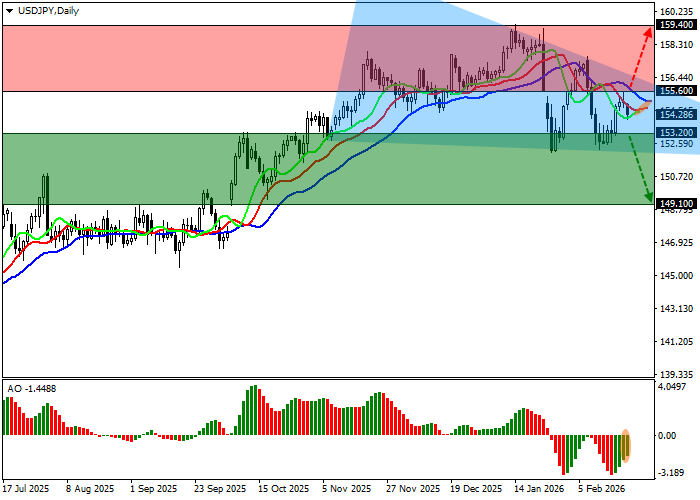
On the daily chart, the instrument is correcting within a broader downtrend, retreating from the resistance line of a “triangle” pattern bounded by 156.00–152.00.
Technical indicators are easing their sell signals: the fast EMAs of the Alligator indicator are converging toward the signal line, while the AO histogram is forming corrective bars in negative territory.
Resistance levels: 155.60, 159.40.
Support levels: 153.20, 149.10.
Trading scenarios and USD/JPY outlook
Short positions can be opened after a decline and consolidation below 153.20, targeting 149.10. Stop loss: 154.50. Time horizon: 7 days or more.
Long positions can be opened after a rise and consolidation above 155.60, targeting 159.40. Stop loss: 154.00.
Scenario
| Timeframe | Weekly |
| Recommendation | SELL STOP |
| Entry point | 153.15 |
| Take Profit | 149.10 |
| Stop Loss | 154.50 |
| Key levels | 149.10, 153.20, 155.60, 159.40 |
Alternative scenario
| Recommendation | BUY STOP |
| Entry point | 155.65 |
| Take Profit | 159.40 |
| Stop Loss | 154.00 |
| Key levels | 149.10, 153.20, 155.60, 159.40 |
