
According to data from Germany’s Federal Statistical Office, the annual growth rate of the consumer price index stood at 1.9%, down from 2.1% in January. The monthly indicator increased by 0.2%, while the harmonized index rose by 2.0% year-on-year and 0.4% month-on-month, fully matching analysts’ preliminary estimates. The data suggests that officials at the European Central Bank (ECB) may maintain a wait-and-see stance regarding potential adjustments to monetary policy.
Meanwhile, foreign trade statistics for January showed a decline in external trade activity: imports fell by 5.9%, while exports dropped by 2.3%. Despite this, Germany’s trade surplus adjusted to 21.2 billion euros, reflecting weak global demand and heightened uncertainty for the manufacturing sector and export-oriented industries.
According to the IFO Institute for Economic Research, the escalation of the Middle East crisis could negatively affect economic activity. The institute lowered its baseline forecast for Germany’s real GDP growth this year from 0.8% to 0.6% if energy price pressure remains prolonged. Preliminary projections for 2027 also suggest weaker growth, with the economy expected to expand by only 0.8% compared with the previously forecast 1.2%. IFO experts note that if the situation in the Middle East stabilizes, inflation may reach around 2.5%. Otherwise, it could accelerate to 3.0%, increasing production costs and consumer prices.
The overall situation in the bond market is also limiting demand for risk assets, as yields across the bond curve remain in the “green zone.” This week saw auctions of two-year and ten-year government bonds, which were sold at yields of 2.270% and 2.890% compared with 2.020% and 2.730% previously.
Currently, benchmark one-year bonds are trading at a yield of 2.240%, significantly higher than the 1.149% recorded last Friday. Ten-year bonds are trading at 2.942% compared with 2.860%, while twenty- and thirty-year bonds stand at 3.433% and 3.518%, exceeding their previous levels of 3.353% and 3.441% respectively.
The top gainers in the index include Zalando SE (+9.50%), Brenntag AG (+5.10%), BASF SE (+4.62%), Hannover Ruck SE (+4.45%), and Symrise AG (+4.22%).
The biggest decliners include Deutsche Bank AG (–5.27%), Heidelberg Materials AG (–4.46%), Commerzbank AG (–4.09%), Continental AG (–3.56%), and Infineon Technologies AG (–3.08%).
Support and Resistance Levels
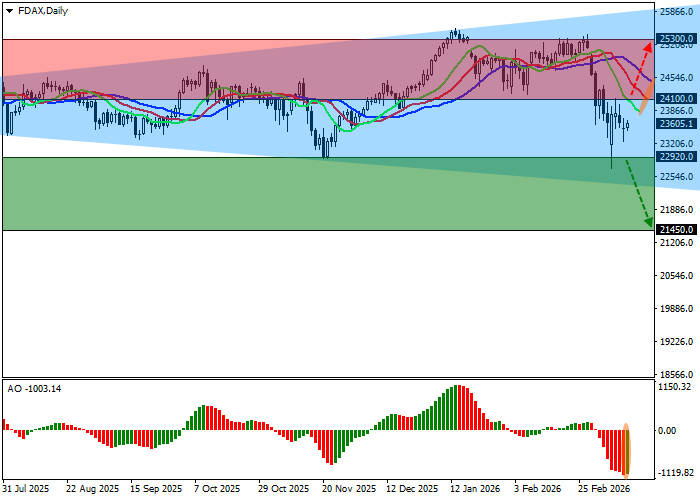
On the daily chart, the index remains within a corrective trend, once again moving away from the resistance line of the “expanding formation” pattern with boundaries between 26000.0 and 22500.0, which formed at the end of last year.
Technical indicators reinforce the sell signal: the fast EMAs of the Alligator indicator are positioned below the signal line, while the AO histogram is forming corrective bars in negative territory.
Support levels: 22920.0, 21450.0.
Resistance levels: 24100.0, 25300.0.
Trading Scenarios and DAX 40 Forecast
Short positions may be opened after the price consolidates below 22920.0 with a target at 21450.0. Stop loss — 23300.0. Implementation period: 7 days or more.
Long positions may be opened after the price consolidates above 24100.0 with a target at 25300.0. Stop loss — 23700.0.
Scenario
| Timeframe | Weekly |
| Recommendation | SELL STOP |
| Entry point | 22919.5 |
| Take Profit | 21450.0 |
| Stop Loss | 23300.0 |
| Key levels | 21450.0, 22920.0, 24100.0, 25300.0 |
Alternative Scenario
| Recommendation | BUY STOP |
| Entry point | 24099.5 |
| Take Profit | 25300.0 |
| Stop Loss | 23700.0 |
| Key levels | 21450.0, 22920.0, 24100.0, 25300.0 |
