
Huang’s departure put Nvidia’s role in financing the AI build-out under closer scrutiny. At the end of the fiscal third quarter, Nvidia listed $518 billion in future commitments, including $390 billion in supply and capacity agreements and $102 billion in cloud services and data centre leases. It disclosed another $32 billion in conditional agreements with specialist cloud providers and up to $118 billion in gross exposure under separate guarantees. Some of those arrangements depend on partners first securing their own financing and bringing computing capacity into service. Nvidia’s quarterly CFO commentary.
For providers such as CoreWeave and Nebius, continued backing from Nvidia matters because building capacity requires substantial funding before it generates revenue. Investors initially questioned whether that backing would change after Huang’s exit. On the November 17 earnings call, Kress said Nvidia was maintaining its approach to those commitments. Shares of CoreWeave and Nebius extended their gains after her comments.
The first earnings report after the leadership change beat Wall Street expectations. Revenue for the third quarter of fiscal 2027 reached a record $115.8 billion, up 103% from $57.0 billion a year earlier and 20% from $96.2 billion in the previous quarter. GAAP diluted earnings per share rose 108% to $2.70 from $1.30. Adjusted diluted earnings per share increased 111% to $2.68 from $1.27.
The Data Center segment accounted for roughly 93% of total sales. Its revenue rose 110% year on year to $107.6 billion, with the launch of Vera Rubin contributing nearly $20 billion in additional revenue compared with the previous quarter. Nvidia forecast fourth-quarter revenue of $130 billion, plus or minus 3%. In September, the board increased its existing share repurchase authorisation by $150 billion, leaving $227.3 billion available at quarter-end. Nvidia’s quarterly presentation and earnings release.
Nvidia shares rose about 4% in extended trading after the report, then gave up those gains during the November 18 session. The next quarter will test whether strong chip demand can sustain a recovery as the board searches for a permanent CEO and investors reassess the returns on AI infrastructure spending. The stock’s recent weakness had already spilled over into the Nasdaq-100.
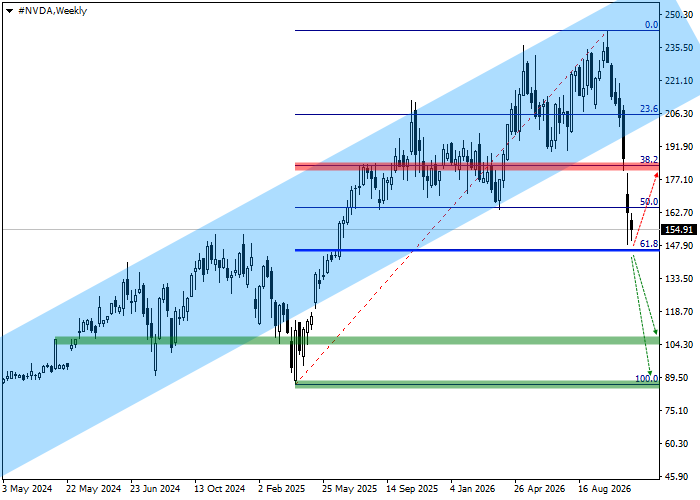
On the weekly chart, Nvidia has broken below support near $195 and moved out of its long-term rising channel, whose boundaries sit around $190 and $260. The breakdown shifted attention to $144, near the 61.8% Fibonacci retracement and the October 25, 2024 intraday high. A sustained break below that area would strengthen the case for a deeper decline.
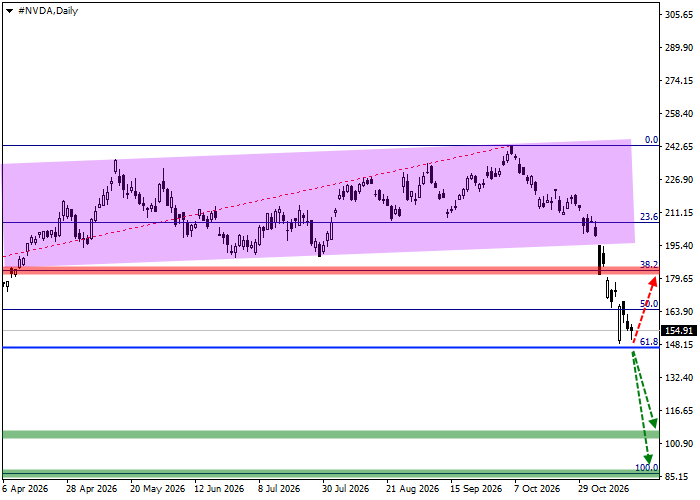
The daily chart shows the shares below their former rising channel, which had boundaries near $195 and $245. If $144 gives way, the bearish scenario targets $85, the full retracement level in this setup and an area just below the April 2025 low. That is the profit-taking level for the short scenario. A sustained recovery above $183, near the 38.2% Fibonacci retracement, would invalidate the setup.
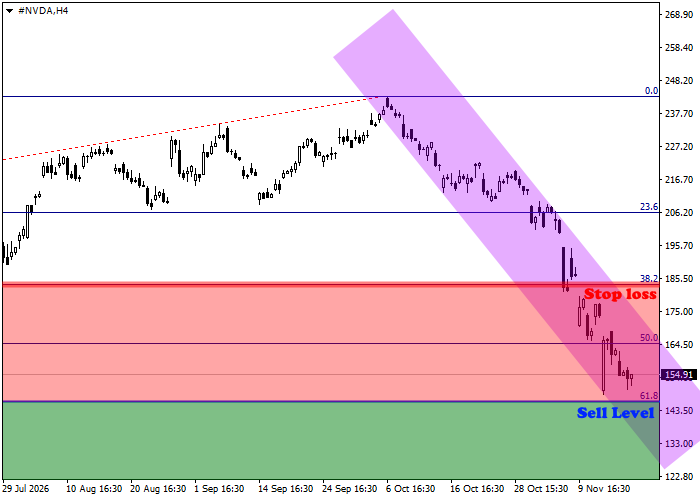
The four-hour chart is used to confirm the entry. A close below $144 would trigger the short scenario, with $85 as the target and $183 as the invalidation level.
The setup uses an average daily volatility reading of 767 points over the past month. The projected move from $144 to $85 covers $59. Reaching the target in roughly 47 trading sessions would require an average net decline of about $1.26 per session after the break. That timeframe assumes sustained selling once support gives way.
