Indonesia's stock market recorded its steepest one-day decline since 1998 on Friday, October 16, after MSCI raised the possibility of removing the country from its Emerging Market classification. The announcement triggered a sharp sell-off in Jakarta, pushed the Indonesian rupiah beyond 18,000 per US dollar and raised concerns about further foreign capital outflows.
The German stock index DAX 40 is posting a moderate decline in the morning session, pulling back from the local highs of November 17 that were renewed at the end of last week. Investors are locking in part of their long profits ahead of today’s business-activity data release at 11:00 (GMT+2). Forecasts suggest that Germany’s manufacturing PMI from S&P Global and Hamburg Commercial Bank (HCOB) will remain at 48.4 points, while the eurozone composite manufacturing reading is expected at 49.7 points. In recent months, industrial activity in the region has shown only modest growth, supported by higher government defense spending and infrastructure-modernization programs in Germany. However, analysts doubt that these initiatives will be enough to restore the EU’s budget surplus, as the bloc remains under pressure from intensifying competition from Chinese manufacturers, the loss of cheap energy supplies from Russia, and trade restrictions introduced by U.S. President Donald Trump.
Shares of ExxonMobil Corp., the U.S. oil and gas company, are trading within a medium-term upward trend. Last week, the price tested the 118.75 level (Murray level [8/8]), but has not yet managed to consolidate above it.
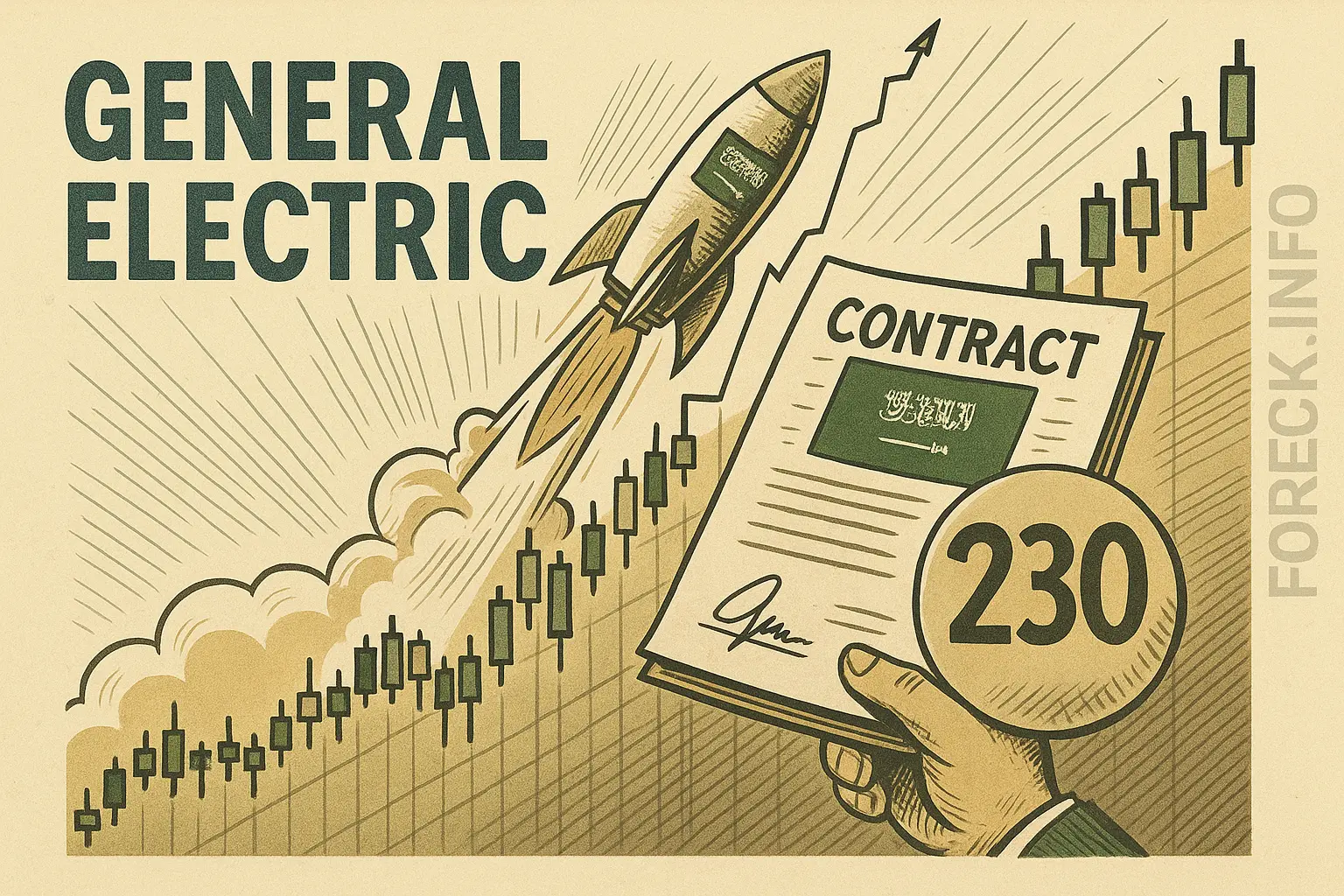
The global upward trend in the shares of the diversified corporation General Electric Co. continues, with the price trading just below the 300.00 mark.
The leading index of the Frankfurt Stock Exchange, DAX 40, is trading around 24,226.0. The market maintains the strong positions achieved earlier this spring and continues to hold near local highs, despite mixed corporate earnings from major index components.
The U.S. benchmark index S&P 500 is consolidating near 6823.0 amid corporate earnings reports and news suggesting the possible reopening of the federal government after a prolonged shutdown.
Stock market analysis is simply about figuring out where a stock might head next. Investors look at two sides: fundamentals and technicals. Fundamentals mean earnings, debt, cash flow, or even what the Fed is doing with rates. Technicals are the charts — trends, support and resistance, volume, and recurring patterns. Put them together, and you get a practical view of risk and timing, helping decide when to step in or step out.