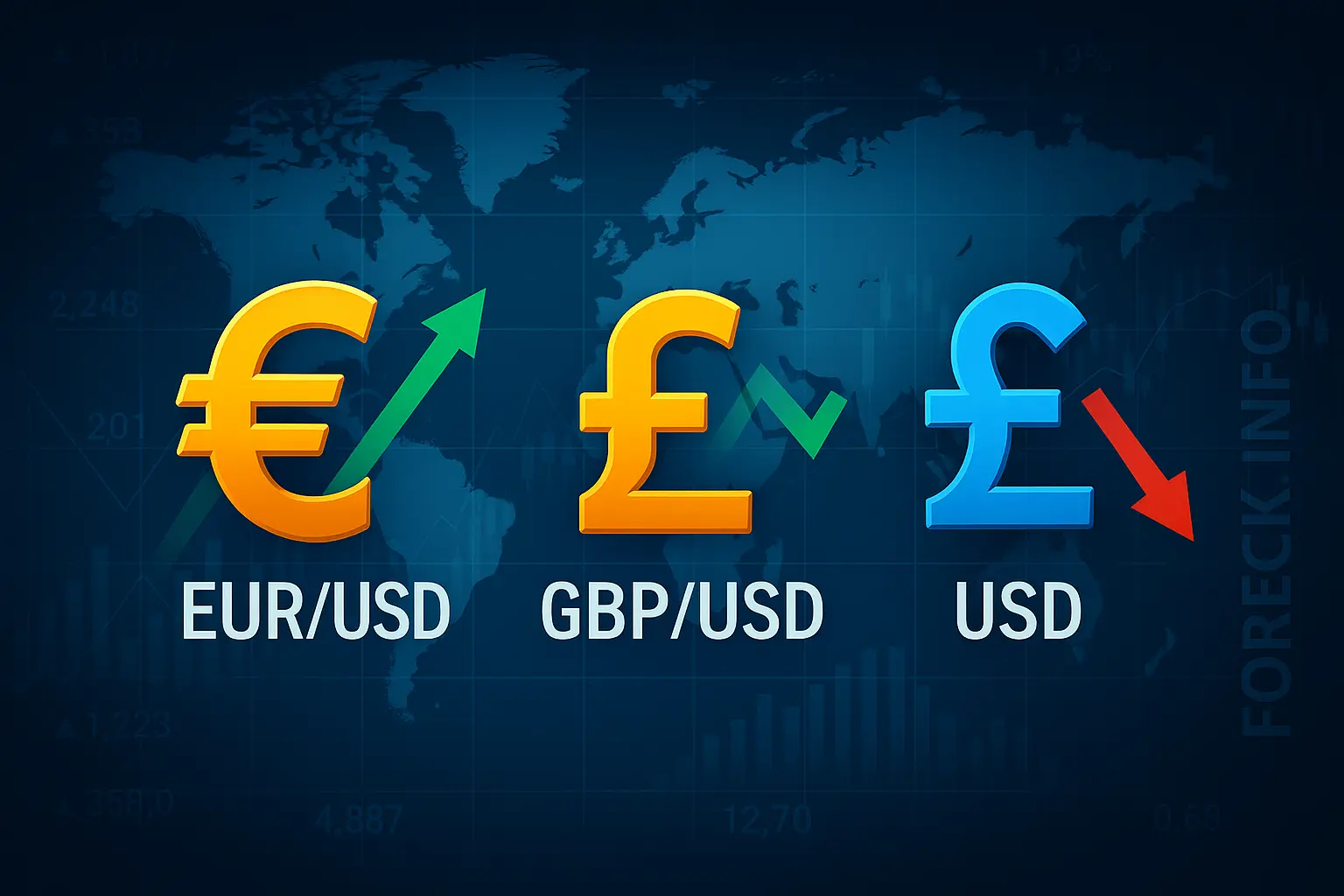
The US dollar strengthened against the euro, sterling and yen ahead of Kevin Warsh’s Jackson Hole speech on August 28. The Australian dollar outperformed its major peers, while oil slipped as traders weighed Washington’s shift towards economic pressure on Iran.
The euro and British pound are gaining ground against the U.S. dollar in Thursday’s forex session, with EUR/USD testing the 1.1525 level as the correctional impulse extends. The week is set to close with minimal net change, as traders digest the outcome of the Federal Reserve’s two-day meeting. As anticipated, the Fed left its benchmark rate unchanged at 4.50% and released updated forecasts: CPI is now expected at 3.0% by end-2025 (vs. 2.7% earlier), 2.4% in 2026 (vs. 2.2%), and 2.1% in 2027 (vs. 2.0%). GDP growth was revised to 1.4% for 2025 (down from 1.7%) and 1.8% for 2026 (up from 1.6%). Meanwhile, German PPI inflation showed a deeper annual drop of –1.2%, and monthly data beat expectations at –0.2%. Earlier in the week, upbeat ZEW survey results lifted euro sentiment: Germany’s economic sentiment index jumped to 47.5 (vs. 35.0 forecast), while the eurozone reading climbed to 35.3.
The U.S. dollar gained ground against the Japanese yen while softening versus the euro and British pound in Thursday’s forex trading. Market participants focused on the outcome of the latest Federal Reserve meeting, where the central bank kept its policy rate unchanged at 4.25–4.50%—a decision reached despite ongoing criticism from the Republican administration. Former President Donald Trump had called for a sharp 1% rate cut, blaming Fed Chair Jerome Powell for “costing America billions.” The accompanying statement noted optimism regarding moderate business activity growth and labor market stability. Currently, eight out of nineteen FOMC members support a rate cut to 4.00–4.25% by year-end, while seven favor no change.
Bitdeer Technologies, a leading Bitcoin mining firm, triggered a sharp market reaction after revealing its plan to issue $330 million in convertible bonds maturing in 2031 at a yield of 4.875%. The debt offering, expanded from an initial $300 million, also features an additional $45 million purchase option for early investors, underscoring robust demand from institutional players despite recent volatility in the mining sector.
United States. The US dollar is depreciating against the euro, yen, and pound on the forex market as escalating tensions in the Middle East reshape investor sentiment. The prospect of US involvement in the conflict is a particular concern: the National Security Council has given Tehran two days to decide on continuing nuclear negotiations, while Iran responded with threats to target American bases in the region. Against this backdrop, traders are gravitating towards safer havens than the dollar, such as the yen and Swiss franc.
United States: The US dollar is extending its gains against the euro, yen, and pound as geopolitical risks intensify. Tensions in the Middle East have persisted for five consecutive days, with market participants increasingly anxious about potential US involvement. President Donald Trump has called for American citizens to evacuate Tehran, convened the National Security Council, and cut short his G7 summit trip—a sequence that triggered early-morning selling in the dollar.
TRON was preparing to enter the US public market through a deal involving Nasdaq-listed SRM Entertainment. The Financial Times described the transaction as a reverse merger, while SRM officially announced a $100 million equity investment to launch a TRX treasury strategy.
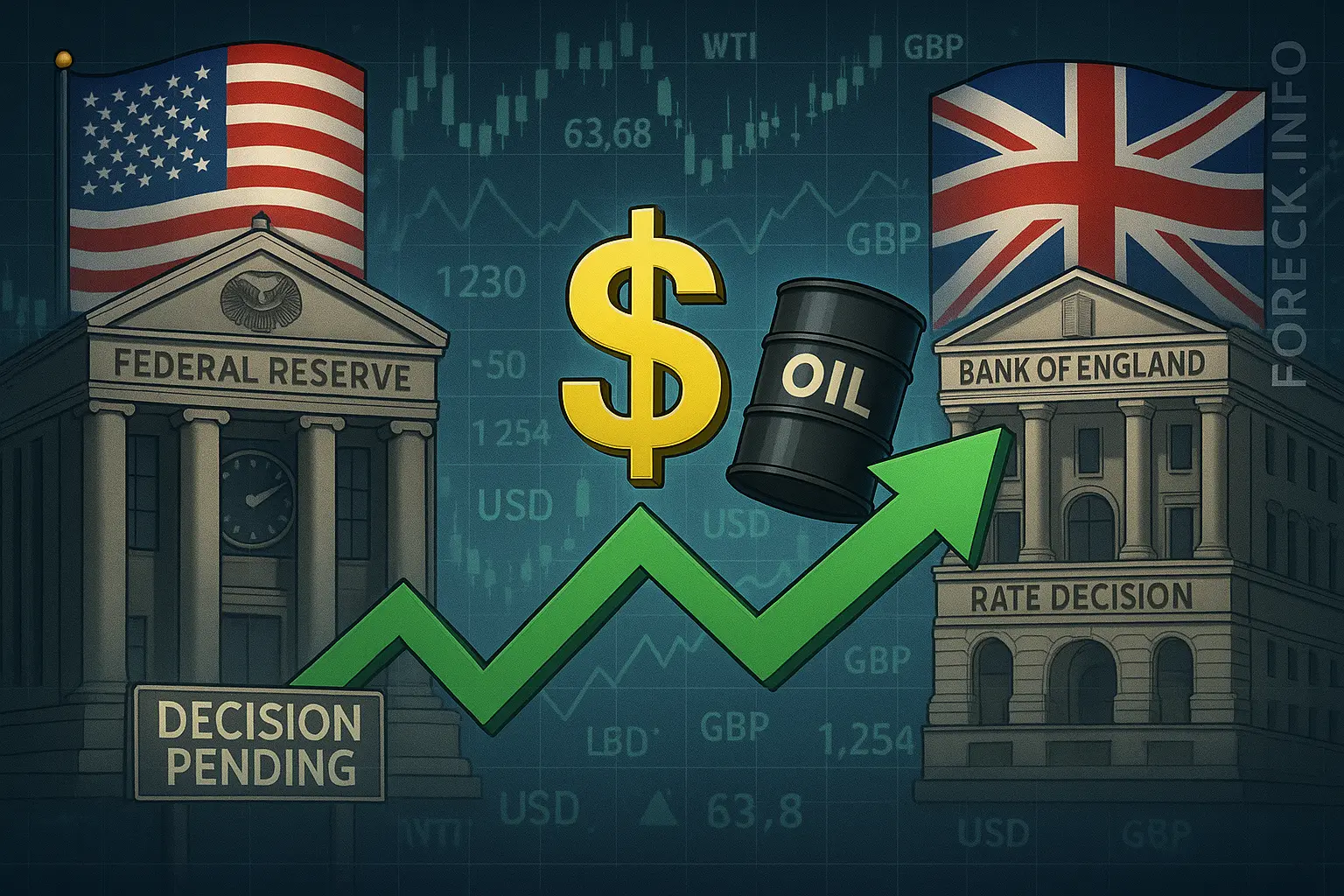
The US dollar is weakening against the euro, yen, and pound. Heightened fears of escalation in the Israel-Iran conflict are driving a flight to safe-haven assets, with new demand for oil-exporter currencies following Israeli strikes on energy infrastructure. As the US continues its transition to an oil-exporting model—supplying much of the EU’s hydrocarbon demand—the greenback receives some support. Meanwhile, all eyes are on the upcoming FOMC decision (Wednesday, 20:00 GMT+2). Despite recent macro data pointing to a slowing economy and ongoing political pressure from President Donald Trump, CME FedWatch Tool now prices a 99.8% probability that the Fed will hold rates steady at 4.25–4.50%.
Currency traders are strapping in for what’s shaping up to be a make-or-break week on the global stage. With the world’s monetary policy elite—from the Federal Reserve and the Swiss National Bank to the Bank of Japan and Bank of England—about to reveal their latest moves, the FX market is alive with speculation, recalibrated bets, and no shortage of nerves.
The US dollar is gaining ground against the euro, yen, and British pound. This bullish momentum is driven by escalating geopolitical risks in the Middle East, where Israeli forces carried out preemptive missile strikes on Iranian targets. As geopolitical uncertainty intensifies, investors have turned en masse to safe-haven assets, boosting the greenback. However, this trend may be short-lived: recent macroeconomic data continue to highlight ongoing weaknesses in the domestic economy. After May's CPI rose from 2.3% to 2.4%, the US labor market showed further signs of cooling, with initial jobless claims remaining at 248,000 for the second straight week—the highest since October—and total claims reaching 1.956 million, the most since the COVID-19 pandemic. As a result, the Fed has diminishing justification to maintain high rates, and mounting pressure from the Trump administration could bring rate cuts sooner than previously expected.
EUR/USD: Euro Retreats from Multi-Year Highs as Dollar Volatility Intensifies
The euro is losing ground against the U.S. dollar during the Asian session, retracing after a sharp rally that had pushed EUR/USD to record levels unseen since October 2021. Persistent dollar weakness globally is driven by mounting investor concerns over the potential damage from President Donald Trump’s aggressive trade agenda. There are increasing fears that high, unilateral tariffs could erode not only the U.S. economic outlook but also confidence in the dollar as the world’s primary reserve currency.
The US dollar continued to decline against the euro, yen, and pound. Investors remain focused on the recent US-China trade talks in London, which initially lifted the dollar after a framework agreement was reached to uphold the Geneva norms adopted in mid-May. However, official approval from China’s President Xi Jinping is still pending. In addition, US inflation data showed an acceleration in the Consumer Price Index (CPI) to 2.4% in May, up from 2.3%. While the core index, excluding food and energy, remained unchanged, the uptick in inflation signals potential negative pressure on demand stemming from President Donald Trump's ongoing "trade war" strategy. Today’s jobless claims report furthered concerns, revealing a rise to 248,000 applications.
The US dollar weakened against the euro, yen, and pound following the conclusion of high-stakes US-China trade talks in London. The two-day meeting resulted in a framework agreement, restoring conditions reached in mid-May: both parties agreed to lower mutual tariffs for 90 days, with US rates at 10.0% and Chinese rates at 30.0%. Notably, the White House failed to secure all objectives—China retained the right to restrict semiconductor material exports, leaving room for further negotiations in the near future. Markets barely responded to a slight uptick in the May CPI (from 2.3% to 2.4%), which continues to pressure the US economy as the Fed maintains its current monetary policy.
Recent Analysis on Forex, Gold, Oil & Global Markets
Latest Forex and commodity market news, analysis, and trends from FORECK.INFO. Markets are driven by macro data, central bank decisions, earnings, and supply-demand factors. Technical analysis helps identify trends, key levels, and potential trading opportunities while managing risk.