

The increasing likelihood of near-term monetary policy tightening by the US Federal Reserve is significantly reducing investor demand for risk assets. It should be recalled that last week the regulator kept the interest rate in the 3.50%–3.75% range. At the same time, nine out of nineteen members of the Federal Open Market Committee (FOMC) expect borrowing costs to rise this year, while Federal Reserve Chair Kevin Warsh stated that the current rate is restrictive only for the housing sector. Against this background, traders’ expectations for a rate increase have shifted toward September, while several adjustments to credit conditions by the end of the year cannot be ruled out.
Additional pressure on the sector is coming from new legal restrictions related to the cryptocurrency industry. The House of Representatives approved a Senate housing bill yesterday, which, among other provisions, includes a ban on the Federal Reserve issuing a government-backed stablecoin for four years. Restrictions on the creation of a CBDC had previously appeared in several executive orders, but this is the first measure that will be sent to President Donald Trump for signing. Meanwhile, the Digital Asset Market Clarity Act (CLARITY), key hearings on which are scheduled to begin in the House of Representatives on July 17, is facing growing opposition both within Congress and among the public, casting doubt on its approval. Many critics are dissatisfied with the absence of provisions preventing current politicians from benefiting from cryptocurrency-related businesses. In addition, several public organisations, including the National District Attorneys Association, are concerned that the bill could complicate investigations into illegal activity and weaken customer identification requirements for crypto companies. For XRP specifically, the approval of CLARITY is important because it would formally classify the token as a digital commodity under the supervision of the US Commodity Futures Trading Commission (CFTC), which could trigger investment inflows into Ripple ETFs. As uncertainty over the adoption of this key crypto industry legislation rises, overall market sentiment remains negative, as confirmed by the decline in the Fear and Greed Index to 17.
Support and resistance levels
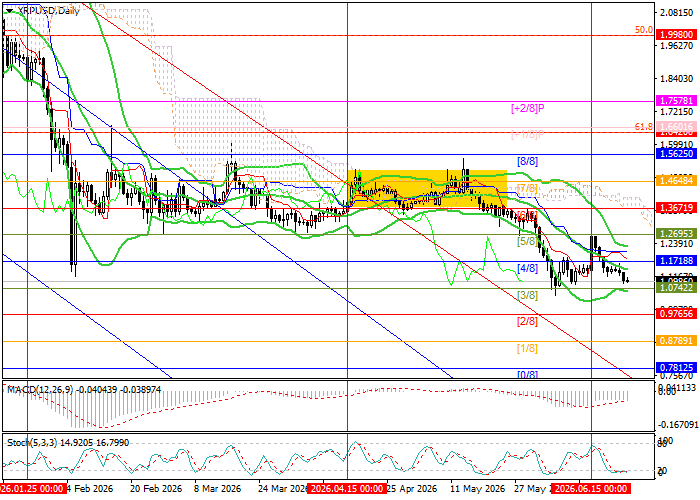
The asset is approaching 1.0742 (Murray level [3/8]); a breakout below this level would allow it to reach 0.9765 (Murray level [2/8]) and 0.8789 (Murray level [1/8]). However, if the price consolidates above 1.2695 (Murray level [5/8]), which was tested in the middle of the month, growth is expected to resume toward 1.4648 (Murray level [7/8]) and 1.5625 (Murray level [8/8]).
Technical indicators maintain a sell signal: the Bollinger Bands are turning downward, the MACD histogram is expanding in negative territory, and the Stochastic has reached the oversold zone, which does not rule out a reversal and a limited correction.
Resistance levels: 1.2695, 1.4648, 1.5625.
Support levels: 1.0742, 0.9765, 0.8789.
Trading scenarios and XRP/USD forecast
Short positions may be opened below 1.0742, with targets at 0.9765 and 0.8789, and a stop-loss at 1.1450. Expected implementation period: 5–7 days.
Long positions may be opened above 1.2695, with targets at 1.4648 and 1.5625, and a stop-loss at 1.1720.
Main scenario
| Timeframe | Weekly |
| Recommendation | SELL STOP |
| Entry point | 1.0740 |
| Take Profit | 0.9765, 0.8789 |
| Stop Loss | 1.1450 |
| Key levels | 0.8789, 0.9765, 1.0742, 1.2695, 1.4648, 1.5625 |
Alternative scenario
| Recommendation | BUY STOP |
| Entry point | 1.2700 |
| Take Profit | 1.4648, 1.5625 |
| Stop Loss | 1.1720 |
| Key levels | 0.8789, 0.9765, 1.0742, 1.2695, 1.4648, 1.5625 |
