

US investment research firm Bernstein published a note on stablecoins on March 23, 2026, outlining potential developments in the field of AI-driven payments.
Stablecoins Gain Support From AI Payments
Stablecoins are cryptocurrencies whose value is pegged to stable assets such as the US dollar, euro, or gold. Unlike traditional cryptocurrencies, stablecoins maintain relatively stable value and enable fast and efficient cross-border payments.
According to CoinMarketCap, citing Bernstein’s research, stablecoins could benefit in the long term from the growth of AI-driven payments, even though current usage remains modest. Analysts believe stablecoins can make micropayments economically viable and enable programmable payments between software agents to be executed automatically.
Current transaction volumes remain relatively small. For example, Stripe and Tempo reported about $5,000 in transaction volume during the first week, while Coinbase’s x402 protocol processed around $24 million over 30 days, according to CoinMarketCap citing Bernstein data.
Infrastructure Matters More Than Current Volumes
Noah Levine of venture capital firm Andreessen Horowitz (A16z) wrote in a post on X (formerly Twitter) on March 11, 2026, that the actual payment volume executed by AI agents is only about $1.6 million.
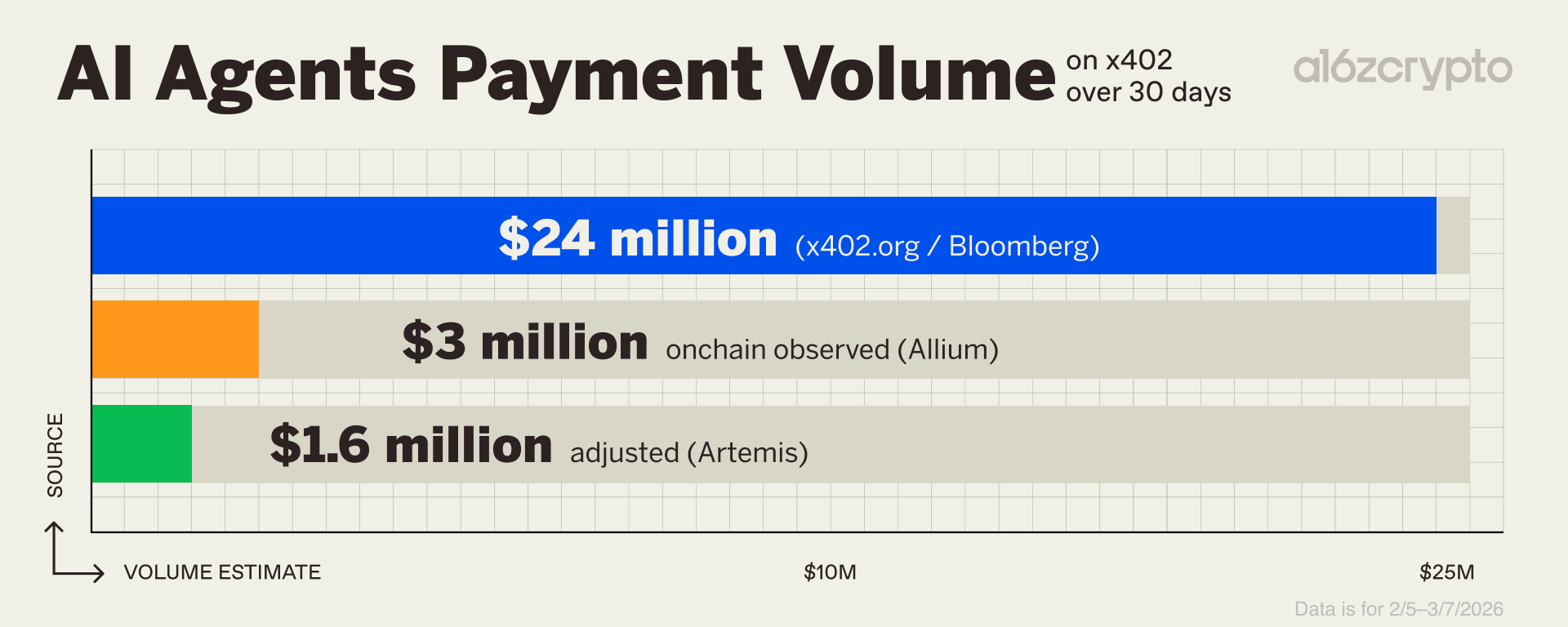
According to Levine, the infrastructure being built around the x402 protocol is far more important, as it has already been integrated into Stripe, Cloudflare, Vercel, and Google’s agent payments framework. In other words, the key potential of x402 lies not in its current volumes but in building the future payments infrastructure.
AI Payments Could Accelerate Growth
According to Bernstein, AI-based payments are not yet the main growth driver of the stablecoin market, but they could become an additional source of expansion in the future. At present, demand is still driven by traditional use cases such as cross-border payments, remittances, card-based products, and neobanking.
Total payment volume increased from $213 billion in 2024 to $375 billion in 2025. Growth was primarily driven by peer-to-peer (P2P) transactions, although activity also expanded in the B2C, B2B, and C2B segments.
USDC Dominates the AI Payments Segment
According to Bernstein, Coinbase and Circle, through the USDC token, remain key players in the stablecoin market. Thanks to strong liquidity and clearer regulatory conditions, USDC could take a leading position in the AI-driven payments segment.
By early 2026, USDC had already processed around $2.4 trillion in transaction volume, significantly exceeding Tether (USDT), which recorded $1.4 trillion.
This material is provided for informational purposes only and does not constitute investment advice.
