

However, recent developments point to a possible trend reversal: Bitcoin is beginning to regain strength against gold. This relative strength may be only the beginning. In the long term, several fundamental factors suggest that Bitcoin has significant upside potential — possibly even greater than gold.

Bitcoin has significant upside potential relative to gold

A key element in the current discussion is the development of the store-of-value market. Data shows that this market has grown substantially in recent years — by an estimated three to four times in less than five years. Most of this growth was absorbed by gold, while Bitcoin lagged far behind.

In 2021, gold’s market capitalization stood at around 11 trillion dollars, while Bitcoin reached approximately 1.26 trillion dollars — about a 10% share of the store-of-value market. By 2026, gold is estimated at roughly 31 trillion dollars, while Bitcoin has grown only slightly to around 1.33 trillion dollars. As a result, Bitcoin’s market share has fallen to about 3.8%.
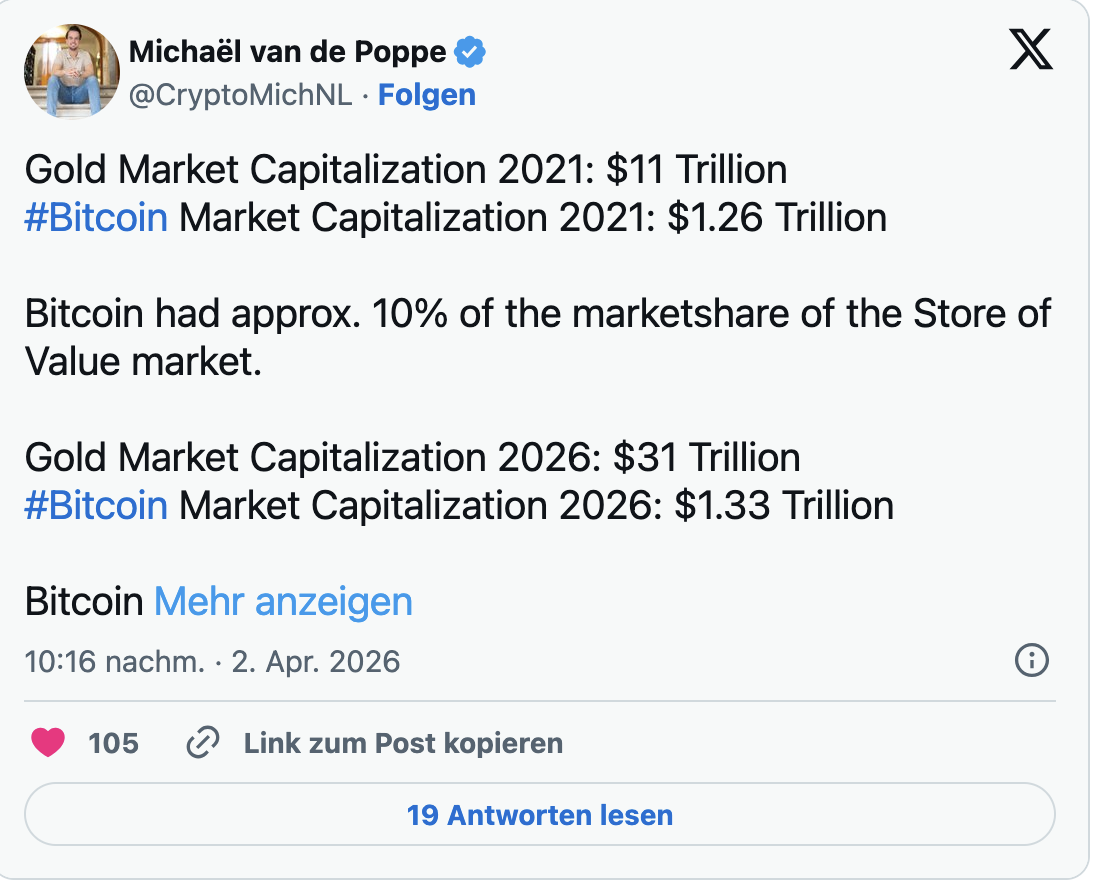
In 2021, gold’s market capitalization was around 11 trillion US dollars, while Bitcoin reached roughly 1.26 trillion US dollars, representing about a 10% market share in the store-of-value segment. Today, in 2026, gold’s market capitalization is estimated at approximately 31 trillion US dollars, while Bitcoin, valued at around 1.33 trillion US dollars, has barely grown. Bitcoin’s market share has therefore fallen to around 3.8%. This development may look bearish for Bitcoin at first glance — but it could actually mean the opposite. It shows that Bitcoin has so far barely benefited from the massive inflow of capital into safe assets. While gold is already highly valued, Bitcoin may still have considerable catch-up potential. In addition, many of the current arguments against Bitcoin — such as technological risks like quantum computing or regulatory uncertainty — are long-term in nature and could fade over time. At the same time, Bitcoin remains a unique asset: limited supply, global tradability, and growing institutional integration. If Bitcoin were simply to return to a 10% share of the store-of-value market, current models would imply a price level of around 200,000 US dollars. And that would only be a return to previous ratios — not even a structural breakthrough. The current weakness may therefore be less a sign of weak demand and more a temporary effect of macroeconomic shifts. That is exactly where the opportunity lies: while gold has already made a strong move, Bitcoin may only be at the beginning of a new valuation phase. Bitcoin L2 as a game changer: more than just digital gold An important factor that could further accelerate this development is the evolution of the Bitcoin ecosystem itself. For a long time, Bitcoin was seen primarily as “digital gold” — a pure store of value with limited functionality. But that narrative could now change fundamentally. With the emergence of Bitcoin Layer-2 solutions, Bitcoin can for the first time be used much more broadly. Applications such as faster transactions, DeFi structures, or programmable smart-contract functions could make Bitcoin far more attractive in the long run — and clearly differentiate it from gold. One particularly interesting project in this area is currently Bitcoin Hyper. Despite an overall weak market environment, the project has already raised more than 32.25 million US dollars in presale — a clear sign of strong demand and investor confidence. Go directly to the Bitcoin Hyper presale. The concept behind it is ambitious: Bitcoin Hyper combines the security and reputation of Bitcoin with the scalability and speed of Solana. This is made possible through the use of the Solana Virtual Machine (SVM), which is expected to attract developers and build a growing ecosystem. At the same time, a bridge between Layer 1 and Layer 2 ensures that Bitcoin can be efficiently integrated into new applications. Technological components such as zk-proofs are also worth highlighting, as they provide additional security and efficiency. This creates a hybrid system that could address both institutional and retail demand. Another incentive is the current staking model offering around 36% APY, which appears especially attractive for early investors. Combined with the dynamic price structure in the presale — where the token price rises step by step — this creates additional pressure for early entry. Overall, the picture is clear: while gold remains largely static in its function, Bitcoin continues to evolve. If the Layer-2 narrative takes hold, Bitcoin could be viewed not only as a store of value, but also as a versatile financial infrastructure.
Gold market capitalization in 2021: 11 trillion dollars. X

At first glance, this may look negative for Bitcoin, but the situation could mean the opposite. These figures show that Bitcoin has so far barely participated in the inflow of capital into safe-haven assets. While gold has already advanced significantly, Bitcoin may still have substantial catch-up potential.

In addition, many of the current arguments against Bitcoin — such as technological risks like quantum computing or regulatory constraints — are long-term in nature and may weaken over time. At the same time, Bitcoin remains a unique asset thanks to its limited supply, global liquidity, and growing institutional interest.

If Bitcoin returns even to a 10% share of the store-of-value market, current models suggest a potential price of around 200,000 dollars. And that would merely be a return to former proportions, not a structural breakthrough.
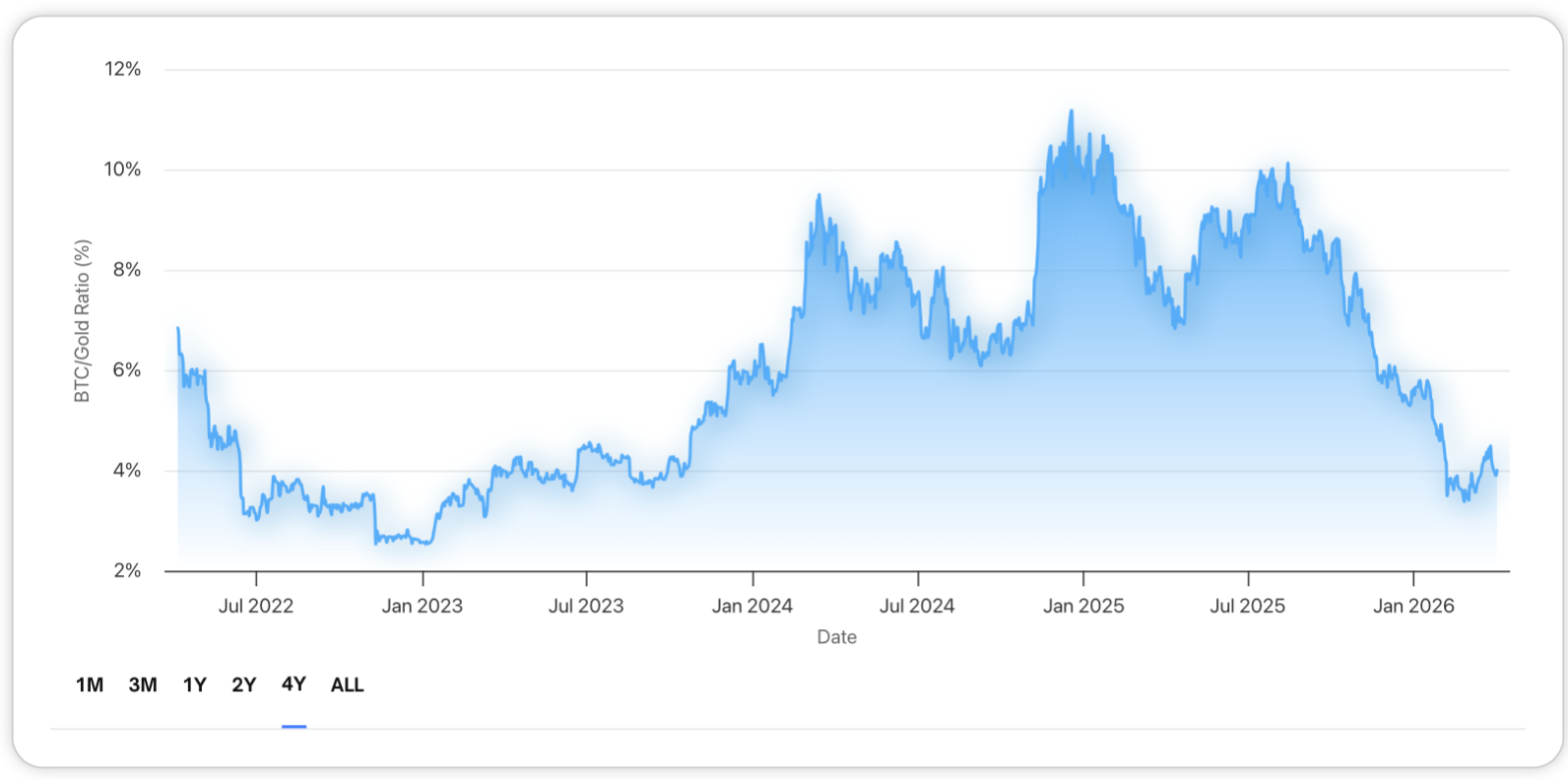
Market capitalization

Bitcoin’s current weakness may be less a sign of falling demand and more a temporary effect of macroeconomic shifts. While gold has already gone through a major rally, Bitcoin may be at the beginning of a new valuation phase.

Current dynamics suggest that Bitcoin may be entering a new phase of growth relative to gold. Strong fundamentals, Layer-2 development, and institutional interest are creating conditions for a revaluation of BTC. If this trend continues, Bitcoin could become not only digital gold, but also a key financial infrastructure of the future.