

The founding members are BlackRock, Coinbase Crypto Exchange, Strategy, Fidelity Digital Assets, Galaxy, Anchorage Digital, ARK Invest, Block and Blockstream. Together, they represent several parts of the institutional Bitcoin ecosystem, including asset management, custody, exchanges, payment services and infrastructure development.
The $15 million will not be placed in a single jointly managed fund. Each member will independently select the developers, researchers and organisations it wants to support. The figure represents the aggregate value of the members’ commitments over three years.
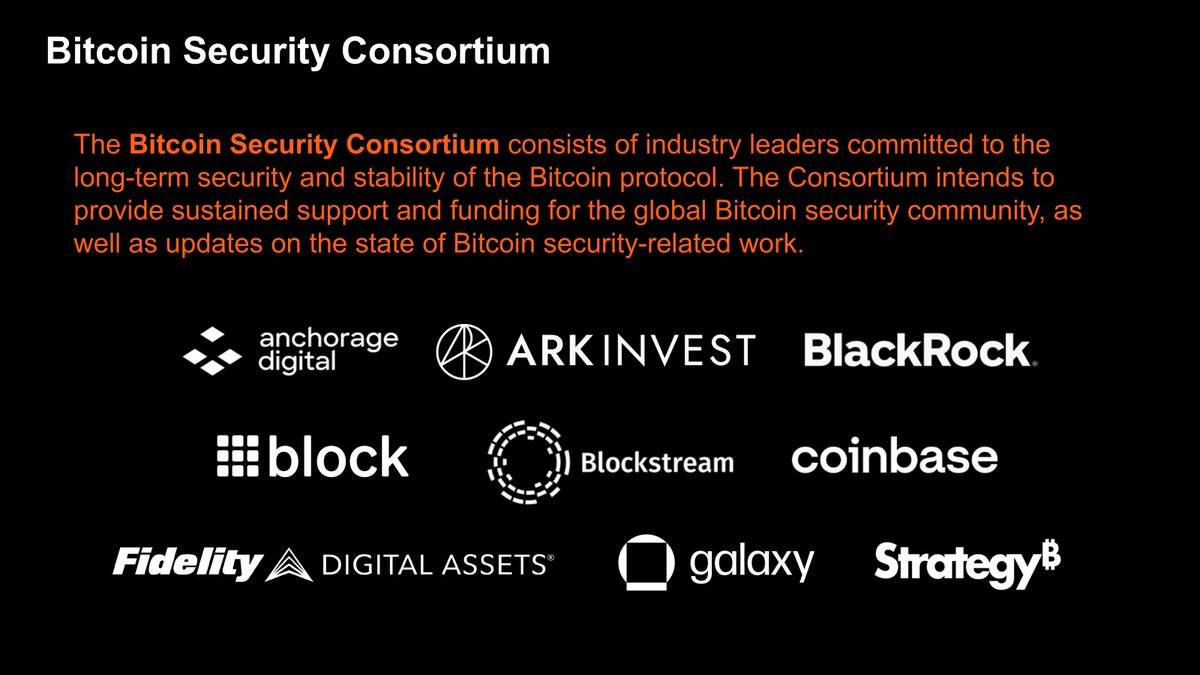
In addition to providing financial support, the Bitcoin Security Consortium intends to publish information about the state of Bitcoin security and become a reliable reference for investors, the media and the public.
The group has stressed that it will not develop or direct the Bitcoin protocol, promote particular protocol changes or speak on behalf of Bitcoin developers. Decisions concerning the network will remain with Bitcoin’s global and decentralised open-source community.
The consortium’s day-to-day operations will be coordinated by Mike Schmidt, Executive Director of the non-profit organisation Brink, on a voluntary basis. Brink specialises in funding and supporting open-source Bitcoin developers.
Preparing Bitcoin for the Quantum Computing Era
A key area of focus for the consortium will be post-quantum cryptography — security technologies designed to protect Bitcoin against the potential future capabilities of quantum computers.
Bitcoin relies on digital signatures based on elliptic-curve cryptography. With conventional computers, deriving a private key from its corresponding public key is considered computationally impractical.
A sufficiently powerful quantum computer running Shor’s algorithm could theoretically solve this mathematical problem much faster. An attacker might then be able to recover a private key from an exposed public key and produce valid transactions without the legitimate owner’s approval.
No quantum computer capable of carrying out such an attack against Bitcoin exists today. Nevertheless, the consortium argues that preparations should begin well in advance because designing, reviewing, testing and deploying major changes across a decentralised network can take many years.
Strategy CEO Phong Le said the company, as a long-term Bitcoin holder, has a strong incentive to ensure that the network remains secure for future generations. Funding developers, he said, is a natural way for the company to support the ecosystem.
Robert Mitchnick, BlackRock’s Global Head of Digital Assets, similarly highlighted the importance of Bitcoin Core developers and the need to make additional funding available for Bitcoin’s long-term security.
Institutional Concern About Quantum Risk Is Growing
Financial institutions are paying increasing attention to quantum security as the technology continues to advance.
In December 2024, Google introduced its Willow quantum processor. According to the company, the chip completed a benchmark calculation in under five minutes that would take one of today’s leading supercomputers approximately 10 septillion years. However, Google described Willow as a step towards a useful, large-scale quantum computer rather than a system currently capable of breaking modern cryptography.
In February 2025, Microsoft introduced Majorana 1, which the company described as a quantum processor based on its Topological Core architecture and designed as a step towards scalable topological quantum computing. Existing quantum systems, however, remain far below the scale and reliability required to mount a practical attack against Bitcoin.
In a prospectus filing dated 9 May 2025 for the iShares Bitcoin Trust ETF, the issuer included a detailed warning that sufficiently advanced quantum computing could make Bitcoin’s underlying cryptography ineffective, compromise the network or allow malicious actors to target wallets holding bitcoin.
How Much Bitcoin Could Be Exposed?
According to Project Eleven, a company focused on post-quantum blockchain security, approximately 6.9 million BTC was held in addresses it classified as quantum-vulnerable as of February 2026. This represented roughly 33% of Bitcoin’s circulating supply at the time.
The category includes early Pay-to-Public-Key outputs, reused addresses and certain output types, including Taproot, where public keys are already visible or become exposed after a transaction. This does not mean that the funds can be stolen today. The risk would only become practical if a sufficiently powerful and fault-tolerant quantum computer were developed.
Project Eleven’s model places the baseline estimate for Q-Day — the point at which a quantum computer could practically break widely used public-key cryptography — in 2033. Its earliest scenario points to 2030, while its later scenario extends to 2042. These dates are modelled estimates rather than definitive predictions.
Project Eleven estimates that the digital asset industry holds more than $3 trillion in aggregate value and that virtually all of it is secured by elliptic-curve-based digital signature schemes. The potential issue therefore extends beyond Bitcoin to Ethereum, Solana, stablecoins, blockchain bridges, custody systems and other parts of the digital asset infrastructure.
Galaxy Commits Up to Another $5 Million
Two days before the Bitcoin Security Consortium was announced, Galaxy launched its own Galaxy Bitcoin Quantum Readiness Initiative.
Galaxy said it would provide up to $5 million in grants for developers and researchers working on post-quantum solutions for Bitcoin. The programme also includes a dedicated research and publishing effort and the creation of a Quantum Advisory Council.
The launch of several funding initiatives within the same week suggests that major institutional participants increasingly view quantum security as a long-term infrastructure challenge.
Conclusion: Quantum computers do not pose an immediate practical threat to Bitcoin, but migrating the network to new cryptographic standards could take years. Major industry participants are therefore beginning to fund research and security preparations well in advance.
