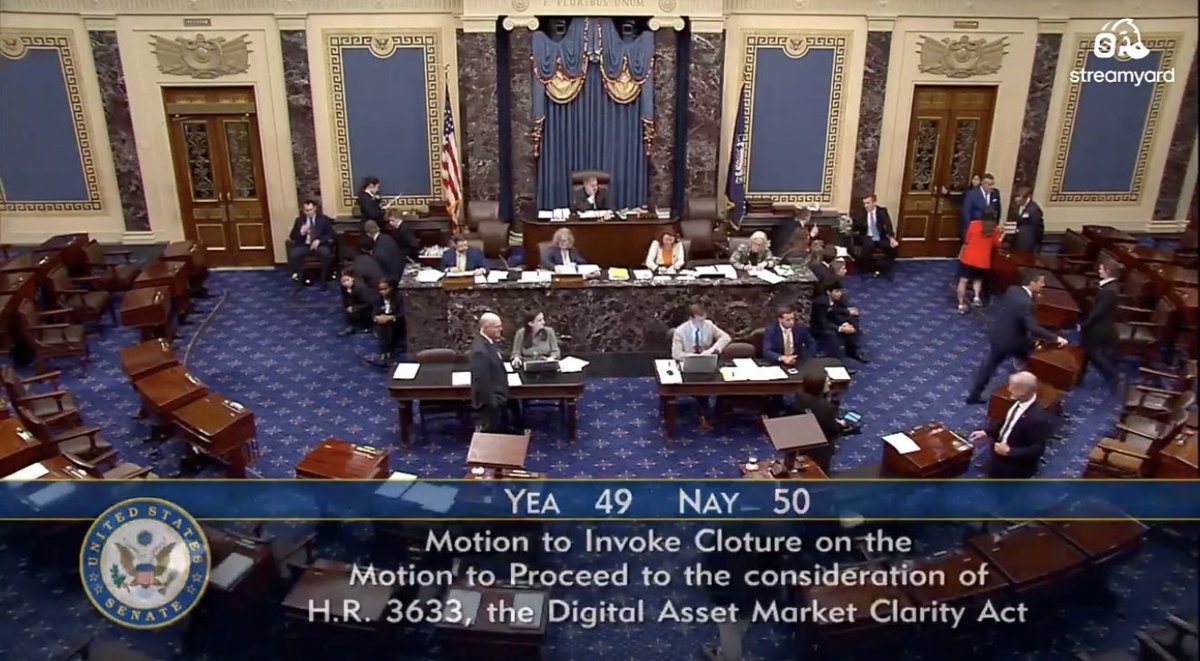
The US Senate failed to invoke cloture on the Digital Asset Market Clarity Act, preventing the chamber from moving to debate on legislation intended to establish a broad regulatory framework for the American cryptocurrency market.
In the procedural vote held on September 15, the motion received 50 votes in favour and 49 against, falling short of the 60 votes required to advance.
Importantly, this was a vote on whether the Senate should proceed to debate the CLARITY Act, not a final vote to pass the legislation.
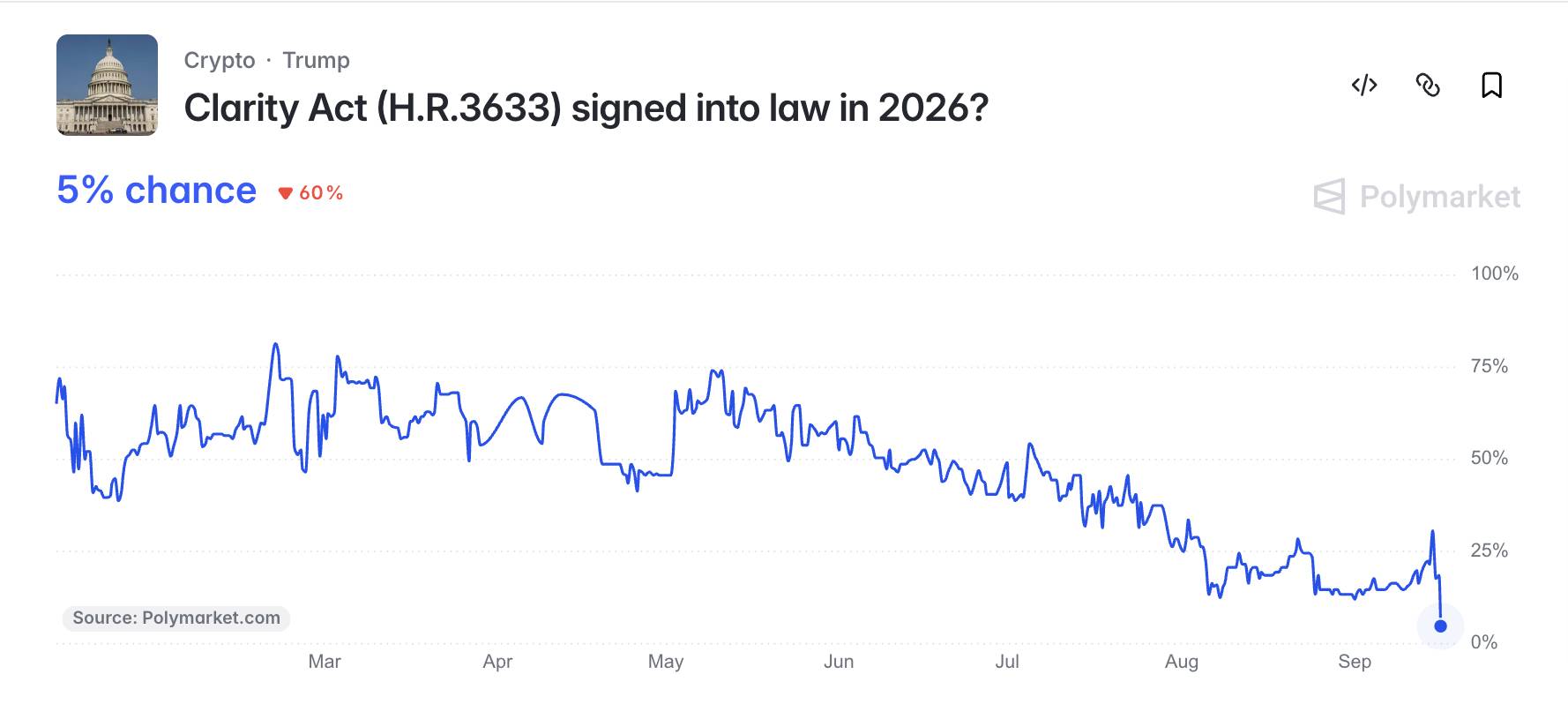
The defeat sharply reduced the bill’s chances of being considered again in 2026. Congress has fewer than 36 legislative days left in the current session, while lawmakers are increasingly focused on the November midterm elections.
Dispute over ethics rules and Trump’s financial interests
One of the main obstacles was the prolonged dispute over ethics provisions. For months, lawmakers revised the bill in an effort to restrict government officials and their relatives from benefiting financially from digital assets while in office.
Only days before the vote, Republicans released a revised draft of more than 630 pages. It incorporated over 126 changes requested by Democrats after almost a year of negotiations.
President Donald Trump reportedly accepted about 80% of the new bipartisan proposals in an attempt to remove one of the biggest barriers to Democratic support. Senator Cynthia Lummis described the revised text as what could be the parties’ final opportunity to reach an agreement.
As FORECK.INFO reported in its analysis of the revised CLARITY Act, the draft expanded enforcement powers for state attorneys general and required officials with substantial crypto investments to divest or place the assets in a blind trust. Democrats argued that these measures still did not adequately address conflicts of interest.
Immediately before the vote, Democratic lawmakers demanded that the ethics restrictions be extended to President Trump’s children. They also wanted officials with significant financial interests in crypto businesses to sell those holdings rather than merely transfer them into blind trusts. Lummis rejected the proposal, leaving the dispute unresolved.
Democratic senators who had been viewed as possible supporters—including Kirsten Gillibrand, Catherine Cortez Masto, Angela Alsobrooks, Cory Booker and Mark Warner—ultimately voted against advancing the bill.
Warner said the parties had moved close to agreement on law-enforcement and national-security provisions. However, he argued that the bill still failed to address conflicts arising from Trump’s ability to benefit from the crypto industry through projects including World Liberty Financial and the TRUMP memecoin.
The CLARITY Act also faced opposition from 18 state attorneys general, who were concerned that the legislation could restrict the ability of states to pursue fraud and misconduct involving digital assets.
US banking groups also lobbied for tighter restrictions on stablecoins, while software developers sought clearer legal protections for creators of non-custodial digital-asset tools.
The debate continues after the vote
Despite the failed procedural vote, several senators said the result did not necessarily mark the end of the legislation.
Asked by journalist Eleanor Terrett whether she was prepared to let the bill die after voting against cloture, Democratic Senator Angela Alsobrooks said she was not.
Alsobrooks argued that more than 70 million Americans participate in the crypto market without a clear federal framework. Congress therefore still has a responsibility to establish rules for the sector. She nevertheless criticised Republican leaders for forcing a vote before concerns about Trump’s crypto-related conflicts of interest had been resolved.
Lummis, one of the main Republican architects of the CLARITY Act, accused Democrats of never being serious about advancing the bill. She said Republicans had accepted repeated requests for changes during more than a year of negotiations, only for Democrats to introduce new conditions whenever an agreement appeared close.
Lummis argued that the failed vote meant Congress had missed an opportunity to protect investors from fraud and preserve US leadership in the cryptocurrency industry. She accused Democrats of prioritising political calculations over the creation of a regulatory framework.
The Digital Chamber described the result as a setback rather than a final defeat and said it would continue pushing for comprehensive digital-asset legislation.
SEC Chair Paul Atkins also reiterated his support for congressional passage of the CLARITY Act as a durable legal foundation for the market. At the same time, he said the SEC and CFTC were prepared to use their existing authority to develop crypto rules if Congress remained deadlocked, meaning that regulatory progress does not depend entirely on this bill.
Bitcoin falls after the CLARITY Act vote
The cryptocurrency market reacted quickly after the Senate failed to advance the bill. Bitcoin traded near $77,200 before the vote but fell below $76,000 as opposition increased, briefly approaching $75,000 before recovering towards $75,600 at the time of the original report.
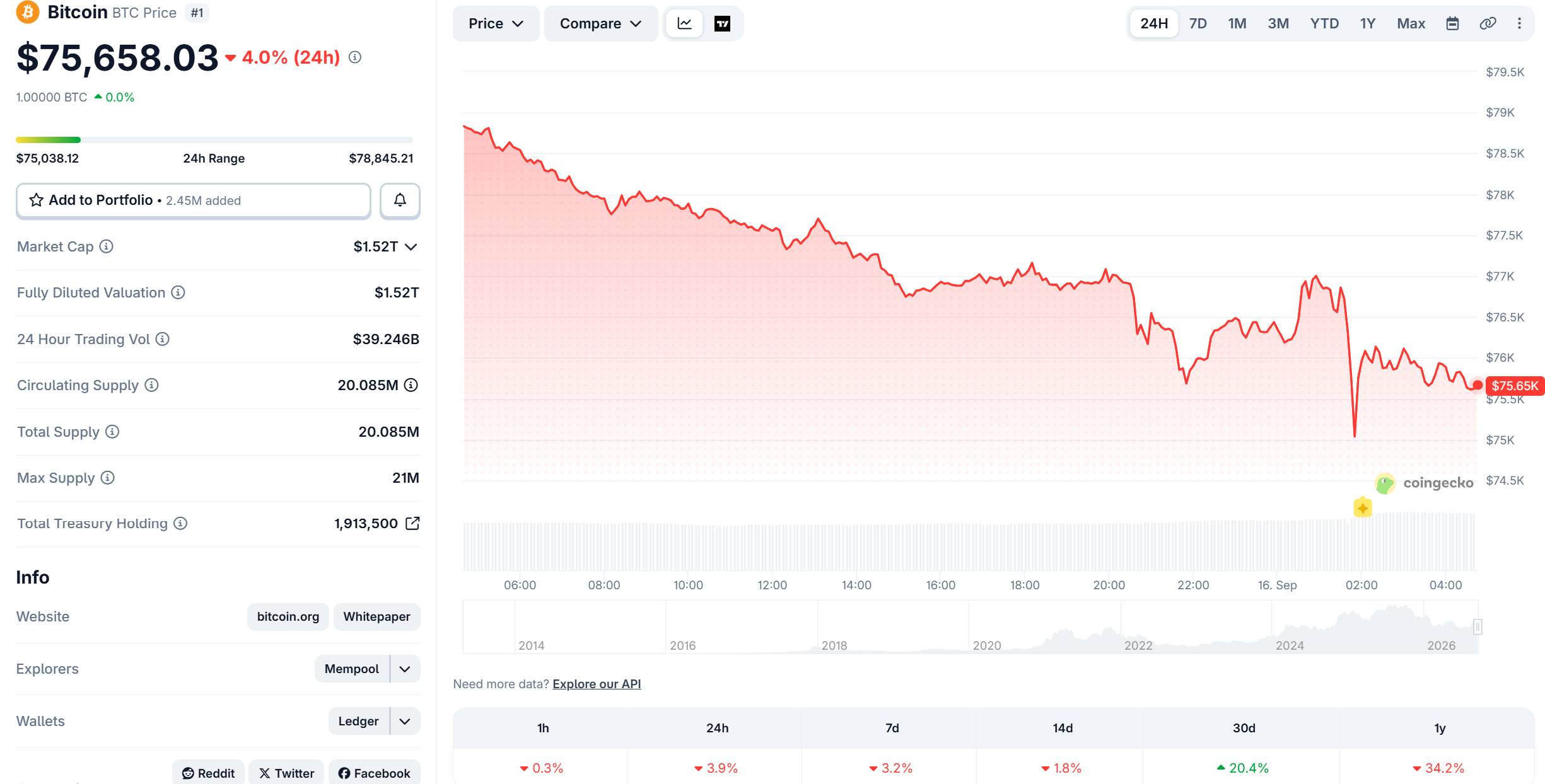
The market did not experience a broader panic sell-off, partly because investors had already prepared for the possibility that the legislation would stall. On Polymarket, the estimated probability of the bill becoming law in 2026 fell from about 34% to 17% before the vote and then to approximately 5% after the result.