

Ethereum Foundation has outlined a roadmap to make Ethereum Layer 1 quantum-resistant by December 2029. It has also identified two Ethereum Improvement Proposals (EIPs) that must ship with the Hegotá upgrade to keep the broader roadmap on track.
Alongside this, its Protocol Cluster published a unified tier list for the 62 EIPs proposed for Hegotá for the first time, bringing together views previously expressed separately by individual teams. The assessment incorporates input from around 60 researchers and engineers following several rounds of discussion and independent evaluation.
Two must-ship EIPs for Hegotá
Of the 62 proposals, the Protocol Cluster assigned only two to S-tier, meaning they must be included in Hegotá. Under this prioritization, if either runs into development problems, the hard fork schedule would be adjusted before either proposal is removed from the upgrade.
The first is FOCIL (EIP-7805), the consensus-layer headliner designed to strengthen Ethereum’s resistance to transaction censorship. Instead of allowing block builders to decide alone which transactions enter a block, FOCIL lets a group of validators impose inclusion requirements for eligible transactions. This limits a builder’s ability to deliberately delay or exclude users’ transactions.
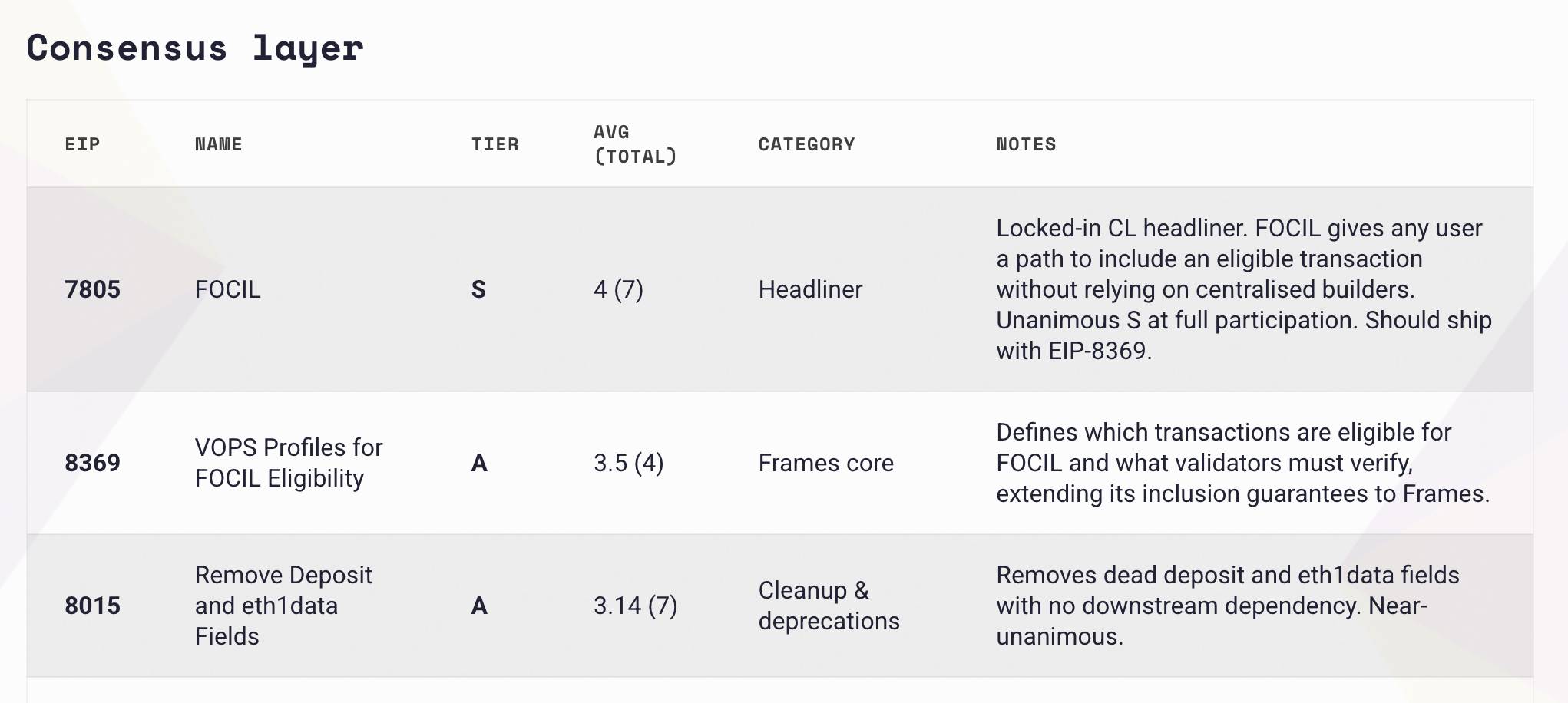
The mechanism aims to give eligible user transactions a fairer path into blocks and reinforce Ethereum’s credible neutrality. FOCIL is intended to ship alongside EIP-8369, which defines eligibility and verification requirements for extending those guarantees to the new transaction model.
On the execution layer, Ethereum Foundation selected Frame Transactions (EIP-8141) as the centerpiece. The proposal introduces native account abstraction at the protocol level, allowing programmable accounts to operate without requiring a separate bundler infrastructure as a prerequisite.
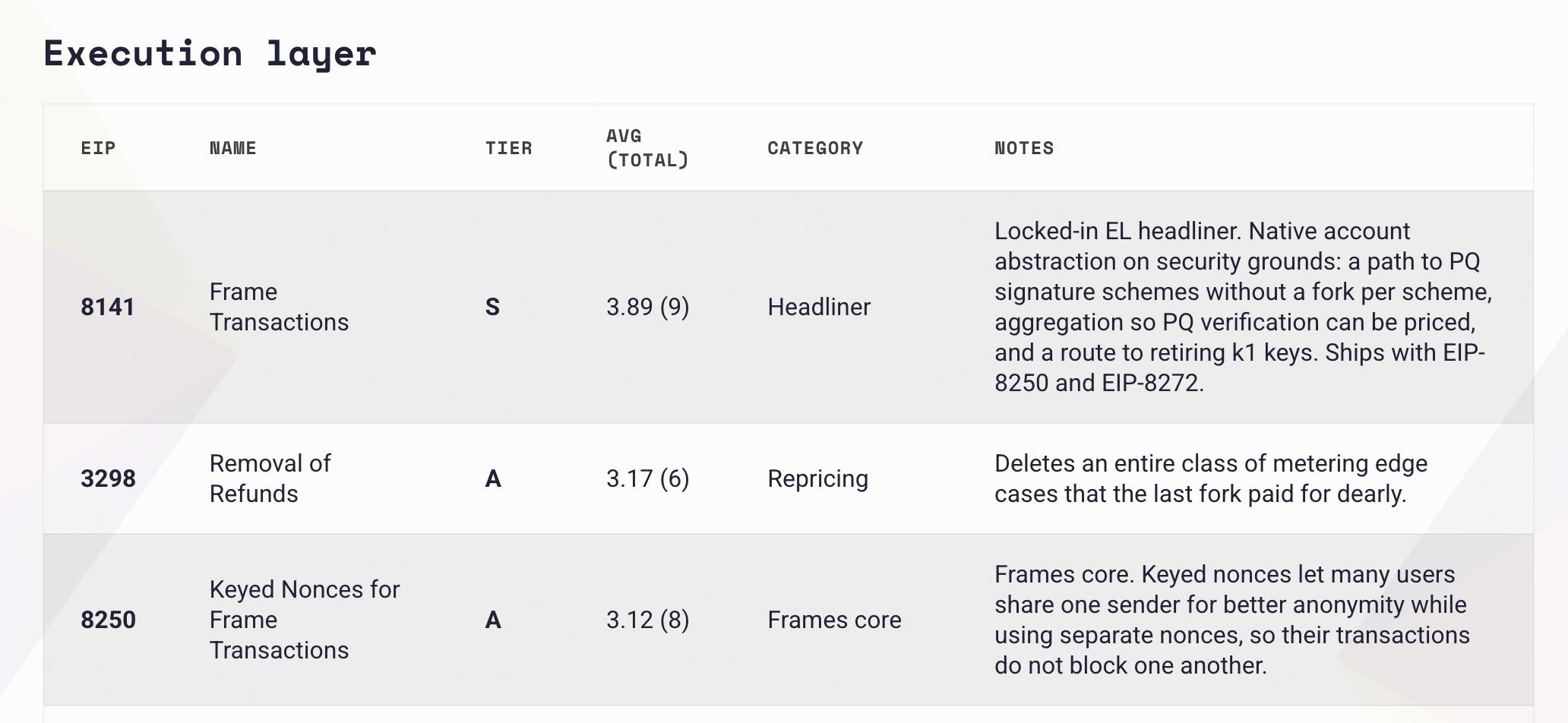
The new format separates a transaction into distinct steps, such as validating the sender, determining who pays gas and executing the requested actions. Separating these stages means the transaction signer does not necessarily have to pay the fee, making transaction processing more flexible and enabling additional wallet features.
For example, users could pay an intermediary in ERC-20 tokens while that intermediary covers the network fee in ETH, or an application or third party could sponsor their gas costs. The proposal does not replace ETH as the protocol’s fee asset. Frame Transactions also enables account designs supporting multisignature authorization, social recovery, batching multiple actions and more flexible authentication methods.
According to Ethereum Foundation, the main value of Frame Transactions goes beyond user experience: it provides a foundation for moving accounts away from today’s ECDSA signatures on secp256k1 toward post-quantum signature schemes. New account authentication methods could then be introduced without requiring a separate hard fork for every signature scheme. Frame Transactions is expected to ship with EIP-8250 and EIP-8272, two complementary proposals for the new transaction system.
Ethereum aims to become a quantum-resistant Layer 1 before 2030
Alongside the Hegotá rankings, Ethereum Foundation published its current multiyear protocol priorities. Its development roadmap sets a central target: quantum resistance across Ethereum Layer 1’s execution, consensus and data layers by December 2029.
The Foundation says this date aligns with post-quantum migration targets pursued by Google, Microsoft and Cloudflare. Nobody can precisely predict Q-day, when quantum computers could become powerful enough to break the relevant cryptography. Ethereum is therefore planning around a deliberately cautious scenario in which it could arrive as early as 2030, rather than presenting that year as a firm prediction.
Hegotá itself will not make Ethereum fully quantum-resistant. It primarily lays the groundwork for subsequent upgrades. The current roadmap places Minimum Viable Post-Quantum protection at J*, followed by full resistance at L*. Developers are also considering moving the remaining post-quantum attestation work forward to K*, while postponing mandatory execution proofs by one fork.
To meet the target, the Foundation calculates that, if Glamsterdam ships in December 2026 and full protection arrives five forks later in December 2029, upgrades would need to follow an average cadence of around 7.2 months. This is a planning scenario rather than a confirmed release schedule, and it requires multiple research and development efforts to proceed in parallel.
Beyond post-quantum security, Ethereum Foundation identifies four other long-term research directions: fast finality, privacy, state management and zkEVM. It emphasizes that early quantum readiness is intended both to protect the network from future threats and to demonstrate its ambition for Ethereum to remain operational for 50, 100 or even 1,000 years
