
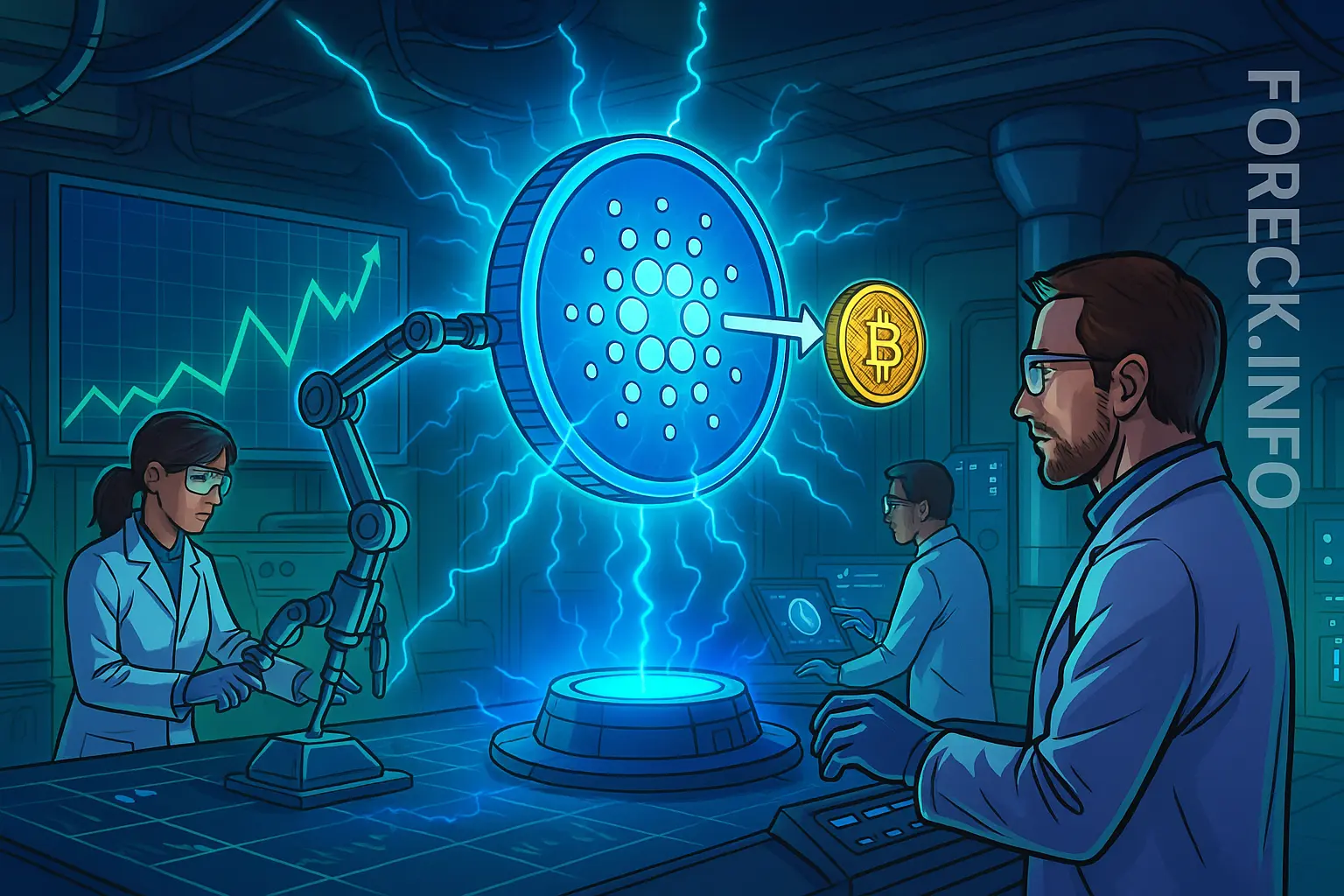
A few days ago, Cardano’s first “partner chain” — Midnight — went live. Its native token, NIGHT, saw an extremely volatile launch: after spiking to around 0.10 US dollars at listing, the price crashed to roughly 0.035 dollars. A classic “degen dump” on exchanges — that is exactly how Cardano founder Charles Hoskinson described the move. The price has since stabilized in a 4–7 cent range.
Despite its short trading history, Midnight is already viewed as one of the most interesting newcomers in the privacy narrative. The project combines zero-knowledge technology with Cardano’s security and aims to build a regulator-friendly “programmable privacy layer” for Web3, enterprises, and public institutions. Hoskinson openly talks about a long-term target valuation of around 10 billion US dollars, while the current fully diluted valuation (FDV) stands at roughly 1 billion dollars.
More than “just” a privacy chain
From a technical standpoint, Midnight goes far beyond classic privacy coins like Monero or Zcash. Sebastian, CTO of the Midnight Foundation, puts it this way:
“We’re not just building private gold, we’re building private oil.”
While most existing privacy networks only obscure the base coin, Midnight enables private smart contracts, custom tokens, and decentralized applications — from DeFi protocols and prediction markets to private stablecoin payments. By default, states and balances are hidden, but through a mechanism called selective disclosure, users and businesses can selectively reveal specific data — for example, for KYC, credit checks, or regulatory reporting.
In doing so, Midnight addresses two key trends at once: growing institutional demand for privacy-preserving yet regulation-compatible blockchains, and retail users’ desire to use stablecoins in everyday life without exposing their full transaction history.
Another advantage is its unusually fair token launch: no VC pre-sale, with broad distribution via the Scavenger Mine and Glacier airdrop. NIGHT is already trading on major centralized exchanges — Binance (Alpha), Kraken, OKX, Bybit, KuCoin, as well as on Cardano ecosystem DEXs such as Minswap and SundaeSwap. For such a young project, this is an exceptionally broad listing footprint.
Midnight (NIGHT) technical analysis
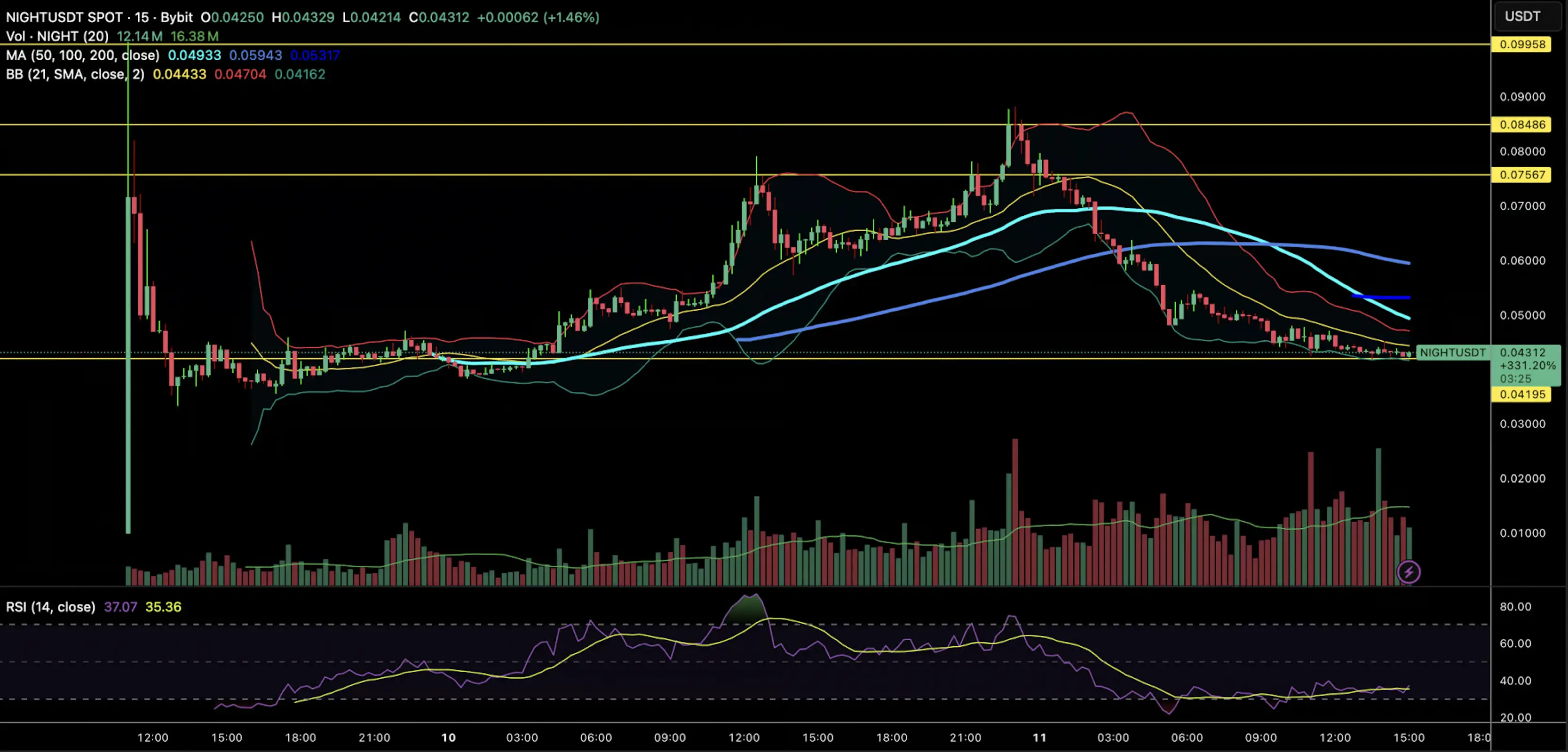
Over the last 24 hours, NIGHT has traded between roughly 0.0392 dollars (low) and 0.0875 dollars (high). At the time of writing, the token is trading around 0.0435 dollars (–50%). Market capitalization briefly exceeded 1 billion dollars and has since pulled back to about 700 million dollars. Fully diluted valuation (FDV) remains slightly above 1 billion dollars. Around 16.6 billion NIGHT are in circulation, with a max supply capped at 24 billion tokens.
After the initial crash, the price posted a notable rebound, followed by another correction. On the downside, an initial support zone can be identified around 0.04 dollars. Still, caution is warranted. While the price may look undervalued on a long-term horizon, a deeper short-term correction remains possible, and a more attractive entry zone could emerge in the 0.031–0.025 dollar range.
On the upside, the 0.072–0.085 dollar area acts as short-term resistance, where the latest spike was sold off. A sustained breakout above this range could open the door to the 0.10–0.15 dollar targets Hoskinson mentioned.
On lower timeframes, the RSI has previously entered strongly overbought territory and has recently retreated to around 33 on the hourly chart, pointing to short-term buyer exhaustion. The wide trading range and high volume confirm a strong-trend but highly volatile market phase, where sharp counter-moves remain possible at any time.
NIGHT price outlook: long-term promising, short-term overheated
From a fundamental perspective, several factors suggest that Midnight has realistic mid-term potential to enter the top 100 cryptocurrencies by market cap. The project introduces a novel approach to privacy that goes beyond traditional confidentiality tools: programmable data disclosure (selective disclosure) enables not only private transactions but also private smart contracts and flexible token models — a design that targets both institutional and retail users.
In addition, Midnight is deeply integrated into the Cardano ecosystem, leveraging its infrastructure and staking-based security model, which gives the network a robust technical foundation from day one. The roadmap also envisions gradual expansion into other ecosystems such as Ethereum and Solana, which could materially increase the project’s reach and relevance in a multichain environment.
This growth potential is further supported by a fair launch without venture capital and early listings on tier-one exchanges — a rare combination for a project at such an early stage that significantly accelerates market penetration.
From a valuation standpoint, however, the token currently looks quite ambitious: an FDV above 1 billion dollars alongside phased airdrop unlocks suggests that NIGHT may be overpriced in the short term. The coming months are likely to be shaped by additional airdrop tranches, each of which can add incremental selling pressure.
In the short term, the setup looks two-sided:
-
Bullish as long as the price holds above the 0.042 dollar area and pullbacks are being bought. A breakout above 0.075 dollars on strong volume could extend the uptrend.
-
Cautious / bearish if NIGHT falls below support around 0.042 dollars — in that case, retests of the 0.04–0.025 dollar range or even slightly lower levels become more likely.
Over the long term, Midnight remains an intriguing candidate thanks to its technological design, strong backing from the Cardano ecosystem, and the broader global privacy trend. Anyone considering an entry should be fully aware of the high volatility, use staggered (laddered) entries, and closely monitor upcoming airdrop waves.