
On Sunday evening, the Bitcoin rate once again fell below the $90,000 level, while centralized crypto exchanges continue to report a steady decline in BTC balances. As of now, the amount of Bitcoin held on exchanges has dropped to its lowest level since autumn 2018.
According to the latest on-chain data from analytics firm CryptoQuant, investors have withdrawn more than 196,000 BTC worth approximately $17.4 billion over the past three months from platforms such as Binance, Coinbase, Kraken, and others. This process has accelerated a trend that first began to take shape earlier this spring.
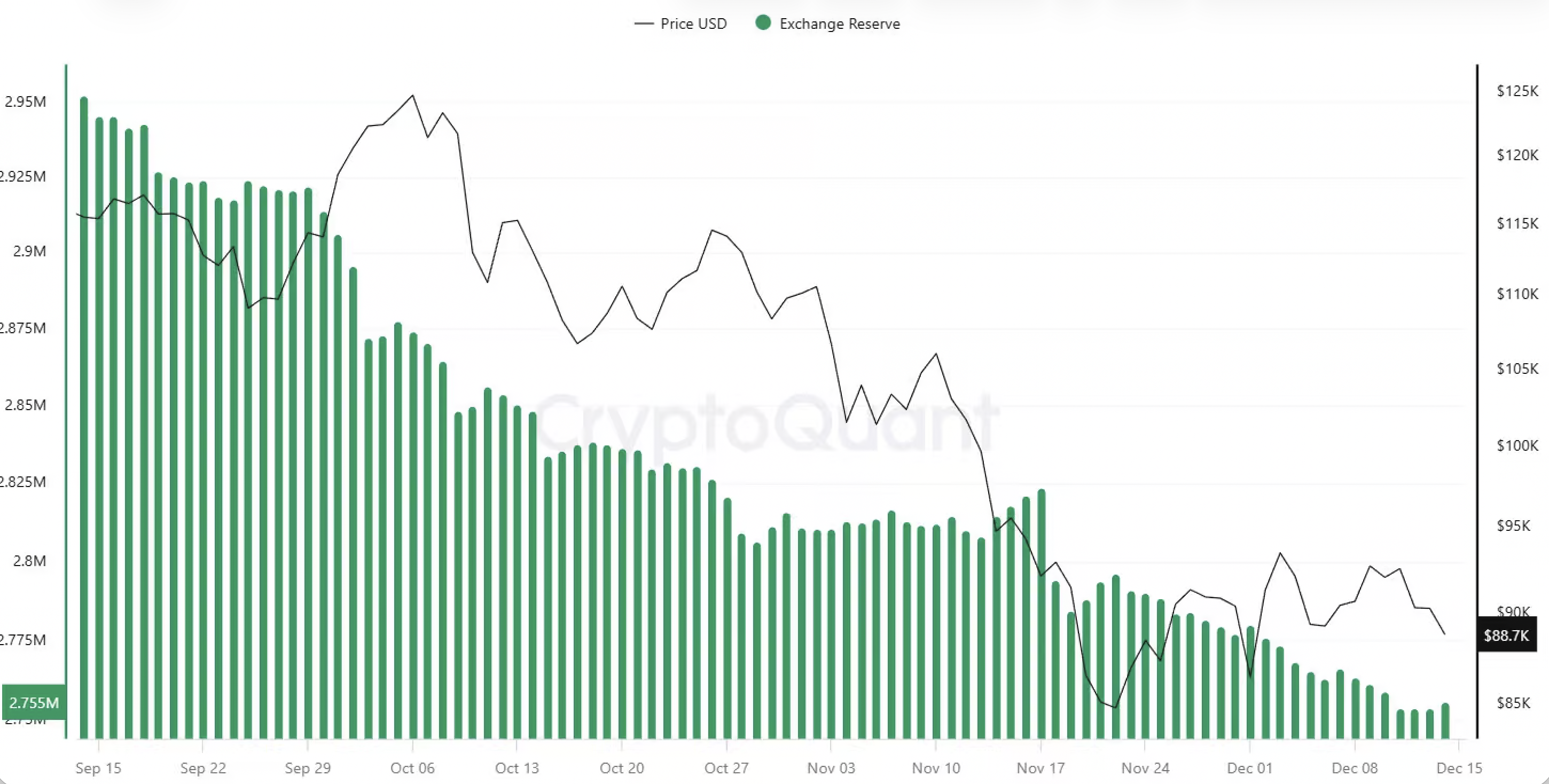
On September 14, exchanges collectively held around 2.952 million BTC. Today, that figure has fallen to approximately 2.755 million BTC. This means that only about 13.1% of all Bitcoin ever mined is currently stored on crypto exchanges. At first glance, more users appear to be following the long-standing crypto principle: “Not your keys, not your coins.”
Why is Bitcoin leaving exchanges?
Commenting on the decline in BTC reserves at the world’s largest exchange, Binance, CryptoQuant analysts noted:
“When the market is rising, long-term holders and large investors tend to move BTC from exchanges into cold wallets, reducing potential selling pressure.”
According to the analysts, this behavior is typical of strong markets and reflects confidence rather than fear. But does this automatically make it a bullish signal?
An alternative interpretation
There is another explanation. More crypto-friendly regulation in the United States has encouraged traditional financial institutions to launch their own custody solutions. At the same time, Bitcoin treasury companies (including MicroStrategy) and spot Bitcoin ETFs have accumulated hundreds of thousands of BTC since the beginning of the year — assets that are also held outside traditional exchanges.
As a result, it is premature to speak of an automatic “supply shock.” Bitcoin’s history shows that exchange outflows do not always lead to higher rates. For example, in 2021, massive BTC withdrawals failed to prevent a sharp market decline following China’s crypto ban.
What does this mean for the Bitcoin rate?
For patient investors, the current situation may still be seen as a moderately positive signal, as similar conditions in the past have often supported rate growth over the medium to long term.
However, one critical ingredient for the next major rally is still missing: the return of demand — both from retail investors and from large institutional players.