
In February, the eurozone economic sentiment index fell from 40.8 points to 39.4 points, while analysts had expected a reading of 45.2 points. The corresponding indicator for Germany declined from 59.6 points to 58.3 points versus preliminary estimates of 65.0 points. Rising defense spending by European countries this year continues to signal stronger budgetary support; however, its impact on business activity and private investment remains limited. According to the latest official data for 2025, total defense spending by the bloc’s 27 member states amounted to around €381.0 billion, equivalent to 2.1% of aggregate gross domestic product (GDP). Germany has already approved a defense budget of €108.2 billion, underscoring the priority placed on strengthening security and modernizing the armed forces. At the same time, venture capital investment in defense startups, including artificial intelligence (AI), cybersecurity, and unmanned systems, is estimated at less than $1.0 billion in 2026—an order of magnitude below public spending—reflecting private capital’s caution amid long payback cycles, regulatory barriers, and persistent geopolitical uncertainty.
Meanwhile, Germany’s January inflation data released earlier met analysts’ preliminary expectations: on a monthly basis, CPI rose from 0.0% to 0.1%, and on an annual basis from 1.8% to 2.1%, while the harmonized indicator adjusted from 0.2% to −0.1% month-on-month and from 2.0% to 2.1% year-on-year, exceeding the German Bundesbank’s 2.0% target. A stable inflation backdrop in the EU remains a key factor supporting demand for the single currency, as it reinforces the view held by most investors that the European Central Bank (ECB) will refrain from additional monetary easing amid a resilient labor market. Employment in the fourth quarter increased by 0.2% to 176.13 million people, exceeding expectations and marking the nineteenth consecutive quarter of positive dynamics, pointing to a slow but steady expansion of the regional workforce and a solid foundation for sustaining economic activity.
Following the release of the US inflation report late last week, markets revised their expectations regarding the pace of potential interest rate cuts in 2026. Headline CPI fell from 2.7% to 2.4% year-on-year—the lowest level since May last year—and from 0.3% to 0.2% month-on-month, compared with consensus forecasts of 2.5% and 0.3%, respectively. Core inflation, which excludes food and energy prices, adjusted from 2.6% to 2.5% year-on-year and from 0.2% to 0.3% month-on-month. These figures, combined with signals pointing to a cooling labor market, have formed a solid basis for a resumption of monetary easing in the second half of the year. According to the CME FedWatch Tool, investors are pricing in two or even three rate cuts of the minimum increment, with the probability of the first move in June estimated at around 52.0%, while the likelihood of rates remaining in the 3.50–3.75% range at the March 18 meeting stands at 90.2%.
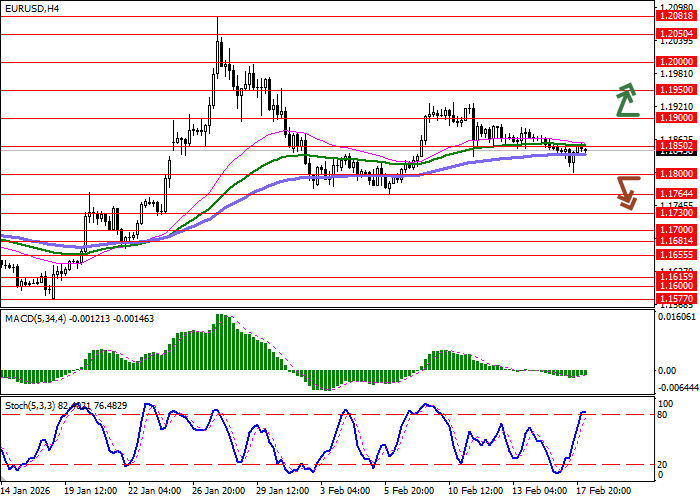
Support and resistance levels
On the daily chart, Bollinger Bands are showing a downward slope, with the price range narrowing and reflecting mixed trading conditions in the very short term. MACD maintains a relatively firm sell signal, remaining below the signal line. The Stochastic oscillator has turned flat without reaching the 20 level, which would indicate oversold risks for the single currency in the near term; therefore, traders are advised to wait for clearer signals from the indicator.
Resistance levels: 1.1850, 1.1900, 1.1950, 1.2000.
Support levels: 1.1800, 1.1764, 1.1730, 1.1700.
Trading scenarios and EUR/USD outlook
Short positions may be opened after a confident downside breakout below 1.1800, targeting 1.1700. Stop-loss: 1.1850. Time horizon: 2–3 days.
Further development of the corrective move followed by an upside breakout above 1.1900 could signal long positions with a target at 1.2000. Stop-loss: 1.1850.
Scenario
| Timeframe | Intraday |
| Recommendation | SELL STOP |
| Entry point | 1.1795 |
| Take Profit | 1.1700 |
| Stop Loss | 1.1850 |
| Key levels | 1.1700, 1.1730, 1.1764, 1.1800, 1.1850, 1.1900, 1.1950, 1.2000 |
Alternative scenario
| Recommendation | BUY STOP |
| Entry point | 1.1905 |
| Take Profit | 1.2000 |
| Stop Loss | 1.1850 |
| Key levels | 1.1700, 1.1730, 1.1764, 1.1800, 1.1850, 1.1900, 1.1950, 1.2000 |