

Previously, market participants focused on the summary of opinions from members of the Bank of Japan, which this time was supplemented by the official stance of the government’s financial and economic bloc. The document emphasizes that the regulator intends to maintain a balanced monetary policy aimed at sustainably achieving the 2.0% inflation target while preserving close coordination with parliamentary institutions. In recent months, the annual core inflation rate has remained in the 2.3–2.5% range, while GDP dynamics show only a moderate pace of recovery, forcing officials to balance support for economic activity with a gradual normalization of monetary conditions. The review also notes that several board members view the recent key rate hike as justified, pointing out that the previous level was “too low relative to inflation” and failed to effectively restrain yen weakness and rising government bond yields. As a reminder, following the December 18–19 meeting, the Bank of Japan decided to raise borrowing costs from 0.50% to 0.75%, marking another step away from an ultra-loose stance, especially amid moderate wage growth. An additional argument in favor of potential policy tightening has been the reduced significance of external tariff risks from the United States, which are no longer seen as a key destabilizing factor. At the same time, rising risks of a global economic slowdown are supporting profit recovery among Japan’s export-oriented corporations, increasing their interest in a stronger yen.
The bearish momentum in the U.S. dollar persists, with the index holding near 97.8 points on the USDX, reflecting cautious investor sentiment ahead of the release of the minutes from the Federal Reserve’s December monetary policy meeting, scheduled for today at 21:00 (GMT+2). The document may help clarify the balance of risks within the Federal Open Market Committee (FOMC): market participants continue to consider a scenario of monetary easing, particularly if the labor market cools further. Additional uncertainty stems from previously published forecasts pointing to a potential slowdown in U.S. economic growth, while inflationary pressures could intensify again across several indicators. This combination complicates policymakers’ strategic choices and creates a restrained, predominantly negative short-term backdrop for the U.S. dollar.
Support and resistance levels
On the daily chart, the price continues to correct within an overall upward trend, attempting to approach the lower boundary of the 160.00–152.00 channel.
Technical indicators are slowing the previously stable buy signal generated in early October: fast EMAs on the Alligator indicator are approaching the signal line, while the AO oscillator histogram, remaining above the zero line, is forming new corrective bars.
Support levels: 155.50, 152.80.
Resistance levels: 156.80, 159.30.
Trading scenarios
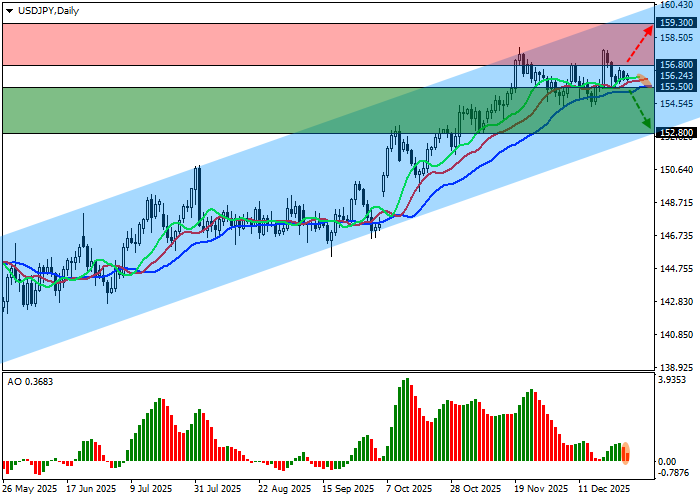
Trading scenarios and USD/JPY outlook
Short positions can be opened after the price consolidates below 156.80, targeting 159.30. Stop-loss: 155.00. Time horizon: 7 days or more.
Long positions can be opened after the price consolidates above 155.50, targeting 152.80. Stop-loss: 156.50.
Scenario
| Timeframe | Weekly |
| Recommendation | SELL STOP |
| Entry point | 156.80 |
| Take Profit | 159.30 |
| Stop Loss | 155.00 |
| Key levels | 152.80, 155.50, 156.80, 159.30 |
Alternative scenario
| Recommendation | BUY STOP |
| Entry point | 155.50 |
| Take Profit | 152.80 |
| Stop Loss | 156.50 |
| Key levels | 152.80, 155.50, 156.80, 159.30 |