
In Germany, the IFO Institute published its business climate data, based on a survey of executives from around 7,000 companies in manufacturing, construction, wholesale, and retail. In April, the indicator fell to its lowest level since May 2020, reaching 84.4 points and extending the negative trend that began three months earlier. Meanwhile, the ZEW economic expectations indicator declined to –17.2 points, its lowest level since December 2022, while the current conditions index dropped to –73.7 points. The negative macroeconomic backdrop was further reinforced by data from GfK Group’s consumer confidence index, a forward-looking indicator of household spending and confidence in the economy. For May, the index fell sharply from –28.1 points to –33.3 points, while investors had expected a much smaller decline to –29.5 points.
At the same time, reports that Germany has formed a crisis task force amid risks of energy supply disruptions highlight the growing vulnerability of Europe’s energy infrastructure to geopolitical and logistical shocks. The focus is on a possible blockade of the Strait of Hormuz, a key global oil transport route that, before the acute phase of the US-Iran confrontation, accounted for around 20.0% of global liquid hydrocarbon supplies. Another concern is the potential shutdown of the Druzhba pipeline, one of the largest land-based channels for crude oil deliveries to Central and Eastern Europe. The pipeline supplies refineries including the Schwedt plant, which provides fuel to Berlin and the capital region’s aviation hub. Available petroleum product volumes are estimated at around 300,000 tonnes in industrial storage facilities and approximately 1.1 million tonnes in state reserves, limiting the time frame for stable operations in the event of supply disruptions. Crisis management has been assigned to Frank Wetzel, State Secretary at the Ministry for Economic Affairs, underscoring both the priority of the issue and the systemic nature of risks to overall energy resilience. A shortage of aviation fuel is particularly important, as Germany consumes around 9.2 million tonnes annually, while domestic production capacity totals roughly 4.5 million tonnes and imports amount to 6.1 million tonnes, highlighting the country’s significant dependence on external flows and re-exports.
On Friday, US investors focused on data from the University of Michigan. One-year inflation expectations were revised down from 4.8% to 4.7%, while five-year expectations were revised higher from 3.4% to 3.5%. At the same time, the consumer expectations index rose from 46.1 points to 48.1 points, in line with neutral forecasts, while the consumer sentiment index increased from 47.6 points to 49.8 points.
Today at 19:30 (GMT+2), ECB President Christine Lagarde is scheduled to speak. She may again signal a wait-and-see approach to adjusting monetary policy parameters amid rising uncertainty and deteriorating economic prospects caused by the Middle East conflict. Negotiations between the US and Iran, mediated by Pakistan, have effectively stalled at this stage, while Iranian authorities have stated that they will not engage in talks as long as the blockade of ports remains in place. The only positive signal in recent days was Tehran’s proposal to reopen the Strait of Hormuz in exchange for a long-term ceasefire and a postponement of key decisions on the nuclear deal. However, the White House has already stated that the maritime blockade strategy will continue, effectively tying any resolution of the crisis to Iran’s capitulation. As a result, energy prices are likely to continue putting upward pressure on the US dollar in the near term while creating stagflationary risks for the euro, since the eurozone economy is far more vulnerable to disruptions in oil supplies from the Middle East.
Support and resistance levels
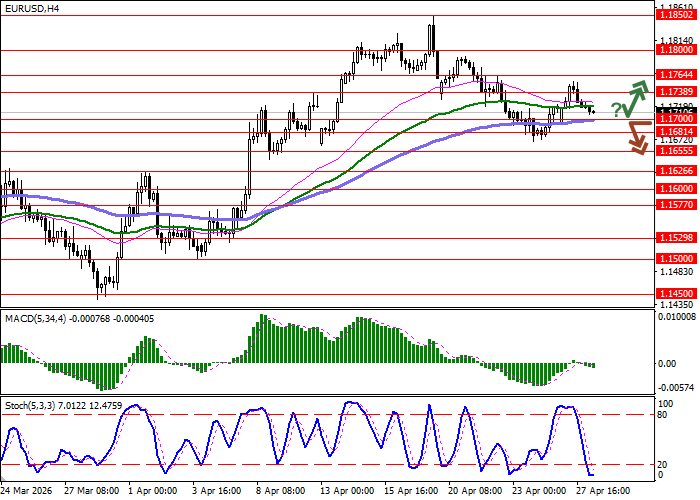
On the daily chart, Bollinger Bands are turning sideways: the price range is narrowing, reflecting mixed trading conditions in the very short term. MACD is turning upward and preparing to form a new buy signal, with the histogram attempting to consolidate above the signal line. Stochastic, having moved away from its lows, is rising actively and signals the possible continuation of an upward correction over the nearest time frames.
Resistance levels: 1.1738, 1.1764, 1.1800, 1.1850.
Support levels: 1.1700, 1.1681, 1.1655, 1.1626.
EUR/USD trading scenarios and forecast
Short positions may be opened after a confident breakout below 1.1700, with a target at 1.1626. Stop-loss — 1.1738. Time frame: 1–2 days.
A rebound from 1.1700 as support, followed by a breakout above 1.1738, may become a signal to open long positions with a target at 1.1850. Stop-loss — 1.1700.
Scenario
| Time frame | Intraday |
| Recommendation | SELL STOP |
| Entry point | 1.1695 |
| Take Profit | 1.1626 |
| Stop Loss | 1.1738 |
| Key levels | 1.1626, 1.1655, 1.1681, 1.1700, 1.1738, 1.1764, 1.1800, 1.1850 |
Alternative scenario
| Recommendation | BUY STOP |
| Entry point | 1.1740 |
| Take Profit | 1.1850 |
| Stop Loss | 1.1700 |
| Key levels | 1.1626, 1.1655, 1.1681, 1.1700, 1.1738, 1.1764, 1.1800, 1.1850 |
