

This meeting will be the first under the leadership of the new head of the regulator, Kevin Warsh, and since traders are confident that the interest rate will remain in the target range of 3.50–3.75%, the main attention will be focused on the subsequent press conference and updated economic forecasts. Experts are concerned about increasing inflationary pressure, but given the growing probability of a near-term peaceful settlement of the Middle East conflict, the arguments in favor of switching to a hawkish course may weaken noticeably. Recall that U.S. President Donald Trump and Vice President JD Vance signed an electronic copy of a memorandum of understanding with Iran, which provides for the lifting of the U.S. naval blockade of ports, the opening of the strategically important Strait of Hormuz to shipping, and the start of 60-day negotiations on the nuclear program of the Islamic Republic. The head of the White House added that if no compromise is reached on this issue, U.S. attacks will resume. The official signing ceremony is scheduled for Friday in Switzerland, while Tehran continues to insist on charging fees for passage through the waters, whereas Trump stated that on Friday it would be fully open for traffic without any charges.
The driver of the euro’s upward dynamics was macroeconomic data from the Centre for European Economic Research (ZEW): the June economic sentiment index in Germany rose from –10.2 points to 10.5 points, entering positive territory for the first time since the beginning of the confrontation in the Persian Gulf and significantly exceeding analysts’ consensus forecast of –6.0 points. The same indicator for the eurozone increased from –9.1 points to 9.5 points against preliminary estimates of –7.2 points. This optimism was offset by the continued negative assessment of the current economic situation in Germany, which declined from –77.8 points to –81.0 points, more than analysts had expected. In turn, in April, the EU trade balance decreased by 4.9 billion euros to –1.0 billion euros, compared with 8.7 billion euros a year earlier, while industrial production fell from 0.4% to 0.1% month-on-month against expectations of 0.2%, indicating that the sector’s recovery remains extremely weak and does not provide fundamental support for the single currency amid the ongoing energy crisis.
On June 12, the European Commission announced emergency aid of 540.0 million euros to support farmers facing a sharp rise in fertilizer prices amid geopolitical instability and supply chain disruptions. These measures are intended to protect agricultural production from the negative impact of rising resource costs, which directly affects yields and farmers’ income. EU members were advised to additionally allocate from national budgets an amount twice as large as the bloc’s aid, and as a result, the total potential amount of subsidies could reach 1.5 billion euros. In addition to financial support, official Brussels presented a number of strategic changes within the Common Agricultural Policy (CAP), which will allow faster disbursement of funds, including the introduction of a new liquidity instrument under rural development programs, expanded opportunities for advance direct payments, and a revision of the direct payments budget for 2027.
Support and resistance levels
On the daily chart, the Bollinger Bands are smoothly turning upward: the price range is still narrowing, which does not prevent the further development of bullish dynamics; the MACD indicator is rising, maintaining a strong buy signal, with the histogram located above the signal line, while the Stochastic is near maximum values, indicating risks of the asset being overbought in the ultra-short term.
Resistance levels: 1.1634, 1.1661, 1.1681, 1.1700.
Support levels: 1.1600, 1.1577, 1.1529, 1.1500.
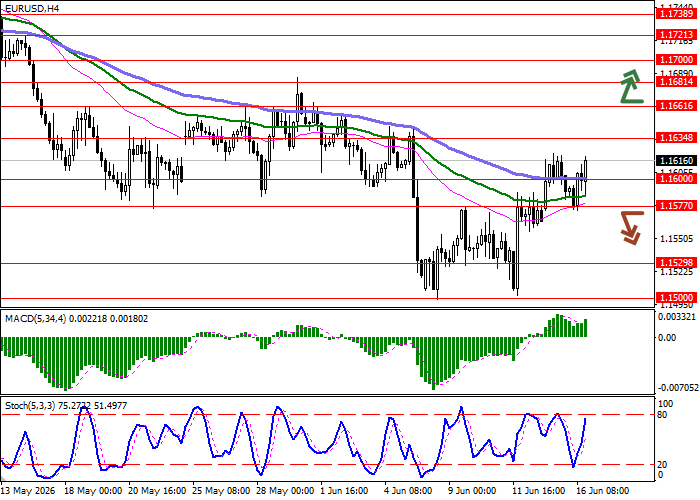
EUR/USD trading scenarios and forecast
Long positions may be opened after the price breaks above 1.1661, with a target at 1.1721. Stop-loss — 1.1634. Expected timeframe: 2–3 days.
Short positions may be opened after the price breaks below 1.1577, with a target at 1.1529. Stop-loss — 1.1600.
Scenario
| Timeframe | Intraday |
| Recommendation | BUY STOP |
| Entry point | 1.1665 |
| Take Profit | 1.1721 |
| Stop Loss | 1.1634 |
| Key levels | 1.1500, 1.1529, 1.1577, 1.1600, 1.1634, 1.1661, 1.1681, 1.1700 |
Alternative scenario
| Recommendation | SELL STOP |
| Entry point | 1.1575 |
| Take Profit | 1.1529 |
| Stop Loss | 1.1600 |
| Key levels | 1.1500, 1.1529, 1.1577, 1.1600, 1.1634, 1.1661, 1.1681, 1.1700 |
