
The Federal Reserve held its policy rate at 3.75%–4.00% at its October 27–28 meeting in a 10–2 vote. Two members preferred an immediate quarter-point hike. The minutes, released on November 18, showed that nearly all participants expected further increases would be appropriate if inflation and the labour market evolved as they anticipated. Two participants said a move of more than 25 basis points could warrant consideration at the next meeting if incoming inflation data were unfavourable.
The minutes also detailed concerns about the rapid growth of debt tied to AI infrastructure. Much of the borrowing has taken place through financing structures that are difficult to assess. Fed staff noted that off-balance-sheet leases and financing arrangements between AI companies could amplify losses if investment returns disappoint. Several participants also questioned whether bank supervisors had enough information about lenders’ indirect exposure through private credit funds and other nonbank institutions.
Fed Governor Christopher Waller told CNBC that inflation was spreading across more categories, including services. He outlined two options for December. The Fed could raise rates by 50 basis points, or it could deliver a quarter-point increase and signal another hike in January and a faster pace of tightening in 2027. On November 19, futures implied a 90.7% chance of a quarter-point move in December and a 73.8% chance of at least another quarter-point increase in January. Reuters on Waller’s remarks and November 19 futures pricing.
Eurozone inflation offers the euro some support. Eurostat’s final October figures confirmed that annual headline inflation rose from 3.8% to 4.0%, while core inflation accelerated from 2.5% to 2.6%. Energy made the largest contribution to the headline rate, followed by services. The figures strengthen the case for another European Central Bank hike after the ECB held its deposit rate at 2.50% in October. A Reuters poll conducted before the final inflation release found that all 71 economists surveyed expected the deposit rate to rise to 2.75% in December. Eurostat’s October release and Reuters’ ECB poll.
Support and resistance levels
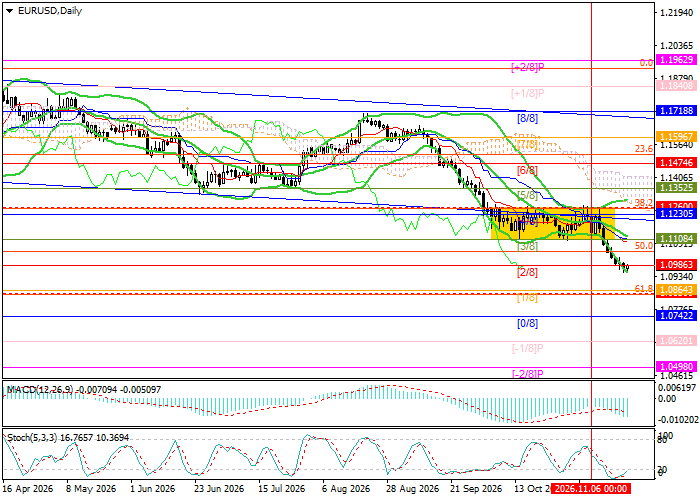
EUR/USD has broken below 1.1108, the Murrey Math [3/8] level and the lower boundary of the 1.1108–1.1260 range covered in our November 16 outlook. A sustained move below 1.0986, the Murrey Math [2/8] level, would bring 1.0850 (61.8% Fibonacci retracement), 1.0742 (Murrey Math [0/8]) and 1.0620 (Murrey Math [−1/8]) into view. A recovery above 1.1260, the 38.2% Fibonacci retracement, would open the way to 1.1474 (Murrey Math [6/8]), 1.1596 (Murrey Math [7/8]) and 1.1718 (Murrey Math [8/8] and the upper boundary of the descending channel).
The technical indicators still favour the downside. The Bollinger Bands are turning lower and the MACD histogram is extending further below zero. The Stochastic oscillator has reached oversold territory, leaving room for a limited rebound.
Resistance levels — 1.1260, 1.1474, 1.1596, 1.1718.
Support levels — 1.0986, 1.0850, 1.0742, 1.0620.
EUR/USD forecast and trading scenarios
The short scenario uses a sell-stop entry at 1.0950, below the 1.0986 support level. Targets are 1.0850, 1.0742 and 1.0620, with a stop-loss at 1.1020. The estimated timeframe is 5–7 days.
The alternative long scenario requires a break above 1.1260. Targets are 1.1474, 1.1596 and 1.1718, with a stop-loss at 1.1150.
Scenario
| Timeframe | Weekly |
| Recommendation | SELL STOP |
| Entry point | 1.0950 |
| Take Profit | 1.0850, 1.0742, 1.0620 |
| Stop Loss | 1.1020 |
| Key levels | 1.0620, 1.0742, 1.0850, 1.0986, 1.1260, 1.1474, 1.1596, 1.1718 |
Alternative scenario
| Recommendation | BUY STOP |
| Entry point | 1.1260 |
| Take Profit | 1.1474, 1.1596, 1.1718 |
| Stop Loss | 1.1150 |
| Key levels | 1.0620, 1.0742, 1.0850, 1.0986, 1.1260, 1.1474, 1.1596, 1.1718 |
