

At the beginning of the week, WTI Crude Oil prices briefly surged by 25.0%, exceeding $110.0 per barrel and reaching their highest level since July 2022. This followed concerns over disruptions to energy supplies through the Strait of Hormuz, which remains blocked by Iran’s Islamic Revolutionary Guard Corps (IRGC), as well as strikes on Iranian infrastructure, including oil storage facilities. At the same time, the U.S. president said that such a rise in prices was “a very small price to pay” for eliminating the Islamic Republic’s “nuclear threat” and ensuring global security. Meanwhile, the British stock market, where energy companies represent the third-largest share among developed economies, continues to show significant gains, supporting the pound along with monetary policy expectations. Investors are currently pricing in only one or two rate cuts by year-end, with the first easing move not expected before June. The February meeting of the Monetary Policy Committee, where votes were split 5:4 in favor of keeping the rate at 3.75%, highlighted growing internal divisions, although weak retail sales data and continued cooling in the labor market may become more influential arguments.
Meanwhile, UK Prime Minister Keir Starmer admitted that the longer the Middle East conflict lasts, the higher the probability of negative consequences for the economic performance of the United Kingdom. According to him, the government is constantly monitoring possible consequences, including coordination between the Treasury and the Bank of England, as well as regular consultations with international partners. This format is aimed at promptly assessing risks for the financial system, consumer sector, and corporate environment. Against the backdrop of geopolitical tensions, particular attention is being paid to energy markets, as the UK remains sensitive to fluctuations in imported energy prices. According to estimates by the Office for Budget Responsibility, persistently high fuel prices could add around one percentage point to inflation, which under such a scenario may approach 3.0% by year-end, well above the 2.0% target. Under these conditions, the British government hopes to soften the impact of volatility on households through the current price cap mechanism for electricity and gas set by Ofgem. From April, the annual tariff cap for a typical British household will stand at around £1.0641K, which is 7.0% lower than the previous quarterly level, although such tools only partially offset potential pressure on the economy.
On Friday at 09:00 (GMT+2), British investors will focus on industrial production data. On a monthly basis, it is expected to rise from –0.9% to 0.3%, while on an annual basis it may increase from 0.5% to 0.6%. For manufacturing output, the indicator is also likely to improve from –0.5% to 0.3% monthly and from 0.5% to 1.2% annually, which could provide support for the pound.
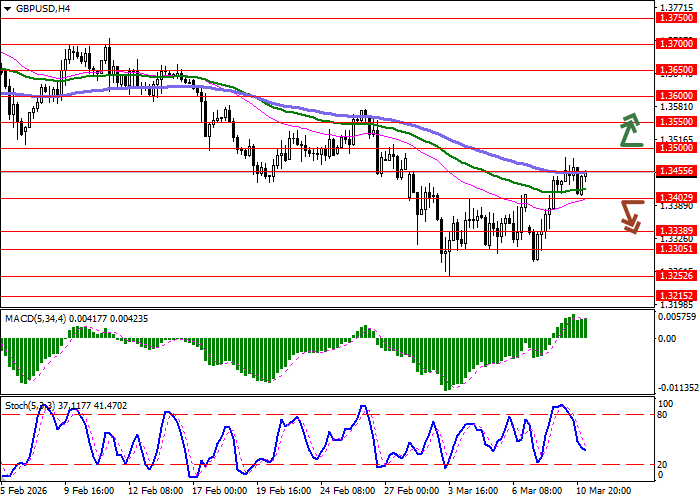
It is worth noting that pressure on GBP/USD has eased following a revision of monetary policy expectations after weak labor market data were released. The February report showed a decline of 92.0K jobs along with a rise in unemployment to 4.4%, strengthening expectations that the U.S. Federal Reserve may delay further tightening or even consider easing monetary conditions. Against this backdrop, the USDX retreated from three-month highs, allowing the pound to extend a three-day rally and test the 1.3500 resistance level.
Support and resistance levels
On the daily chart, Bollinger Bands are flattening into a horizontal range, indicating only minor changes in the price range and reflecting an unstable balance of forces in the ultra-short term. MACD is rising, maintaining a strong buy signal and remaining above its signal line. Stochastic is also preserving an upward direction, but is currently hovering near maximum values, pointing to elevated risks of overbought conditions for the pound in the ultra-short term.
Resistance levels: 1.3455, 1.3500, 1.3550, 1.3600.
Support levels: 1.3402, 1.3338, 1.3305, 1.3252.
Trading scenarios and GBP/USD forecast
Long positions may be opened after a confident breakout above the 1.3500 level, targeting 1.3600. Stop-loss — 1.3455. Timeframe: 2–3 days.
A return of bearish momentum followed by a breakout below the 1.3402 mark may signal an opportunity to open short positions with a target at 1.3305. Stop-loss — 1.3455.
Scenario
| Timeframe | Intraday |
| Recommendation | BUY STOP |
| Entry Point | 1.3505 |
| Take Profit | 1.3600 |
| Stop Loss | 1.3455 |
| Key levels | 1.3252, 1.3305, 1.3338, 1.3402, 1.3455, 1.3500, 1.3550, 1.3600 |
Alternative scenario
| Recommendation | SELL STOP |
| Entry Point | 1.3400 |
| Take Profit | 1.3305 |
| Stop Loss | 1.3455 |
| Key levels | 1.3252, 1.3305, 1.3338, 1.3402, 1.3455, 1.3500, 1.3550, 1.3600 |
