
As expected, the regulator under new Chair Kevin Warsh kept the interest rate in the 3.50–3.75% range for the fourth consecutive time, with the decision made unanimously. The key event was a radical change in the “dot plot” and officials’ rhetoric, which turned out to be significantly more hawkish than expected: the June chart removed the possibility of a borrowing cost reduction in 2026, although previously one adjustment of –25 basis points had been expected. The accompanying statement noted that economic activity is expanding at a solid pace despite increased uncertainty, partly due to the conflict in the Middle East, while inflation remains elevated relative to the 2.0% target, reflecting the hydrocarbon supply crisis. Thus, officials view inflationary pressure as persistent, despite the recent decline in oil prices amid news of a peace agreement between the United States and Iran.
The day before the Fed meeting, the Bank of Japan raised its key rate to 1.00%, the highest level since 1995, marking the fourth increase since abandoning negative borrowing costs in 2024. However, even this historic decision failed to provide sustained support for the yen, as it had already been priced in. Officials noted that the national economy continues to recover moderately, but the rise in “black gold” prices due to the closure of the Strait of Hormuz is putting pressure on corporate profits and household incomes, separately pointing to the need to monitor global financial conditions and external demand, including the technology cycle related to artificial intelligence. According to data published ahead of the decision, wholesale inflation accelerated to 6.3% year-on-year in May, reaching a three-year peak: companies are already facing a noticeable increase in costs for raw materials, fuel, and logistics, which could also pass through to retail prices. The risk of government intervention in the market remains a serious restraining factor: quotes are above the 160.00 level, which traders consider a “red zone” for further interventions. As analysts note, the yen’s inability to strengthen even after the measures taken is affecting the regulator, while Finance Minister Satsuki Katayama has already warned of readiness to take decisive action against excessive volatility. Recall that the effects of the April measures were quickly neutralized. Meanwhile, in May, exports rose from 14.8% to 17.0% against forecasts of 16.2%, while imports increased from 9.8% to 12.5% against 12.8%, resulting in a trade deficit of 378.7 billion yen, better than the expected 564.6 billion yen: the country purchased crude oil at a record price of 114.076 thousand yen per kiloliter, 67.2% more expensive than a year earlier, and at 114.6 dollars per barrel, 52.0% higher. In annual terms, the deficit narrowed by 42.8%, while fuel purchases fell by 57.3% to 4.73 million kiloliters, as supplies from the Persian Gulf region lost 61.9%.
Support and resistance levels
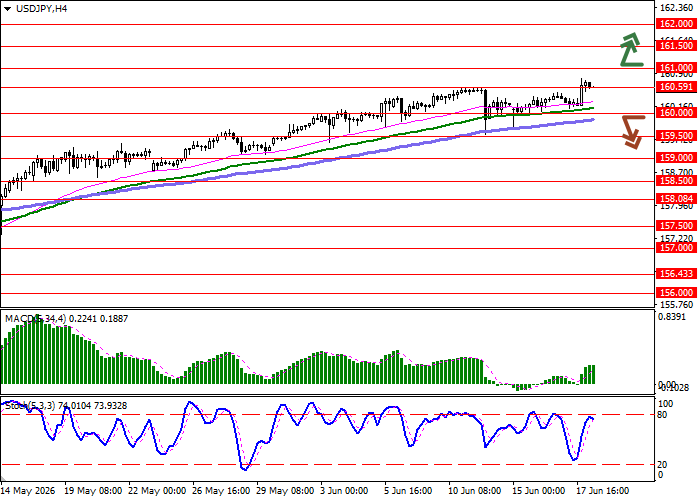
On the daily chart, Bollinger Bands are actively rising: the price range is narrowing, indicating mixed trading in the ultra-short term; the MACD indicator is turning upward, forming a buy signal, with the histogram aiming to move above the signal line, while the Stochastic is near maximum values, indicating risks of the asset being overbought in the ultra-short term.
Resistance levels: 160.59, 161.00, 161.50, 162.00.
Support levels: 160.00, 159.50, 159.00, 158.50.
USD/JPY trading scenarios and forecast
Long positions may be opened after the price breaks above 161.00, with a target at 162.00. Stop-loss — 160.59. Expected timeframe: 1–2 days.
Short positions may be opened after the price breaks below 160.00, with a target at 159.00. Stop-loss — 160.59.
Scenario
| Timeframe | Intraday |
| Recommendation | BUY STOP |
| Entry point | 161.05 |
| Take Profit | 162.00 |
| Stop Loss | 160.59 |
| Key levels | 158.50, 159.00, 159.50, 160.00, 160.59, 161.00, 161.50, 162.00 |
Alternative scenario
| Recommendation | SELL STOP |
| Entry point | 159.95 |
| Take Profit | 159.00 |
| Stop Loss | 160.59 |
| Key levels | 158.50, 159.00, 159.50, 160.00, 160.59, 161.00, 161.50, 162.00 |
