

Ethereum Researchers Want a Brake on Staking Growth
The proposal, titled “Tapered Issuance Burn,” was submitted by pintail, Jérôme de Tychey, dapplion, pa7x1, Ladislaus von Daniels and Justin Drake. It was initially referred to as EIP-8361, but that number had already been assigned to another proposal. Ethereum’s EIP editors subsequently renumbered it as EIP-8363.
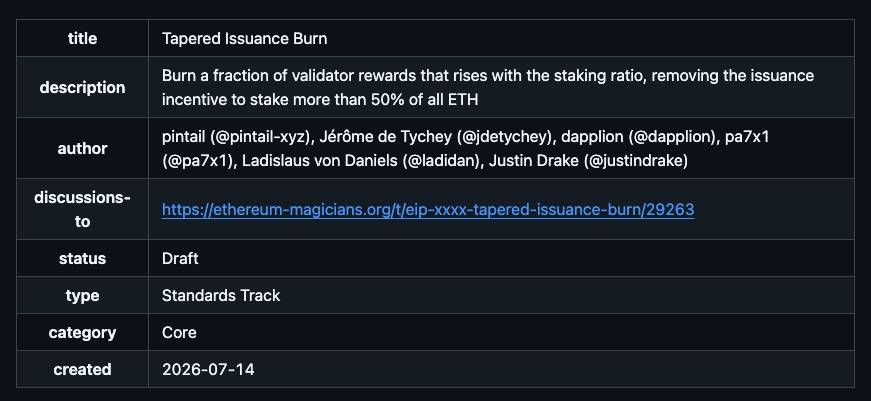
Under the draft, validators would continue receiving rewards under the existing system, but an increasing share of the consensus-layer issuance attached to their duties would be deducted and permanently burned. The calculation would apply to attestations, block proposals and sync committee participation.
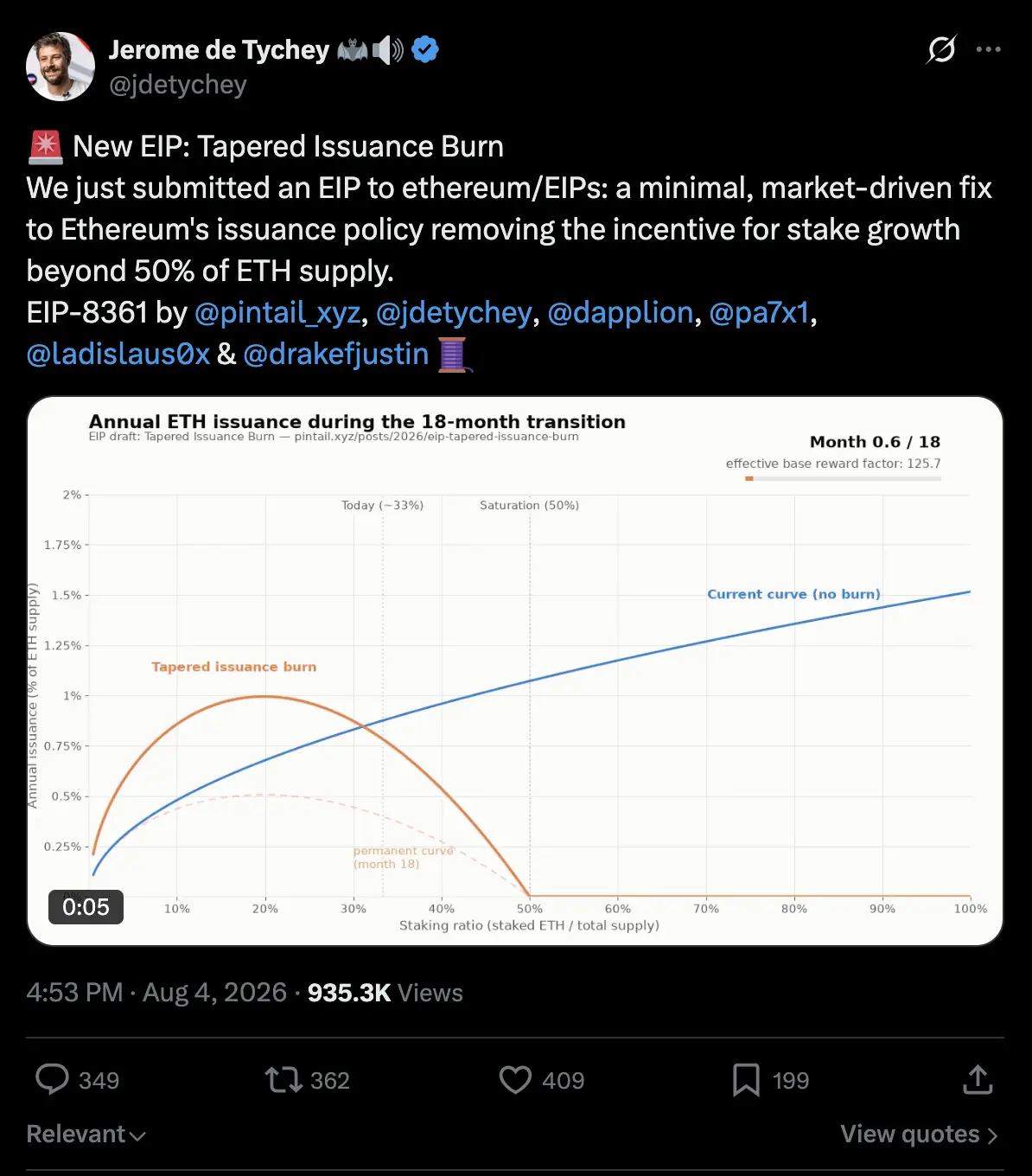
The mechanism becomes more aggressive as the amount of active stake grows. At a fixed saturation balance of 60.25 million ETH — approximately half of the current supply — the deduction would fully offset the consensus-layer issuance earned by a correctly performing validator.
This does not mean that all validator income would fall to zero. Transaction priority fees and maximal extractable value, or MEV, come from the execution layer and are not covered by EIP-8363.
Why the Current Reward Curve Worries Researchers
Ethereum’s existing issuance curve reduces the yield paid to each validator as more ETH enters staking. However, it never completely removes the incentive to stake. According to the proposal, the consensus yield retains a theoretical floor of roughly 1.5% even if the staking ratio becomes extremely high. The authors believe this could eventually push too much of the ETH supply into staking services, exchanges, custodians and exchange-traded products. They argue that once a certain level of economic security has been reached, adding more stake produces limited benefits while increasing other risks.
Among the concerns outlined in the draft are:
- greater concentration of validation power among large exchanges and staking providers;
- continued dilution of ETH holders who choose not to stake;
- pressure on independent validators that cannot match the scale and cost structure of large operators;
- a weaker social-layer response if a large share of ETH is controlled through custodial platforms.
The argument is not simply that large validators could attack Ethereum directly. Rather, the authors are concerned that dominant custodians could become too important to slash or socially isolate without creating disruption across the entire ecosystem.
The scale involved is already substantial. Lido alone is preparing to move more than 8 million ETH through its validator overhaul, illustrating how much of Ethereum’s staking infrastructure can sit behind a relatively small number of major systems.
The Burn Would Be Introduced Over 18 Months
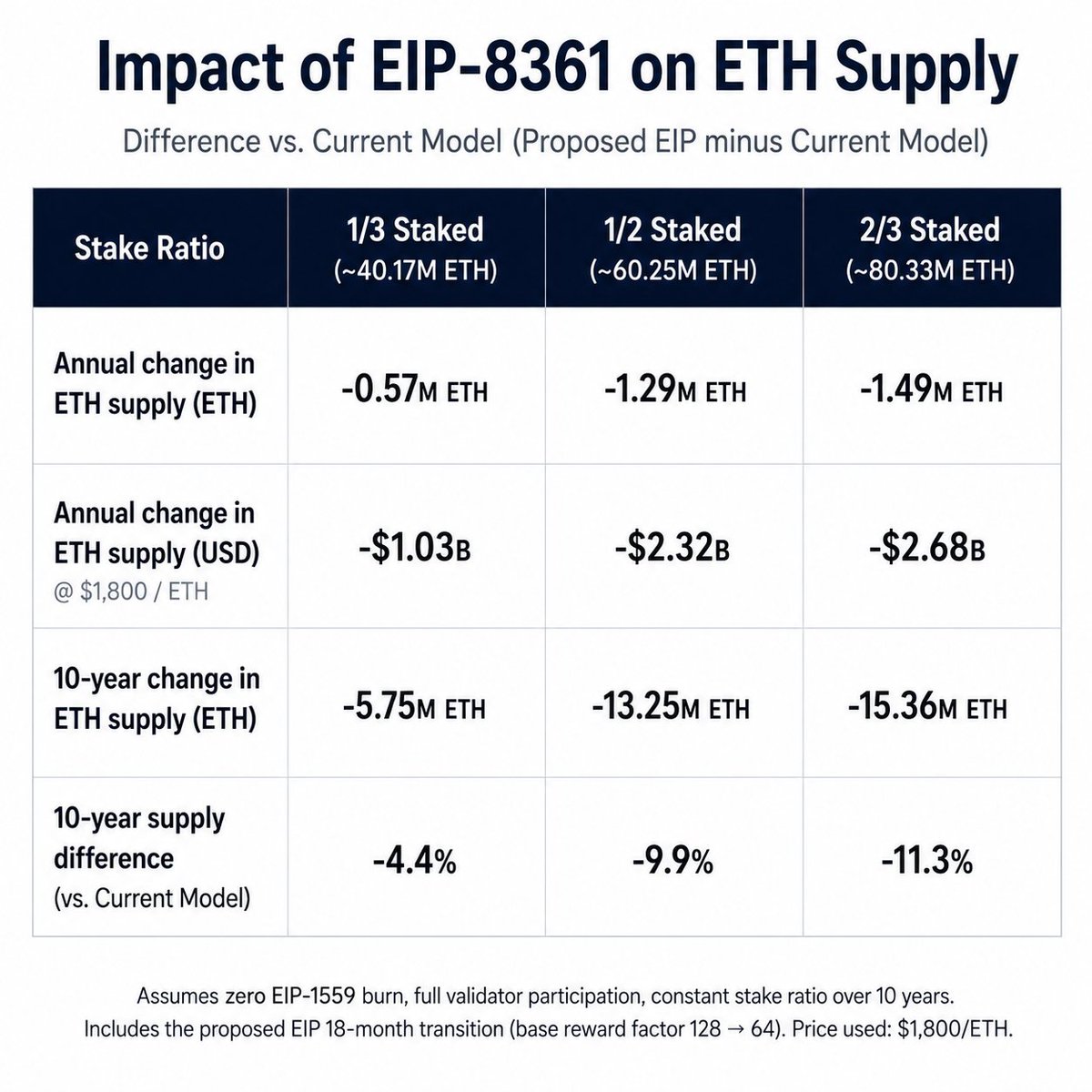
EIP-8363 would not impose the permanent reward curve overnight. At today’s staking ratio of roughly one-third of the ETH supply, applying the final model immediately could reduce consensus-layer yield from about 2.6% to around 1.2%. To avoid a sudden wave of validator exits, the proposal includes an 18-month transition. The base reward factor would initially be doubled and then gradually return to its current level, allowing net rewards to begin close to today’s rate before declining toward the permanent curve.
The shape of the new mechanism would still apply from the first day. If active stake reached 60.25 million ETH during the transition, the burn would already fully offset consensus issuance at that level. The authors expect the market to reach an equilibrium below 50%, where the remaining yield is sufficient to compensate validators for operational, liquidity, slashing and regulatory risks. In other words, 50% is designed as an off-switch for additional issuance incentives, not as the intended destination.
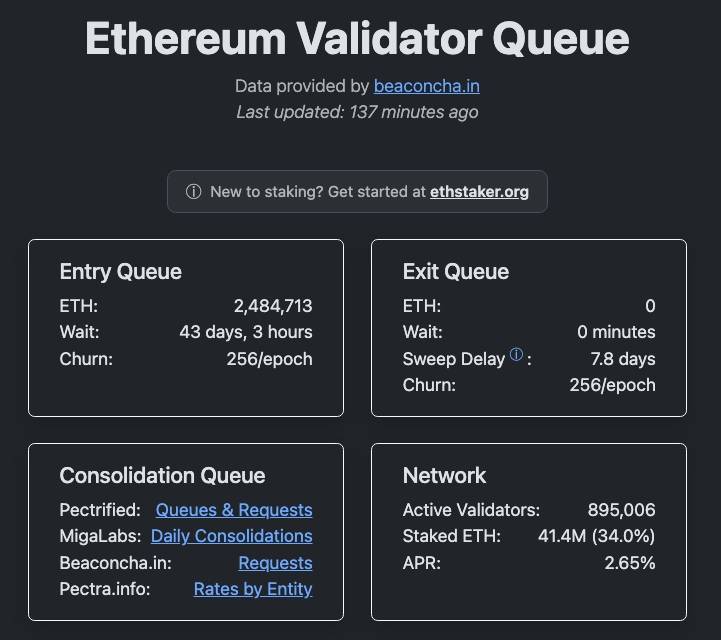
Around 40 million ETH was staked when the draft was prepared, equal to approximately 33% of supply. The validator entry queue was also operating near its protocol limit. The authors estimate that, if demand remains elevated and exits stay limited, more than 70 million ETH could be staked by the beginning of 2028.
DeFi Builders Question the Trade-Off
The proposal quickly divided the Ethereum community. Critics agree that concentration and excessive issuance deserve attention, but question whether lowering validator rewards is the right tool. Aave founder Stani Kulechov argued that staking yield is deeply connected to Ethereum’s lending markets. Many strategies involve borrowing ETH, staking it and using the resulting yield to offset financing costs. Lower rewards could reduce demand for ETH loans and make leveraged staking less attractive. The effects could spread well beyond one lending protocol. Liquid staking tokens such as stETH are widely used as collateral across DeFi, while staking yield acts as an important reference rate for lending, stablecoin borrowing and yield products.
Ether.fi CEO Mike Silagadze also criticised both the economics and the timing of the proposal. He warned that smaller operators with higher relative costs could leave before institutional providers, potentially producing the opposite of the decentralisation outcome the authors want.
That concern is not purely theoretical. Research into Ethereum’s staking market has produced conflicting conclusions about which participants would exit first as rewards fall. Some models suggest delegated stakers are more sensitive because they pay provider fees and accept additional counterparty risks. Others conclude that solo validators are more exposed because they lack scale, superior MEV access and the ability to combine staking with other DeFi returns.
The proposal’s authors acknowledge that this remains one of the main unresolved questions. Their position is that rewards would not naturally fall all the way to zero because validators would stop entering — or begin leaving — once yield no longer compensated them for risk.
Supporters See a Stronger Monetary Policy for ETH
Supporters of lower issuance view the change from another angle. They argue that staking rewards are paid through the creation of new ETH, meaning unstaked holders effectively finance validator yield through dilution. Under EIP-8363, annual consensus issuance would peak when approximately 20% of ETH is staked and then decline as the staking ratio grows. This would reverse the current structure, under which total issuance continues increasing alongside the amount of active stake.
Grayscale research head Zach Pandl has previously argued that reducing staking incentives could support ETH’s long-term value because much of the apparent cash flow received by holders is funded through supply inflation. From this perspective, lower nominal yield may be outweighed by lower dilution.
Still, that outcome is not guaranteed. Lower issuance could benefit holders through slower supply growth, but it could also weaken demand from investors and institutions that value ETH as a productive, yield-bearing asset.
Ethereum Has Changed Issuance Before
The debate continues Ethereum’s long-running effort to balance network security with ETH’s monetary properties. Unlike Bitcoin, Ethereum has no fixed maximum supply and can change issuance through protocol upgrades.
EIP-1559 introduced the permanent burning of transaction base fees in 2021. During periods of heavy network use, the amount burned can exceed newly issued ETH, temporarily making the asset deflationary. мThe Merge produced another major change by replacing Proof-of-Work mining with Proof-of-Stake. This reduced new ETH issuance by roughly 90% compared with the former mining system.
EIP-8363 would take a different approach. Instead of reducing the base issuance formula alone, it would calculate rewards largely as Ethereum does today and then burn a staking-ratio-dependent portion of them.
Hegotá Inclusion Is Far From Guaranteed
The formal pull request and public Ethereum Magicians discussion opened on August 4, shortly before the deadline for proposing additional features for Hegotá. The authors want EIP-8363 to be considered for that upgrade, but proposed-for-inclusion status would not amount to approval. Core developers would still need to assess the economic risks, technical readiness, security implications and community response before deciding whether the proposal should advance. The draft also lacks final test vectors and may change substantially during review.
The timing overlaps with the wider Lean Ethereum roadmap, which aims to simplify the protocol and rethink several parts of its long-term architecture. That does not mean the issuance change is already part of Lean Ethereum or guaranteed to ship with Hegotá.
Conclusion: EIP-8363 could become one of Ethereum’s most important monetary-policy changes since EIP-1559, but it remains an early and highly contested draft. Its supporters see a way to prevent excessive staking, reduce dilution and protect Ethereum from custodial concentration. Critics fear that lower rewards could drive out independent validators, weaken institutional demand and disrupt DeFi markets built around staking yield. The central question is no longer whether Ethereum can attract more stake, but how much stake the network actually needs — and who will remain when the rewards begin to fall.
